
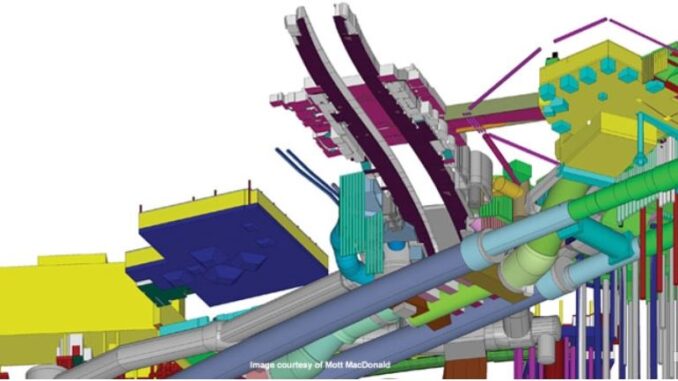
The UK Government’s goals for construction industry is to reduce the CAPEX for public construction (design and build) projects and to reduce the UK’s carbon intensity in line with its EU carbon committments. To reach its goal for the construction industry the UK Government has undertaken several initatives, one of which is a commitment to embrace Building Information Modelling (BIM) in Government projects over a 5-year time frame, to encourage industry to participate in this effort, and to position the UK to become a world leader in BIM.
The UK Government has explicitly targeted Level 2 BIM in the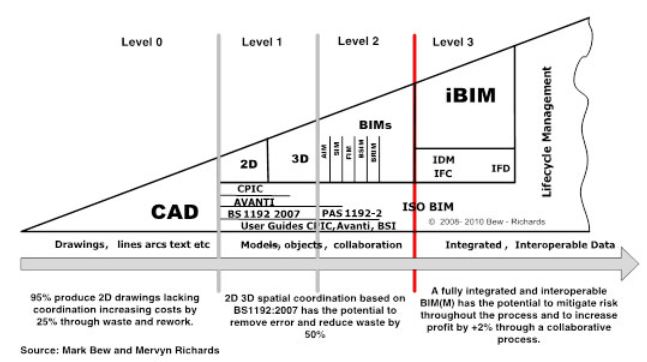 maturity ramp, defined as “file based collaboration and library management.” Level 2 BIM is a series of domain specific models (e.g. architectural, structural, services etc) where structured data can be shared based on COBie UK 2012.
The inital focus is on the design/build part of the lifecycle, but the government has said that “the 20% saving refers to CapEx cost savings however we know that the largest prize for BIM lies in the operational stages of the project life-cycle”
BIM Level 3
The UK Government is projecting that Level 3 BIM will be introduced in 2018. BIM Level 3 is not yet clearly defined but according to Peter Hansford could include big data, support for intelligent infrastructure including smart grid, and enabling smart city models. It could go beyond several subsystem BIM models in BIM Level 2 to a single model. Most interestingly according to Peter Hansford it could provide the basis for whole lifecycle modeling, allowing a building design to be optimized for the whole life cost and whole life carbon footprint.
According to Paul Morrell, Former Chief Construction Adviser, UK, although some companies are claiming to use BIM Level 3, no one is delivering its full potential of this technology. A recent poll of 410 live webinar participants found that no one is operating at BIM Level 3 at present.
Whole Lifecycle
In a panel discussion on BIM Level 3, Rich Saxon, the UK Government’s BIM Ambassador dor Growth, pointed out that some aspects of BIM Level 2 are incomplete which makes talking about adoption of BIM Level 3 extremely ambitious. In agreement with Peter Hansford, he see an important goal of BIM Level 3 should be to go beyond projects to whole lifecycle. In the future he foresees that firms will offer whole life projects including design, build, and maintain. For example, Phillips will design, build and maintain building lighting which is leased to the building owner. He warned that the emerging Internet of Things (IoT) is poised to be disruptive. We can imagine buildings with sensors and analytics able to monitor, analyse and dynamically respond without human intervention to building situational awareness.
Interoperability across the construction lifecycle and the need for standards
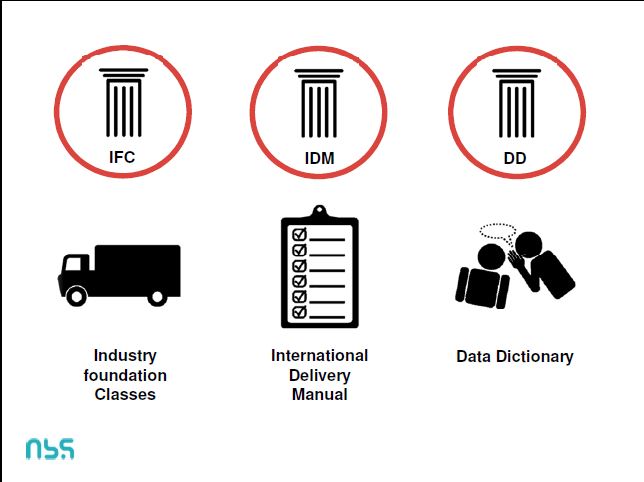 Ian Chapman, Director of the National BIM Library, said that part of BIM Level 3 should be standards – because these make it possible for software to interoperate, which enables data integration across the construction lifecycle (plan, desing, build, O&M). It also makes it possible to find efficiencies by direct comparison of different projects and project outcomes. Software interoperability requires a BIM geometry standard like IFC, a clasification standard like Uniclass 2, an information delivery manual (IDM), and a data dictionary (DD). For example, ISO 29481-1:2010 specifies a methodology and format for the development of an information delivery manual (IDM) and is intended to facilitate interoperability between software applications used in the construction process, to promote digital collaboration between actors in the construction process and to provide a basis for reliable information exchange. The data dictionary as Ian Chapman presented it appears to be very close to the concept library (CB-NL) sponsored by by the Dutch Council on Building Information (BIR) that maps the same objects with different names across the construction lifecycle.
Enabling the right people to make decisions
Anne Kemp, Director of BIM at Atkins Global, argued that there needs to be conversation at the national level to deicde what do we really want from BIM Level 3 ? .Her perspective is that the most important goal of BIM Level3 is that it needs to enable the right people to make decisions. For example, in 2007 Tewkesbury was flooded, but not in the most recent flooding because changes were made – the right people were enabled to make the right decisions.

Be the first to comment