
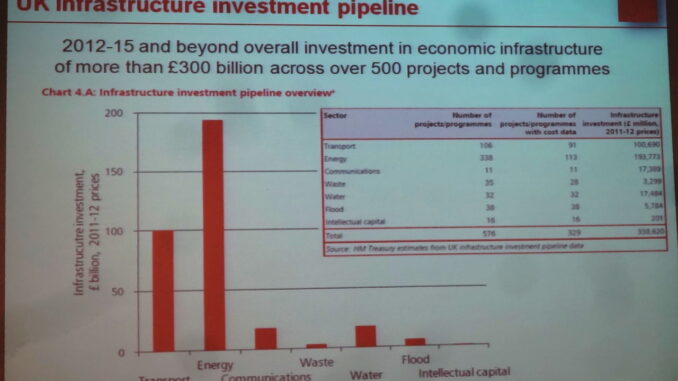
I have blogged previously about the UK National Infrastructure Plan
which plans to invest hundreds of billions of pounds in the next 10 yrs on infrastructure including high speed rail,
energy, aviation, water and wastewater,
roads and highways, and high speed broadband. It is intended that up to 70% of the funding
is to come from the private sector. That means that the program has to provide attractive returns with relatively low risk to attract private capital.
At a Construct IT event at Network Rail in Manchester, Keith Waller from Infrastructure UK provided an update on where the National Infrastructure Plan is right now, some of the challenges, and what the Government is doing to address the challenges.
National Infrastructure Plan
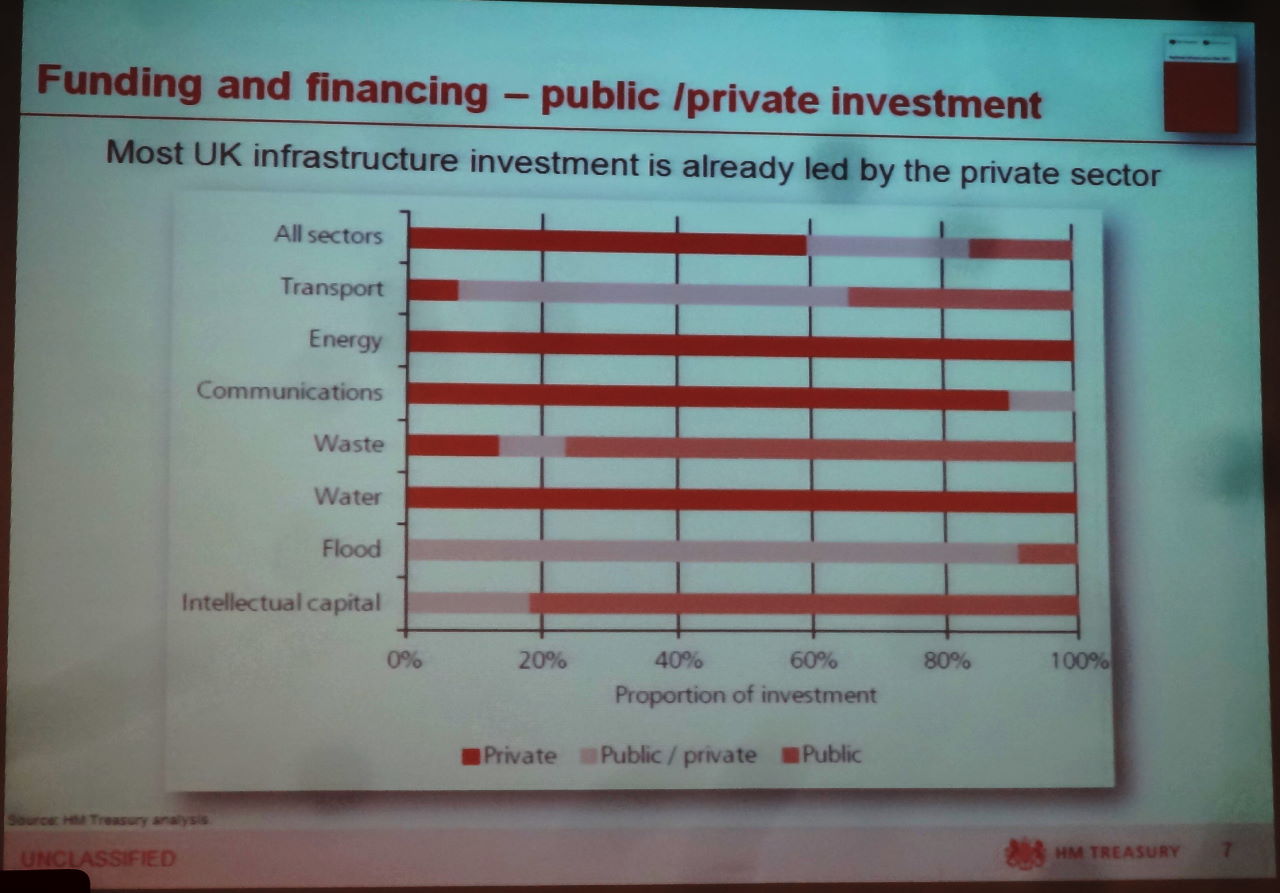 The UK National Infrastructure Plan is designed to provide a long term vision and medium term planning across all sectors which are broken down as transport, energy, communications, waste, water, flood, and intellectual capital. The total cost is estimated to be £300 billion across 500 projects for the period 2012 to 2015. A critical objective objective is 2/3 of the total investment is be private capital. Most UK infrastructure investment is already led by the private sector. For example, water, energy, and communicatons are almost entirely privately funded. Transport is about 2/3 private and public/private partnerships. Intellectual capital is mostly public. Flood is mostly public/private partnerships. To attract additonal private funds the government has guaranteed £ 40 billion in loans to date. It is also developing a new approach to public private investment, referred to as PF2, tmake PPP more attractive to private companies. It appears that the average annual investment in infrastructure had increased by over 10% in 2010-2012
Average annual public and private investment in infrastructure
2005-2010 £29 billion
2010-2012 £33 billion
The UK Government seems to be committed to making this plan happen. It has identifeid 40 projects and programs that are of national significance and critical for growth. It has set up a Cabinet Committee chaired by the Chief Secretary of the Treasury to improve poor coordination and planning and eliminate regulatory holds ups to ensure delivery. A new commercial Secretary Lord Deighton with a reputation for getting things done has been tasked with delivery of the infrastructure plan.
Reducing the cost of infrastructure
A McKinsey study suggested that more private sector involvement in
infrastructure projects could result in an estimated 30% improvement in
construction productivity over 5-10 years, resulting from the
combination of 5-15% reduction in the cost of design and planning, 5-10%
in engineeering, 5-10% in materials purchase and sub-contracting, 3-5%
in construction, and 3-5% from organizational enablers. They estimate
that this would translate into a 20% reduction in overall infrastructure
spend.
McKinsey suggested that governments and infrastructure investors
could reduce risks and increase returns by focussing on three areas,
mproving productivity of existing and new assets
For example, by tuning the regulatory and market structure to improve efficiency and expand capacity.
Making the economic model more attractive to investors
By being smarter about matching capacity expansions to demand and finding additional sources of revenue.
Reducing cost and risk by improving project delivery
By allowing more competition, pushing more risk on to contractors,
and encouraging engineering, procurement and construction (EPC)
companies to increase their build capabilities.
 UK Infrastructure Cost Review
A major Government focus is reducing the cost of infrastructure. For example, in a series of public consultations it has asked why it is more expensive to develop infrastructure in the UK ? The conclusion is that it is the Government’s fault.
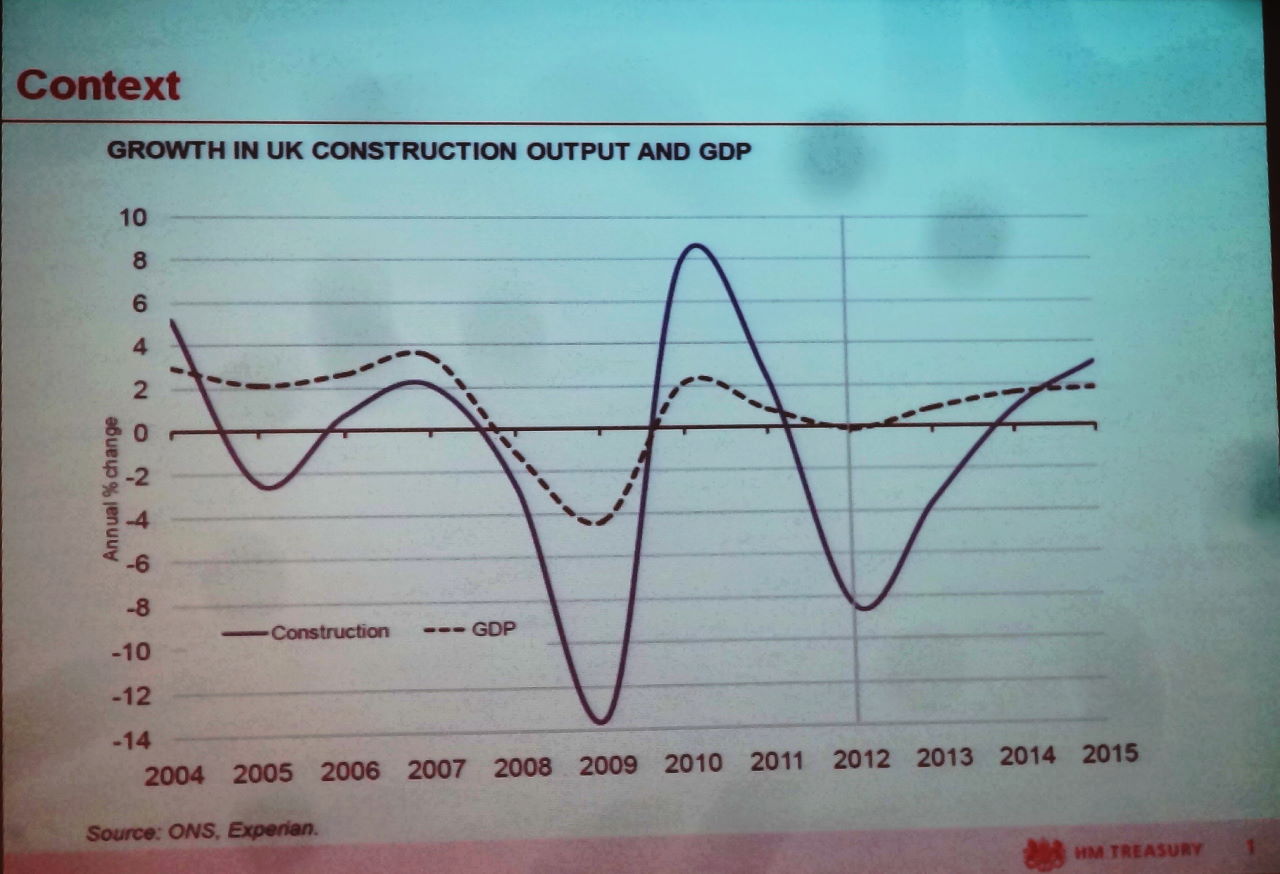
Basically, the reason that was arrived at is that economic cycles are bad for investment. The rise and fall in the GDP for example is amplified for the construction industry (typically 10% ot GDP) so that peaks are higher and the valleys more severe for the construction indusry than for the economy as a whole. Looking specifically at infrastructure, in 2012 output was down 13%, while orders were up 38% compared to the previous year.
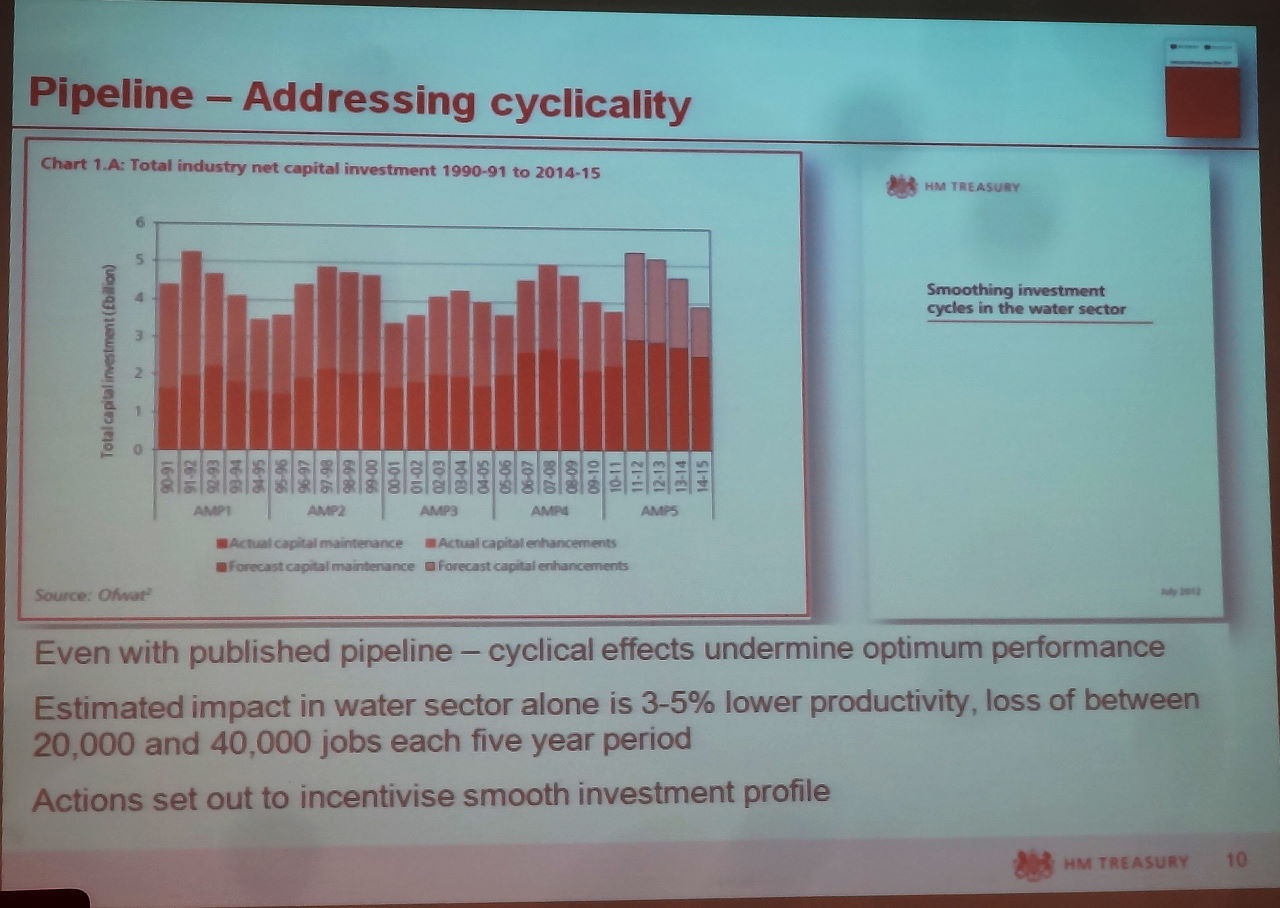 A study of the water industry concluded that because of the economic cycle every 5 years 20,000-40,000 jobs are lost which adds £7 to everyone’s water bill.
An important factor contributng to the economic cycles is that in the past the Government (not singling out any particular party and government) has frequently changed its mind about infrastructure and uncertainty is not conducive to investment. Some ministers have had a long term strategy which is very good for the industry because it encourages investment, but others are rather short term resulting in a “start/stop” approach to policy.
The conclusion is that the most important thing that the government can do is establish a long term policy that persists across elections and other political events. This not only encourages investment, but also allows other sectors to plan for the demands of infrastructure, for example, to estimate skills requirements in order to implement educational and training programs to produce the reauired skills.

Be the first to comment