
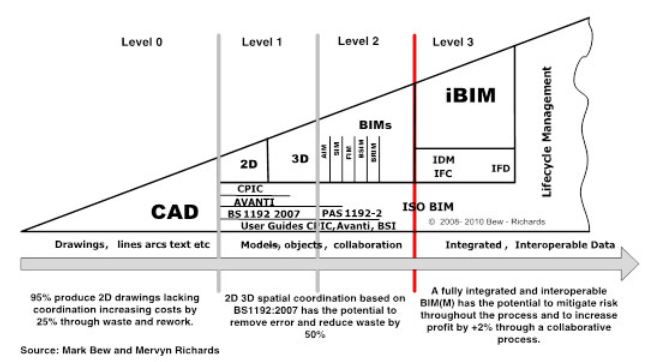
At this year’s AGI GeoCommunity ’13 Conference in Nottingham, an update on the current status of the UK Government’s BIM initiative was given by David Philp, Head of BIM Implementation for the UK Government’s Cabinet Office where he is responsible for the mobilisation and implementation of Level Two BIM across central government’s property portfolio, by 2016.
The gross value add of construction to the UK economy is about £89.5 billion annually, so BIM is going to have a major impact on the UK economy.
The government’s primary motivation for mandating BIM is to reduce public construction costs by 20% by 2016 and to reduce carbon emissions in line with the EU’s 20-20-20 mandate by 2020. In the UK this is referred to as “capex is king, carbon is queen.”
Mandating BIM, CoBIE, and geographical coordinate systems
The Government has mandated Level 2 BIM for all public projects, irrespective of size and for both new construction and refurbishments (renovations), by 2016. COBie UK 2012, which is a formal schema for organizing information about new and existing facilities for both buildings and infrastructure in the form of a spreadsheet, is also a requirement on government projects. These have been known requirements for some time, though some of the details are still being worked out.
What is new and very important from the perspective of BIM/geospatial convergence is that from David’s response to a question from the audience it appears that real world coordinates (geographical projection systems) will also be a requirement on public construction projects.
Totex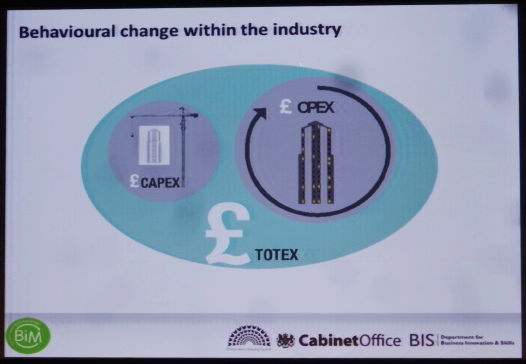
One of the most interesting aspects of the UK government’s approach to managing the cost of construction is focussing on the need to reduce opex as well as capex. Traditionally most of the focus of BIM has been on design-build, or capex. But over the lifetime of a facility, the largest share of the cost of the facility is actually opex. David used the term totex to refer to the UK Government’s focus on controlling operational as well as capital costs. In the recent Construction 2025 report (joint strategy from government and industry for the future of the UK construction industry) the long term goals are a 33% reduction in whole lifecycle costs (capex and opex), 50% faster delivery, and 50% lower emissions (carbon reduction).
Horizontal BIM
At this point the government has about 20 projects using BIM underway, and is looking beyond vertical BIM (buildings) to horizontal BIM (BIM for infrastructure). According to Anne Kemp the government is considering horizontal BIM projects in the Highway Agency and Environmental Agency.
Be the first to comment