
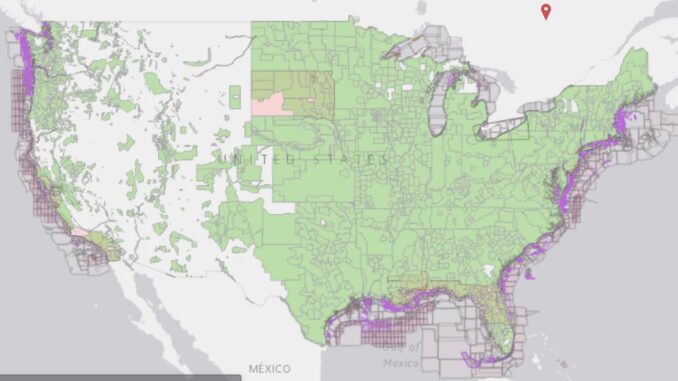
A number of years ago an initiative was funded under the ARRA economic stimulus package to initiate what was then called LiDAR for the Nation. This has resulted in a USGS initiative called 3D Elevation Program (3DEP) whose goal over an eight year period is to develop a 3D elevation map with horizontal resolution of a meter and vertical resolution of 10 cm for the entire U.S. and territories. This entails LiDAR scanning the contiguous continental U.S. and Hawaii and interferometric synthetic radar over Alaska. It also includes bathymetric data for the U.S. coastline. To date 48% of the U.S. has been covered or scanning is underway. An inventory of these projects is available.
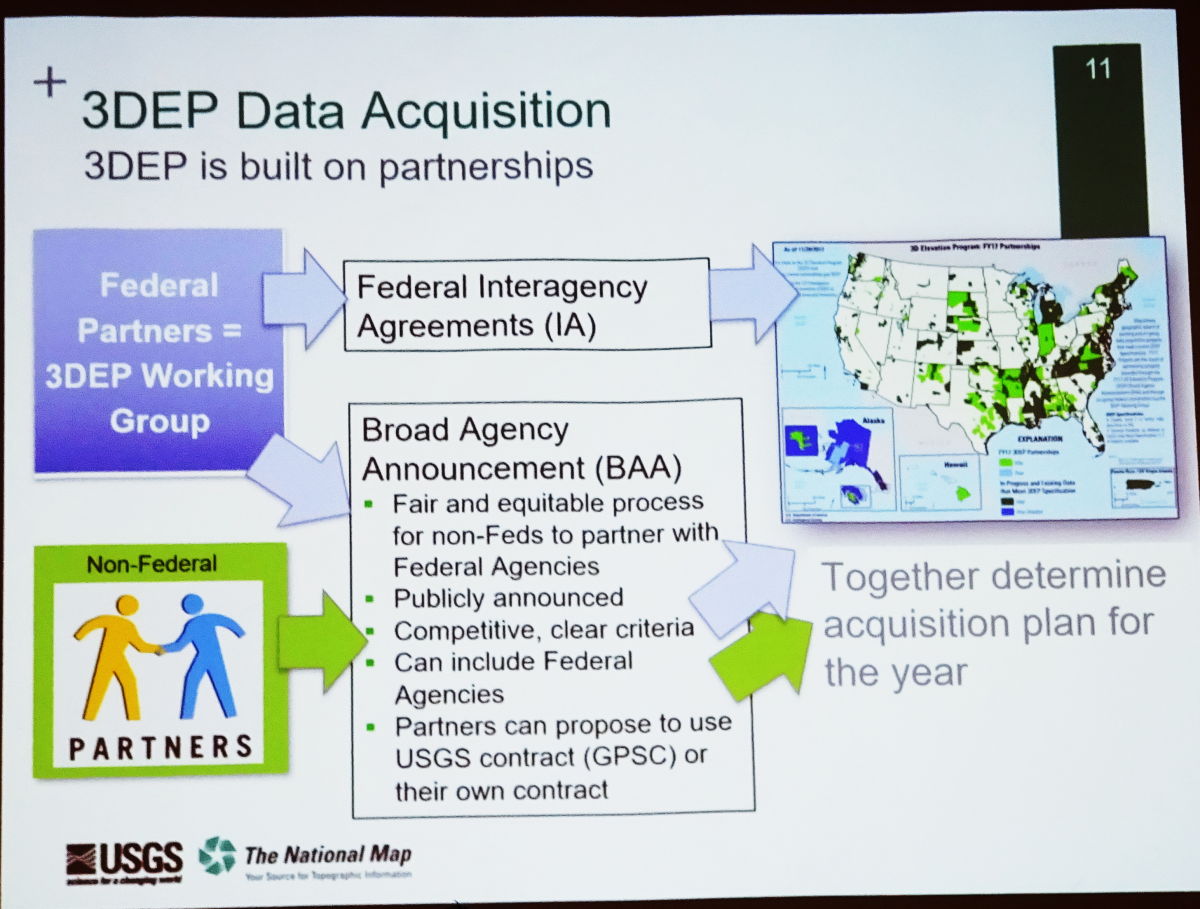 At GIS in the Rockies this year Carol Lydic of the USGS gave an overview of this program and the most recent initiatives to broaden the partnerships that are instrumental in creating the national 3D elevation map. The program is based on partnerships with federal, state, local, and tribal government agencies, academic institutions and the private sector.
In 2012 a study was completed that estimated the economic value to 27 different sectors of accurate 3D data. The top five included in this study (National Enhanced Elevation Assessment) are
- Flood risk management $295m to $502m
- Infrastructure and construction management $206m to $942m
- Natural resources conservation $159m to $335m
- Agriculture and precision farming $122m to $2,011m
- Water supply and quality $85m to $156m
The total economic benefits for all sectors was estimated to be between $1.8B to $13B. I find this to be a very conservative estimate.
A number of years ago I remember hearing about an outstanding program by the state of North Carolina in cooperation with federal agencies that involved a statewide LiDAR scan and the creation of a database of all structures with a footprint of over 800 square feet that allowed estimates to be made of the economic impact of any type of flood anywhere in the state or of a rise in sea level along North Carolina’s coastline. This is of inestimable value in assessing any mitigation project.
In the infrastructure and construction sector, one of the largest contributors to the cost of a civil construction project such as a highway or a railway, is the amount of earth that has to be moved which can be derived from a 3D terrain model. Having a reliable digital terrain model is of great value to any civil project for assessing alternative right of ways during the planning stage and could also be used during the design and construction phases especially if supplemented by information about the soil and geological structure of the subsurface and location of underground utilities.
I found the 3DEP project particularly interesting because it represents a potential model for creating a national infrastructure map including underground infrastructure. Federal organizations that could be involved include USGS, National Map, US DOT, FERC, and NERC. Partners might include NARUC (National Association of Regulatory Utility Commissioners), CGA (Common Ground Alliance), state and municipal DOTs, AGC (Associated General Contractors of America), utility and telecom network operators, general contractors, tribal government agencies, and academic institutions.

Be the first to comment