
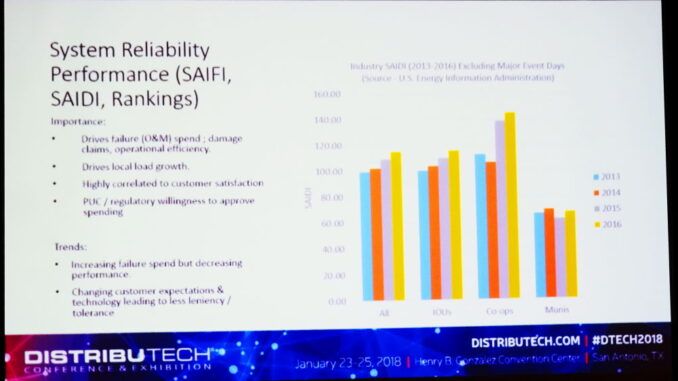
At Utility University at Distributech 2018 Joseph Nichols, a Project Manager at Burns and McDonnell, made the interesting case that over the period 2013 to 2016 there was a trend of increasing failure spend but decreasing performance in the U.S. electric power industry.
SAIDI is a statistic that regulators require utilities to provide that measures the average amount of time a customer is out of service during a year. It is used as a measure of utilities’ performance. Usually extraordinary natural events like hurricanes, tornadoes, and major natural events are excluded from the statistics. Joseph Nichols showed a graph of the SAIDI performance (excluding major natural events) for all U.S. utilities from the U.S. Energy Information Administration (EIA) for 2013 to 2016.
What this graph reveals is that during a time of significant smart grid and distributed energy deployment, the average length of time that customers were without power has pretty much remained constant. (The statistics revealed a slight increase over the 2013-2016 period.)
The good news revealed by the graph is that grid reliability has not dropped significantly with the transformation of the grid resulting from increasing distributed renewable energy, growing use of electric cars, the adoption of smart devices to monitor and manage voltage and other grid parameters, new consumer electronic devices, and the decentralization of the grid. A paper written by the American Council on Renewable Energy (ACORE), entitled Energy Fact Check – The Impact of Renewables on Electricity Markets and Reliability, has argued that renewable energy sources have not eroded grid reliability. Furthermore, the report argues that America’s biggest grid operators and reliability coordinators are reliably integrating large amounts of renewable energy today. They have said that they are confident that they can integrate even more renewables without affecting grid reliability.
The not so good news is that the increased investment in smart devices such as self-healing networks, PMUs and reclosers, line voltage monitoring devices, smart meters and other smart grid technology has not improved grid reliability.

Be the first to comment