
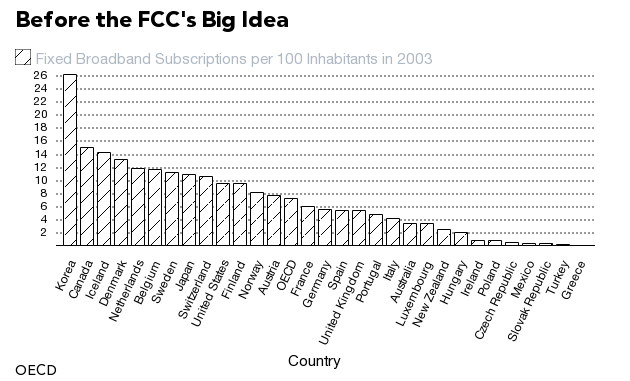
A very interesting article by Brendan Greeley in Bloomberg Businessweek points out that with respect to broadband penetration in the OECD, over the past decade the Unites States has fallen from 10th to 16th. By 2013, France, Norway, the UK, Germany, Luxembourg, Finland and New Zealand have passed the United States.
Back in 2003 South Korea was way ahead of everyone. It had opened up the last mile of its existing cable and phone companies, and offered inexpensive loans to companies to invest in more fiber. After that there there were a number of countries including the U.S. at about 10 percent. France, Germany, and the U.K. were under 6 percent.
At that time, the U.S.had an advantage – every house in the U.S. had a copper telephone line and almost every house had cable as well – which was not the case in the E.U.
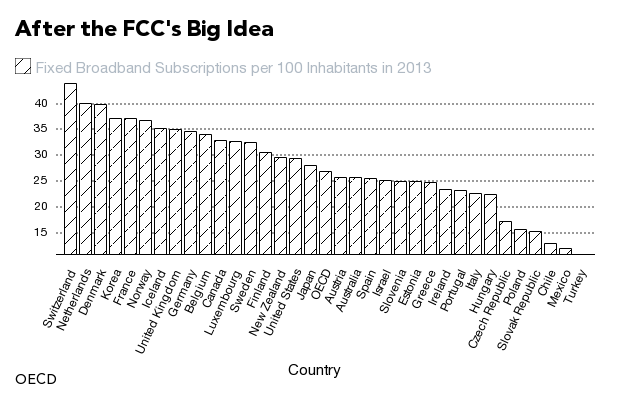 By 2013 all the countries that are ahead of U.S. have either opened up the last mile to compeition or subsidized infrastructure by government or both.
- Switzerland opened up the last mile of its phone monopoly in 2007.
- Under a directive from Brussels, all EU countries have opened up the last mile for all monopolies.
- Sweden, in addition, aggressively invested at both the national and local level in rolling out more fiber.
- The U.K. split British Telecom into two separate companies, one that sells network access and another in the very competitive retail communications market.
- In France, in 2003 there was a single state monopoly France Telecom. Since then France opened up the last mile to open competitiion. In 2013 France is now fourth in the OECD rankings. It used to be 14th in 2003. Brendan Greely mentioned Free, one of the startups that took advantage of open access to France Telecom’s telephone lines and which offers 1-gigabit DSL, free calls to 108 countries, 197 channels, and a set-top box with a game console and a Blu-ray player—all for €39 a month ($53.60). And without any special regulatory concessions, Free has also started investing in its own super-fast fiber connections to homes.
The problem is that the last mile of broadband is expensive: Two alternatives are either the government contributes via subsidies or the regulator forces the existing phone and cable monopolies to open up the last mile on a wholesale basis, enabling new companies to compete. But the FCC in the U.S. has been trying a third alternative, an experiment to see what happens when you encourage monopolies in return for infrastructure investment. The FCC has.allowed the existing phone and cable companies to hold on to their own last miles, competing only with each other and reinvesting their profits into more infrastructure. Brendan Greeley’s perspective is that the FCC’s experiment has failed. The U.S. has dropped to 16th place in the OECD and all the countries ahead of the U.S. in 2013 have either opened up the last mile or subsidized infrastructure by government or both.

Be the first to comment