
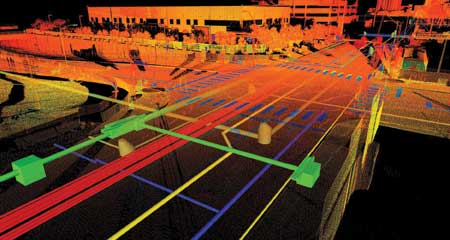
One of the major hazards of all construction activity is inadvertently hitting underground infrastructure. To give some idea of how frequent this occurs, in the US in 2010 there were 112,917 incidents where underground utility facilities were hit during excavation.
I’ve blogged recently about what Heathrow has done to design business processes to optimize data quality. For example, contractors at Heathrow are contractually obligated to progressively deliver as-builts over the lifetime of construction projects.
One of the major challenges facing municipal governments and utilities is one of data management, optimizing information flows for engineering data. I have blogged about this challenge on multiple occasions (here, here, here and here).
A recent article outlines what the City of Las Vegas has done to address this challenge. The city decided to develop a 3D model of above- and below-ground infrastructure in Las Vegas’s core downtown area. They wanted a living 3D model of the city’s existing infrastructure, not an archive, that they could rely on to be an accurate and up-to-date source of information for planning, designing, and maintenance.
The city turned to VTN Consulting for help building the 3D model because VTN has been a longtime proponent of developing 3D city models based on an approach called building information modeling (BIM) for infrastructure. The city model that VTN designed for Las Vegas blends engineering design drawings, geographic information system (GIS) data from a variety of sources and file formats, and aerial photogrammetry. As the team brought GIS and design data provided by the city together with aerial photos to build the framework for the model. The aerial photographs provide a wealth of information about conditions and buildings above ground, and serve as a point of reference for underground infrastructure. They are now bringing in underground utility information. Some of this information is quite old and may often not reflect existing conditions. They’re using American Society of Civil Engineers (ASCE) standards to rank the quality of subsurface utility data on a scale of A to D, with ‘A’ being survey accurate to ‘D’ denoting data from unverified records or oral recollections.
They have focused on optimizing their business processes for updating data about their existing facilities and adding new facilities so that over time data quality will improve. In particular they have ensured that there is tight integration between the engineering design environment and the city model. Engineers can easily not only integrate city model data into their designs at the beginning of projects, but also add their designs to the city model at the completion of projects. One of the major benefits of integrating the city model into the design process is that it enables them to avoid interferences, often called clashes, with existing underground infrastructure during the design phase.
The BIM for infrastructure approach not only makes it easier to spot and address interferences in designs before construction begins, it also helps to improve communication with nontechnical stakeholders including the public. 3D visualizations are more intuitive especially for nontechnical people, whereas 2D drawings and maps require explanation. A 3D model can help win support for a project. A photorealistic rendering of a project is much more effective in conveying the benefits of a project, for example, in not creating an eyesore or even making the city more visually appealing. For a city like Las Vegas that lives from tourism this is a top priority for any project.
Be the first to comment