
The Titan supercomputer at Oak Ridge National Laboratory in Tennessee was names the fastest computer on Earth in November 2012, according to the Top500 list. Most of Titan’s computing capacity comes from its NVIDIA Tesla K20X GPU accelerators. Based on the same architecture used in NVIDIA’s workstation and PC gaming chips, the GPU accelerators perform computations far more power efficiently than any machine equipped with CPUs alone.
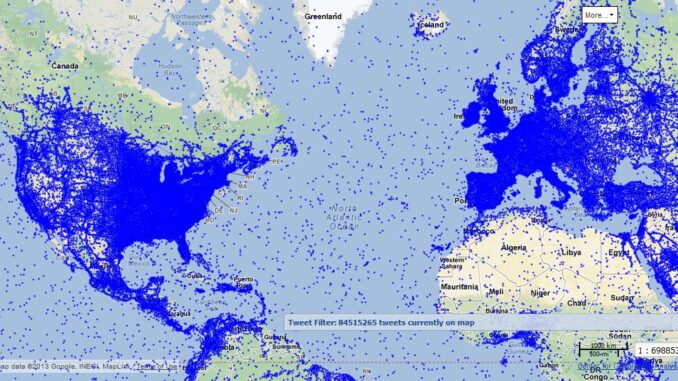
Mapping tweets in real-time
I blogged recently about TweetMap
which is an instance of MapD, a massively parallel database platform being
developed through a collaboration between Todd Mostak, (a researcher at
MIT), and the Harvard Center for Geographic Analysis (CGA). The database can be queried by time,
space, and keyword. The ultimate objective is to be able to query
billions of tweets live in real-time. In this case real-time means from
tweet to tweet on a map in under a second. MapD
is a general purpose SQL database that can be used to provide real-time
visualization and analysis of very large data sets. MapD uses
commodity Graphic Processing Units (GPUs) to parallelize compute
intensive tasks such as querying and rendering very large data sets
on-the-fly. MapD runs on inexpensive hardware with four GPUs ( ~$1000).
Flood modelling
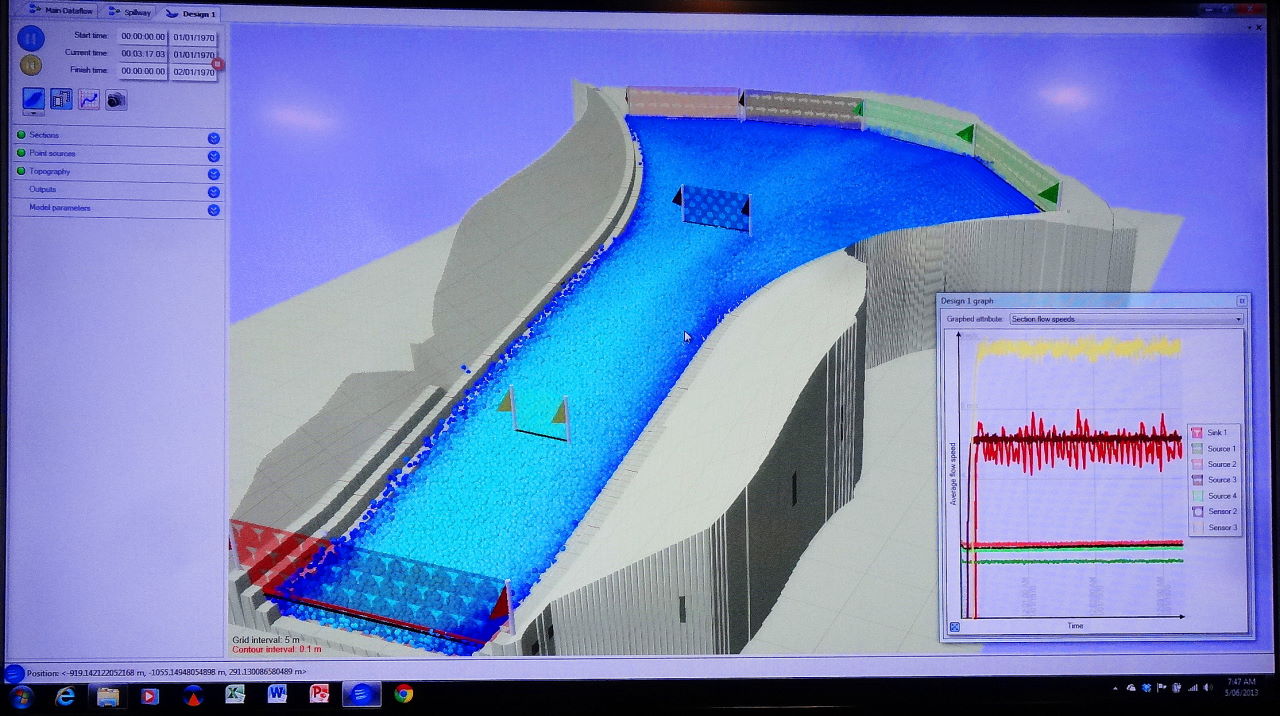 At the HxGN conference in Las Vegas last week, I came upon Myriax Software Pty Ltd, which is a private startup and which has developed EonFusion Flood, which is a hydrodynamic modeling package based on a 4D GIS which can run both 2D grid and 3D particle-based hydrodynamic simulations. This is very compute-intensive stuff and I expected that this was running in the clud on some parallel processing machine. It turns out it was running on a single GPU on a laptop. Fllod can be used for river and floodplain modeling, dam break scenarios, designing spillways for dams, and urban flood risk assessment.

Be the first to comment