
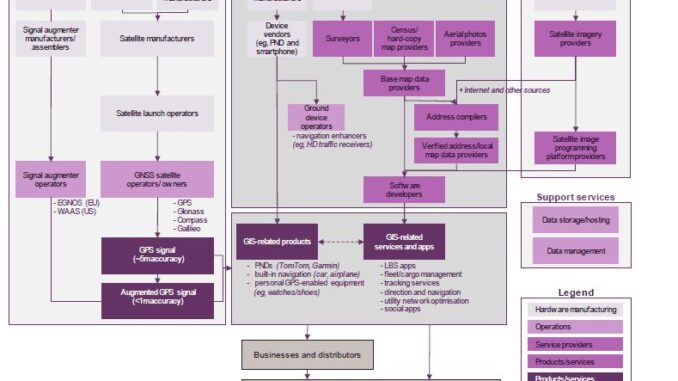
Google released a report What is the economic impact of Geo services ? earlier this year prepared by Oxera Consulting Ltd in the UK.
What are geospatial services ?
Oxera incuded all interactive digital mapping and location-based data, products, and services in its definition of geospatial services. This includes providers of satellite imagery, digital maps, satellite positioning signals (GPS/GNSS), navigation devices, geographic information systems (GIS), and geospatial expert service providers. Digital maps include online maps and locally stored maps, but not hardcopy maps. Geospatial products and services generate direct revenue for companies such as ESRI, Garmen, or Digital Globe.
What is value ?
The study aims to quantify the impact of geospatial services on the world economy and consumer welfare. It breaks these impacts down into
- direct effects – revenue generated by firms developong and providing geospatial data, products and services
- consumer effects – the benefits that consumers, business and
government experience from using geospatial services from geospatial services - wider economic benefts – productivity and efficiency improvements resulting in cost savings from geospatial services
Economic impact of global geoservices
Direct revenues
Global revenues from geospatial products and services as defined by Oxera is estimated to be $150-$270 billion per year. The geospatial industry is estimated to be growing by 13% per year through 2016. [ There are important assumptions that led to these numbers. The lower estimate of $150 billion/year was estimated using a bottom-up approach based on the Bloomberg BICS classification of companies worldwide and assumptions about allocating the revenue from companies that provide geospatial in addition to other services such as Trimble. The $270 billion number was estimated by scaling up the US revenue estimated by Boston Consulting Group to come up with a world estimate.]
Gross value added (GVA) is the grand total of all revenues ( from final sales and subsidies minus direct taxes ) which are incomes into businesses. Geospatial services are estimated to have a global GVA of $113 billion/year, which is about 0.2% of the world’s GVA of $70 trillion.
Consumer benefits
Geospatial services provide benefits (not including direct purchases of geospatial products and services) to consumers. For example, enabling consumers to find the nearest Thai restaurant in seconds rather than leafing through the yellow pages and looking up the location on a map saves time. Finding the fastest route to the nearest hospital saves time and may actually save lives.
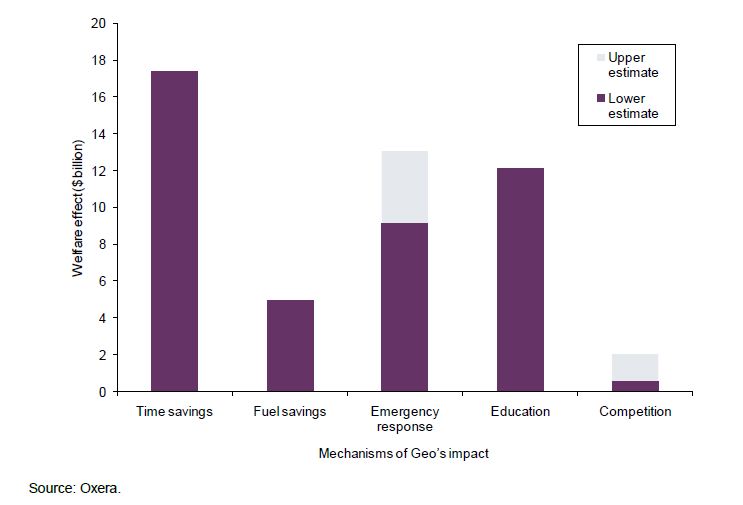 Some of the consumer benefts of geospatial services include time
savings, fuel savings, emergency response, education, and competition.
Examples of categories of consumer benefits include more efficient navigation, estimated to provide benefits of $22 billion/year, and educational benefits estimated to amount to $12 billion/year. Faster emergency response to cardiac arrests is estimated to potentially save 152 lives/year in the UK.
Wider economic impact
Geospatial services also make users more efficient. For
example, a trucking company that has installed GPS trackers on its
vehicles and uses location-aware routng software will be more efficient,
delivering items faster and more efficiently. There are also indirect benefits to the general public in
improved safety. By getting things to end users and
businesses faster and more safely, geospatial services facilitate economic activity.
For example, GPS/GNSS is estimated to provide $10 billion in cost savings to the global economy. Geospatial services are estimated to save 1.1 billion hours of travel time/year and to reduce fuel demand by 3.5 billion liters of gasoline/year.
Thanks to Dr Bob Austin for pointing me to this.

Be the first to comment