
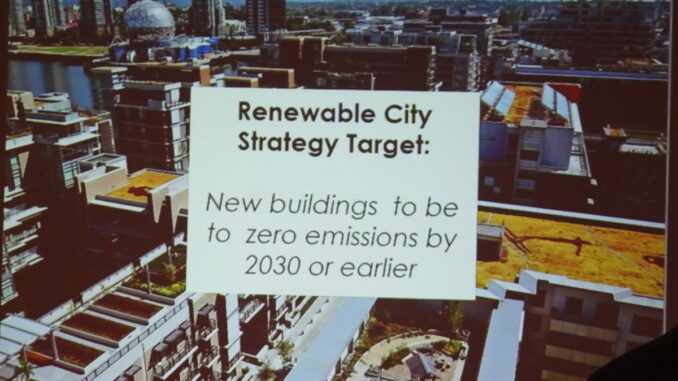
New buildings in Vancouver will be zero-emissions or zero-emissions ready by 2030 or earlier. Vancouver will achieve this by a combination of energy usage reporting, incentives to the private sector, regulation including rezoning and building code changes,and increasing public awareness about low carbon building construction and operation.
At a Canadian BIM Council (CanBIM) conference in Vancouver, Brad Badelt, Assistant Director of Sustainability at the City of Vancouver, outlined how Vancouver intends to meet the goals defined in its 2015 renewable city strategy; 100% renewable energy by 2050 and a reduction of 80% in emissions compared to 2007.
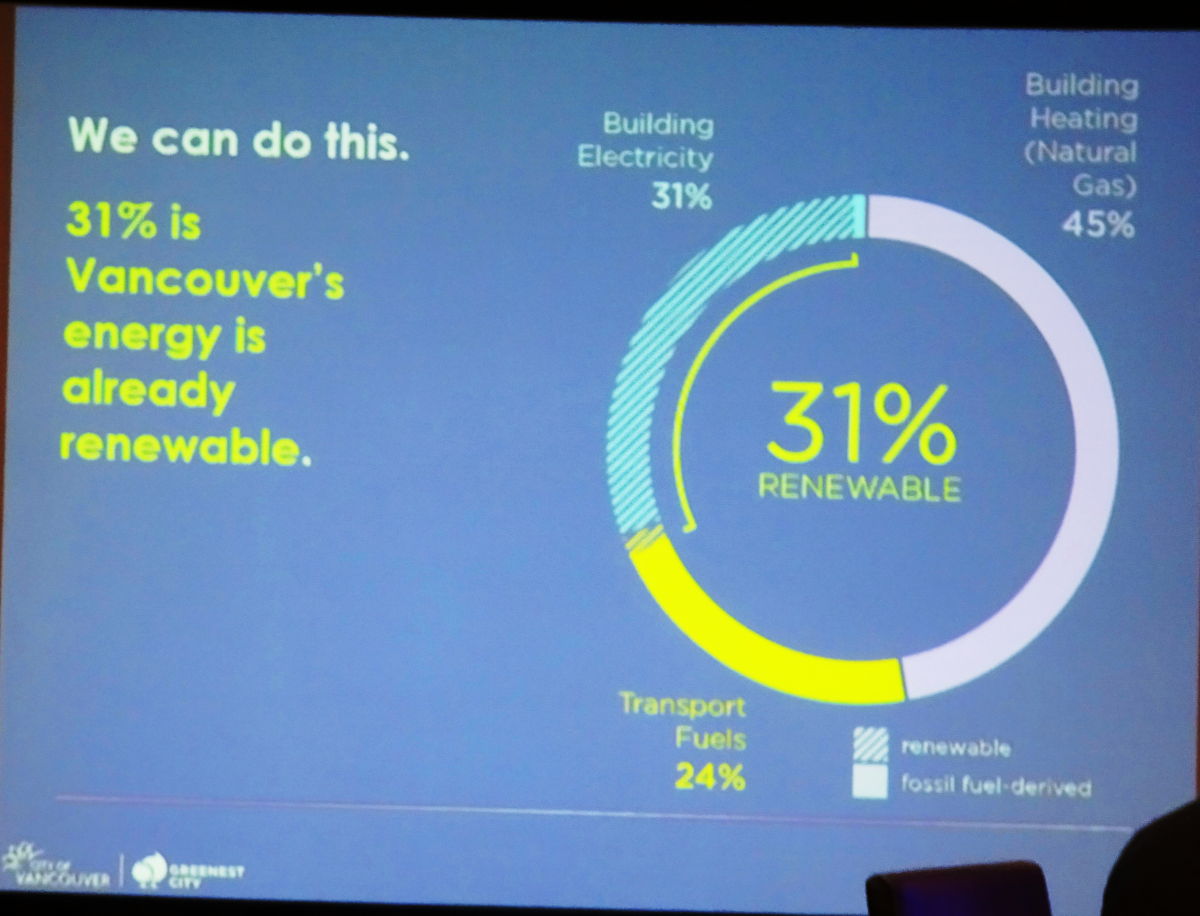 Vancouver is already 31% renewable because the electric power used by buildings is almost entirely renewable. Currently building heating relies almost entirely on natural gas. Vancouver has had electric buses for years and municipal rail (Skytrain) is electric. 57% of CO2 emissions come from heating buildings. Currently almost half of new building floorspace in Vancouver is single family residential.
In 2050 Vancouver’s building stock is projected be 30% built prior to 2010, 30% current or upcoming, and 40% zero emissions buildings. The more that can be done right now to move toward zero-energy-ready buildings, the less retrofitting will be required to achieve Vancouver’s emissions goals.
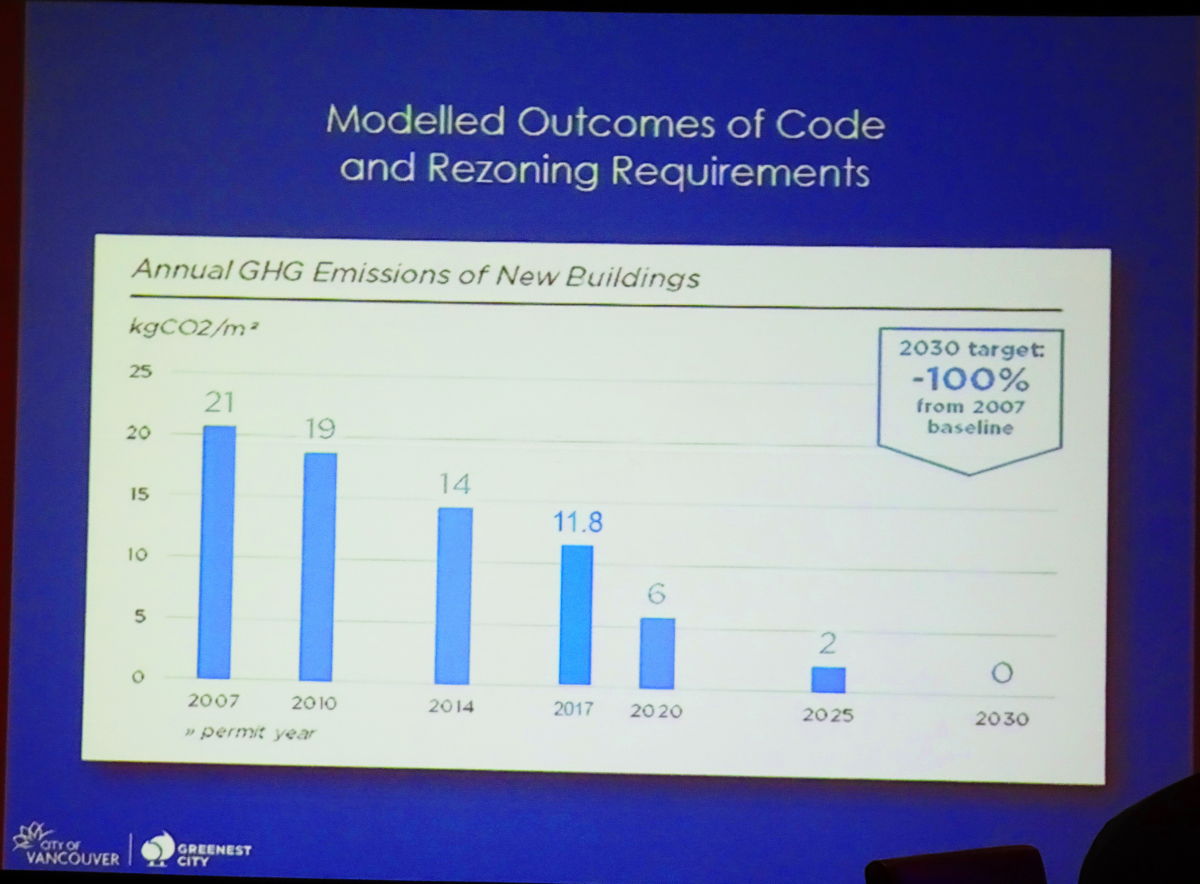 Vancouver’s strategy for achieving all new buildings being zero-emissions-ready by 2030 is multi-faceted. It includes regulation: to gradually restrict greenhouse gas (GHG) emissions, reduce heat loss, and limiting total energy use; city leadership: all new city-owned buildings will be zero emissions; incentives: incentivizing the private sector to move toward zero-emissions building; and capacity building: investing in tools to develop and share knowledge and to remove barriers. One of the things that Vancouver is doing right now is creating a Zero Emissions Building Centre of Excellence, scheduled to open in May, which is the first in Canada. BIM and energy performance modeling will have a key role in the drive toward reduced buildings emissions.
In Vancouver’s zero emissions strategy the next frontier is embodied carbon – emissions sourced to the materials and energy used in the construction of buildings. Vancouver plans to first require embodied emissions reporting followed eventually by regulation. One thing that is definitely in the works is encouraging the use of a lot more wood in construction. This is partly due to the intention to reduce embodied carbon and partly due to using the excess capacity resulting from U.S. duties on softwood imports.

Be the first to comment