
In the last few years I have come across a number of UAVs at the various conferences I have attended. They range from hexacopters to fixed wing aircraft but are limited typically to flight times of 40-50 minutes maximum because of battery capacity. I am also aware of a UAV with a daytime endurance estimated to be 5 to 12 hours depending on wing configuration, weather, and flight profile. All of these have a serious constraint in common, flights are severely limited by weather conditions.
Wave Gliders
In 2009 a pair of unmanned Wave Gliders travelled from Hawaii to San Diego encountering a wide range of weather conditions on the way. The 2,500 mile trip took 82 days. As of 2013 the total Wave Glider fleet had exceeded 400,000 nautical miles at sea.
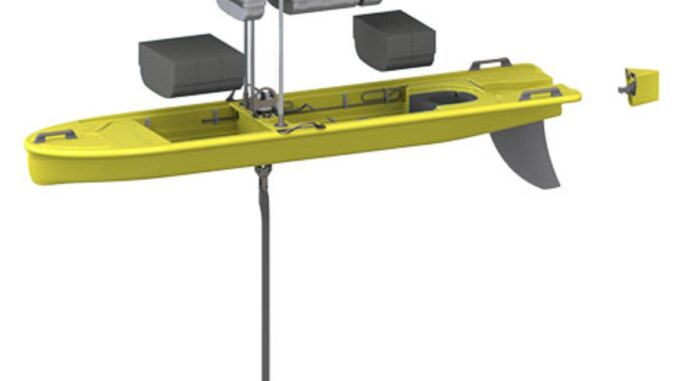
The Wave Glider is an unmanned vessel used for collecting data with a variety of sensors that uses both wave-powered and solar energy to navigate under any kind of ocean conditions from doldrums to hurricanes and cyclones. The Wave Glider converts wave motion to propulsion by exploiting the difference between wave motion on the surface and below the surface where it is much less. The Wave Glider has a two-part architecture that allows this difference in wave motion to be converted to propulsion. It is also able to generate its own power. It has a maximum payload power capacity of 260W and a battery capacity of up to 6.86 kWh. The power system supports various types of energy sources and multiple powered sensors, as well as an auxiliary electric thruster and navigation, GPS, computing and communications equipment.
Everything is controlled by software. Since August, 2011, James Gosling, well-known as the “father of Java”, has been the chief software architect at Liquid Robotics. The software environment has several components and can be used to controls either single vessels or fleets of Wave Gliders. It has a web application for remote mission management that includes piloting and data management tools. This software provides browser and programmatic interfaces (APIs) to allow users and applications to send commands to and receive data from the Wave Glider and its sensors. The Wave Glider has its own operating system for the onboard command-and-control computer, responsible for communications, navigation and collision avoidance, power and security. Sensor Management Software runs the onboard sensor management computer, managing the functions of and data collected from all the sensors on the Wave Glider. The Data Services Environment software provides cloud-based infrastructure that manages the flow of data from the Wave Glider to the remote pilots, mission specialists, and other users and software applications.

Be the first to comment