
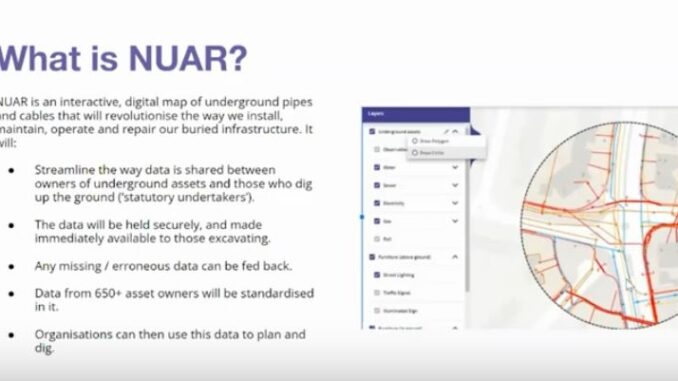
The National Underground Asset Register (NUAR) is intended to be a comprehensive digital map of all underground pipes and cables owned and operated by 650 asset owners in England, Wales and Northern Ireland. When deployed it will provide immediate access to UK underground asset data online from handhelds and other devices to qualified excavators and their contractors. A unique capability that differentiates NUAR from other underground data management systems lies in its ability to combine and visualize underground infrastructure of many different network operators on a single map.
Background to NUAR
In 2018 the Northumbrian Water Group Innovation Festival brought together 20 utilities, telecoms, and local government authorities in Newcastle upon Tyne to voluntarily collaborate in developing a shared underground infrastructure map showing the location of water, wastewater, gas, electricity, telecoms and other underground services provided by the network owners. Later extended to Central London, it became the pilot for what subsequently became the NUAR project sponsored and funded by the Geospatial Commission, part of the UK Government Cabinet Office.
Integrating underground data from different utilities
One key differentiator of the NUAR project is combining and visualizing underground utility data sourced from different utilities on a single map. Globally every utility has developed its own terminology for describing its network facilities, its own ways of graphically symbolizing different equipment, its own choice of base map showing road centre lines and other land base features and its own standards for network documentation.
A major advantage of mapping infrastructure in the UK is that every network operator records the location of their facilities against the same national base map, the Ordnance Survey’s MasterMap. In North America in contrast every utility uses a different base map. Conflating utility data to the same base map is a complicated process which inhibits the development of a representation of underground infrastructure on a single map. In the UK the common national base map provides a foundation for displaying data from many utilities on a single base map. But to meaningfully combine and visualize data from different utilities on a single map requires that data providers agree on standards for data elements, terminology, symbology and templates for network documentation.
Developing a harmonized data model
The first version of the data model was developed in conjunction with about 40 utilities who participated in the North East of England and Central London pilots. Fortunately the development of the Open Geospatial Consortium’s open standard for exchanging underground data Model for Underground Data Definition and Integration (MUDDI) coincided with the NUAR pilot. The NUAR project became the first project to implement MUDDI in the real world. MUDDI supports profiles that enable the MUDDI model to be adapted for different uses cases and countries. For NUAR the UK Excavation Profile was used. Participation in the MUDDI initiative enables the NUAR data model to be openly available to network operators and other organizations who choose to adopt it as a standard for their own data operations.
The central guideline that has guided the development of the model from its inception during the pilot was the need to minimize structural elements that hardwired the model. With a rapidly evolving model it was essential to be able to change different aspects the model without having to reconfigure the entire model as each new utility’s data brought new changes. The result was the development of ways of modelling utility networks that differed from what had been used in previous utility models. Examples include defining general feature types that could be qualified using attributes rather than structures making them more flexible, allowing a single feature table to support multiple spatial data types (points, lines and polygons) rather than separate tables for each data type, and implementing codelists separate from the data model making it possible to change them without republishing the model.
During the initial build phase of the project each it was found that new utility data source continued to bring changes to the model. At this point it had become more essential to carefully manage changes resulting from incorporating data sets from new asset owners because of the potential impact on the data that had already been brought into the model.
As new data is brought into the system, new feature types are discovered, for example, EV charging points, so that over time the data model is becoming more comprehensive with the potential for supporting additional use cases. In addition it is important to support the interaction of NUAR with external systems by making data types general and accessible to multiple systems and incorporating fields for capturing codes unique to the external systems. In the future this will make it possible to support work flows in which network operators’ data systems provide direct data updates to the NUAR database.
One of the important realizations during the development of the Ordnance Survey MasterMap was the critical importance of object identifiers (OIDs). As new data flows in to be analyzed and brought into the NUAR model, it is being found that many asset owners have not implemented feature identifiers. One of the long term benefits of the development of the NUAR data model may be instilling in industry data modelling practice the importance of unique feature identifiers.
Progress of NUAR build phase
At the time of Amy Manefield’s presentation at the SUMSF conference in March, the NUAR team had engaged with all 250 asset owners in the three initial regions of the North East of England, Wales and London. Data Exploration Agreements (DEA) had been signed with 88 of these utilities. The DEA allowed the data from these utilities to be explored, analyzed and the process of transforming it to be initiated. Of the utilities with DEA agreements 42 had already shared their data with the NUAR team and over a dozen of these data sets had been successfully transformed to the NUAR harmonized data model.
This post is based on Amy Manefield’s talk at the Subsurface Utility Mapping Strategy Forum (SUMSF). Amy Manefield is NUAR Head of Data Operations at the NUAR project of the Geospatial Commission.

Be the first to comment