
In her introduction to the session she was chairing at the Canadian Water Network conference Margaret Catley-Carlson, who has been involved with water internationally for about 15 years, focused on some of the myths about water that need to be dispelled if we are going to come to grips with the water challenges facing the world community.
“The water industry” and water users
From Margaret’s perspective it is important to realize that there is a very real disconnect between the powers
that within societies are thought to have the power or
responsibility for shaping the way that water is managed and the very
real way that water is managed in many societies around the world.
She pointsout that the entities that talk, declaim, analyze, and write books about water and
the environment really are in many ways not the managers of water.
Real water management decisions are made by millions of farmers every day in countries all around the world. Some of them are big farmers and some are very small farmers. Water management decisions are also made by hundreds of utilities, by
energy producers and operators, by industries that use water such as mining, and by people who
manage value chains. What is presented in textbooks and in speeches
is not the reality of water management. The important water management decisions, the ones that have significant impact on water quality and quantity, are made by the sectors of the economy
that use water. And far too often water users are not not involved in discussions about water. Margaret recollected that she has been working in the water sector for close to 15 years and has been to more conferences and meetings than she cares to remember and at too many of these people who are in the water sector talk about how people
who are outside of the water sector should be behaving rather than
actually listening to water users. From Margaret’s perspective, the water users are the people we have
to listen to and understand if we want to know how the future of water
is going to be written.
The water nexus
Margaret’s persective is that the management of water suffers
completely by being caught up in the rhetoric of the past century, that
water is plentiful and unlimited. This is especially prevalent in Canada with the result that it
is very difficult to undertake any meaningful dialog, let alone change,
because of the myth that there is an unlimited amount of
water in Canada. As an example, water has been fully allocated in southern Alberta. Increasing energy production there will require either diverting water from agriculture, meaning less beef much of which is exported, or by diverting water from north-flowing rivers as has been done with significant environmental impacts in Russia.
She also points out that limited water resources mean that we can no longer look at drinking water, irrigation, and using water for cooling at electric power plants as completely independent of one another. About 5 years ago a number of people began to realize that talking about water and
agriculture or water and energy provided a
limited view because the outlook for the next hundred years is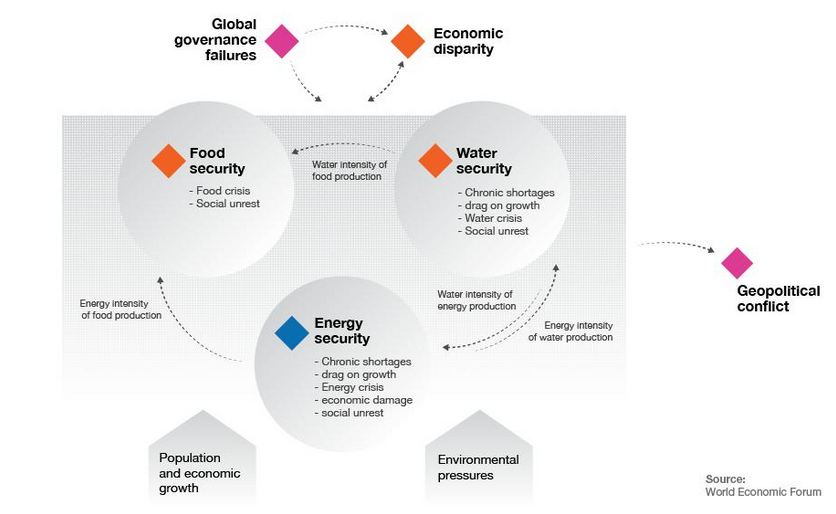 going
going
to be written by something more complicated. The nexus is often represented by a triangle with water in one
corner, energy in another corner and agriculture in the third. Municipalities
and utilities would be included in the water corner. Just looking at the bilateral flow of water between these sectors is not as useful
as considering the complex interplay between all three. For example, if you start to use a lot more water in the energy
sector or the energy sector starts to return water to the system in a
condition by which it cannot be used by agriculture or other
industries, the whole system is affected. It is no longer the case as it was
when we were three billion people and the impact of the activities of one sector on
water could be analyzed by itself. Now we’ve got to look at the
impact in the context of the water nexus. For example, what happens in Mongolia when a
major coal industry goes into an area which depends on agriculture
but is already water-stressed ? This was in reference to images shown at the conference by Carl Ganter of Circle of Blue of a Mongolian farmer standing in a field desiccated by the lowering of the water table by a new coal mine.
Margaret believes that we live in the water nexus which is where competing demands for
water are what is going to write the book about the future of water. The
good thing about this is that there are possible synergies. For example,
cleaned city water can have important agricultural applications. Water and energy can link together in some very important
synergies. For example, in Western Australia solar power generation is being linked to desalination.
But she also feels that there are also some troubling linkages. Some countries decided to reduce their dependence on Middle Eastern oil
and to switch to bio-fuels, even making them statutory. Some countries mandated that in the future all transport had
to use X % of bio-fuels. The nexus
impact of that was to move water away from the food function and crops such as corn or oil palm toward the energy function, with the result that the prices of those
commodities went sky high resulting in food riots in some countries.
What this means is that we can no longer talk about a single sector and how it uses
water. We have to diiscuss water usage in the context of competing uses in the water nexus.

Be the first to comment