
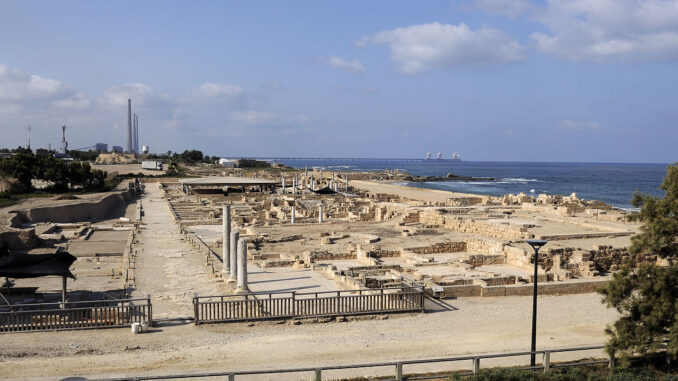
Immersed concrete structures, which were constructed in Roman harbours from about 55 BCE to 115 CE, have remained intact for 2000 years. In contrast modern concrete structures begin to deteriorate after several decades. Caesarea was one of the first projects to use Roman underwater concrete on a large scale. The ingredients in Roman concrete were known by ancient writers. Vitruvius, a Roman architect and engineer, in De architectura specified a ratio of 1 part lime to 2 parts volcanic ash for underwater work. He described the chemical reaction when tuff (an aggregate), volcanic ash from the Campi Flegrei and Vesuvius volcanic districts and lime “come into one mixture and suddenly take up water and cohere together”. Pliny the Elder wrote in Naturalis Historia that “as soon as volcanic ash comes into contact with the waves of the sea and is submerged it becomes a single stone mass, impregnable to the waves and every day stronger”.
A recent study appearing in American Mineralogist has revealed the minerals and chemical reactions responsible for the strength and durability of Roman concrete. Roman marine structures were analyzed with synchroton-based X‑ray microdiffraction at Lawrence Berkeley National Laboratory to identify the chemical composition and crystalline structure. Raman spectroscopy was used to study the chemical bonding. The analysis revealed the presence of aluminum tobermorite, a rare mineral, in Roman concrete. The process that makes Roman concrete harder over the centuries is the crystallization of phillipsite and aluminum tobermorite in the presence of water and at low temperature. This process occurs slowly and begins after the initial hardening of the concrete.
Another benefit of Roman concrete is reduced carbon dioxide emissions. Cement manufacture is a major source of carbon dioxide. Modern Portland cement releases carbon dioxide both from burning fuel to heat limestone and clay to 1,450˚ C and from the chemical process that converts the heated limestone (calcium carbonate) into lime (calcium oxide). It has been found that Roman concrete required much less lime and the lime could be derived from limestone baked at 900˚ C or lower, requiring far less fuel than Portland cement.

_2011-08-02_098.jpg)
Be the first to comment