
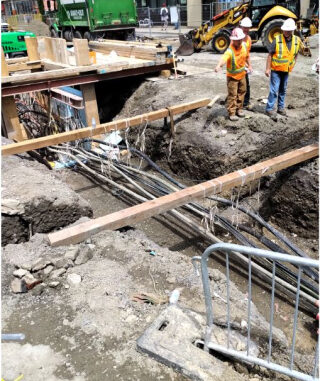
It is estimated that unreliable location information about underground infrastructure represents a $50 billion drag on the U.S. economy. Comparing the United States and Japan reveals a startling difference in the annual incidents of underground utility damage during construction – over 400,000 incidents in the U.S. and less than 150 in Japan. Clearly something can be done to reduce underground utility damage. Important advances in technology now make it possible to capture ground penetrating radar scans at highway speeds; simultaneously capture of above and below-ground scans using LiDAR and GPR to create a complete pre-design survey; generate centimetre accurate as-builts from a video taken with an Android smartphone; map underground pipelines for upto two km using inertial locating; detect underground objects 30 feet deep with acoustic sensing; and integrate existing 2D and site investigation results in a 3D model visualized in augmented reality. On-line systems for sharing information about the location of underground infrastructure have been implemented to manage underground utilities in the public right of way.
Many jurisdictions in the Americas, Europe, and Asia Pacific have implemented policies and organizational structures for capturing and sharing information about the location of underground infrastructure. Statistics reveal that a comprehensive approach involving policies, technologies and construction practices is required to be successful for continuing improvement in reducing utility damage during construction. Based on a review of international initiatives for managing location information about underground infrastructure, a set of 25 recommended elements have been compiled that should be considered by anyone intending to to reduce the risk of underground utility damage during construction.
A white paper prepared by Geoff Zeiss and Dr. Sakura Shinoaki and published by the Geospatial Information and Technology Association entitled Reducing Damage to Underground Utility Infrastructure during Excavation assesses costs, benefits, technical advances, and case studies to develop 25 recommendations for reducing damage to underground infrastructure. The white paper can be downloaded for free here and a summary is available here.

Be the first to comment