
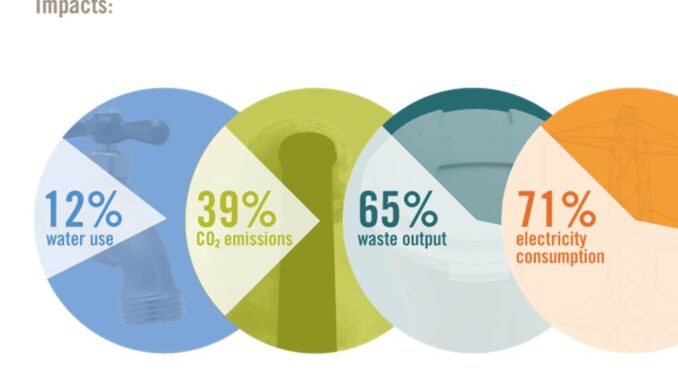
Earlier this month President Obama issued an Executive Order on Federal Leadership in Environmental, Energy and Economic Performance that establishes an integrated strategy for sustainability in the Federal Government and makes reduction of greenhouse gas emissions a priority for Federal agencies.
It establishes that it is the “policy of the United States that Federal agencies shall
- increase energy efficiency;
- measure, report, and reduce their greenhouse gas emissions from direct and indirect activities;
- conserve and protect water resources through efficiency, reuse, and stormwater management;
- eliminate waste, recycle, and prevent pollution;
- leverage agency acquisitions to foster markets for sustainable technologies and environmentally preferable materials, products,and services;
- design, construct, maintain, and operate high performance sustainable buildings in sustainable locations;
- strengthen the vitality and livability of the communities in which Federal facilities are located;
- inform Federal employees about and involve them in the achievement of these goals”
Among the concrete goals specified by the Executive Order is the following:
- “beginning in 2020 and thereafter, ensuring that all new Federal buildings that enter the planning process are designed to achieve zero-net-energy by 2030“
I blogged earlier about two towns in Georgia that passed bylaws requiring that all new municipal buildings be LEED certified.
- “ensuring that at least 15 percent of the agency’s existing buildings (above 5,000 gross square feet) and building leases (above 5,000 gross square feet) meet the Guiding Principles by fiscal year 2015”
The US Federal government owns approximately 445,000 buildings with
total floor space of over 3.0 billion square feet and leases an
additional 57,000 buildings with 374 million square feet of floor space. The Guiding Principles are defined here. There’s a worthwhile article on CNET about software tools to help analyze the potential savings in energy, water, emissions, and material from retrofitting existing buildings.
Some of the other concrete goals in the Executive Order include
- “ensure that 95 percent of new contract actions including task and delivery orders, for products and services with the exception of acquisition of weapon systems, are energy-efficient (Energy Star or Federal Energy Management Program (FEMP) designated), water-efficient, biobased, environmentally preferable (e.g., Electronic Product Environmental Assessment Tool (EPEAT) certified), non-ozone depleting, contain recycled content, or are non-toxic or less-toxic alternatives, where such products and services meet agency performance requirements;
- reducing [] agency fleet’s total consumption of petroleum products by a minimum of 2 percent annually through the end of fiscal year 2020, relative to a baseline of fiscal year 2005;
- reducing potable water consumption intensity by 2 percent annually through fiscal year 2020, or 26 percent by the end of fiscal year 2020, relative to a baseline of the agency’s water consumption in fiscal year 2007,
- diverting at least 50 percent of non-hazardous solid waste, excluding construction and demolition debris, by the end of fiscal year 2015;
- diverting at least 50 percent of construction and demolition materials and debris by the end of fiscal year 2015;
- reducing printing paper use and acquiring uncoated printing and writing paper containing at least 30 percent post consumer fiber”
(Image US Green Building Council)

Be the first to comment