
It is incredible how rapidly wind power generation has grown over the past decade. The latest Global Wind Report Annual Market Update 2012 from the Global Wind Energy Council (GWEC) reports that the 2012 global wind power market grew by more than 10% compared to 2011. In 2012 nearly 45 gigawatts (GW) of new wind power capacity resulted from about €56 billion of investment. The new global total capacity at the end of 2012 was 282.5GW, equal to about a quarter of the total power generation capacity of the U.S.
The EU installed 11.6 GW of capacity in 2012. The total wind power capacity in the EU has reached 105.6 GW. 26% of all new EU power capacity installed in 2012 was wind with investments of between €12.8 billion and €17.2 billion. Wind is responsilble for generating 7% of Europe’s electricity demand.
At the end of 2012, there were 76 GW of wind electricity generating capacity installed in China. China plans to have 100 GW of on-grid wind power generating capacity by the end of 2015.
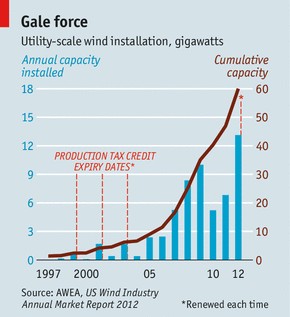
 According to the AWEA 2012 was a record year for the U.S. wind energy industry. More new wind power capacity was installed in the U.S. than any other form of power generation, which is pretty incredible given that 25 years ago there was no significant wind power generation at all. In 2012 over 13 GW of new generating capacity were installed across the U.S. representing $25 billion in private investment. Cumulative wind capacity in the U.S. reached 60 GW by the end of 2012, about 3.5% of total U.S. generation capacity.
According to Bloomberg, MidAmerican Energy, which is nearly 90% owned by Berkshire Hathaway (Warren Buffett), has ordered over a GW of wind turbines from Siemens (Siemens has a wind turbine blade factory in Lee County, Iowa.) for wind farms in Iowa at a cost of about $1 billion. This is despite the fact that the main federal tax credit for wind power the Production Tax Credit (PTC) expired at the end of 2012 (but was renewed January 1 with bipartisan support for one year.)
The PTC pays 2.2 cents per kilowatt-hour for electricity generated for ten years after a turbine is installed. One important reason the PTC has bipartisan support is that it generates employment in primarily rural states like Iowa, Kansas, and South Dakota. Two states generate over 20% of their power from wind and 7 others generate more that 10% of their power from wind.
The American Wind Energy Association (AWEA) has said that the MidAmerican Energy wind turbine purchase shows that wind power is becoming profitable without subsidies.
MidAmerican Energy is a rapidly growing investor owned utility (IOU). The Nevada Public Utiltiies Commission (PUC) has just approved the sale of NV Energy to MidAmerican Energy. In the past I worked quite a bit with NV Energy which is an IOU formed from Sierra Pacific Power (Reno and northern Nevada) and Nevada Power (Las Vegas).
In the U.S. the National Renewable Energy Lab’s (NREL) Geographic Information System (GIS) team provides maps of high-resolution wind data that are used to determine optimum locations for siting wind farms. The national wind resource data provides an estimate of the annual average wind resource for the conterminous United States, with a resolution of 1/3 degree of latitude by 1/4 degree of longitude. 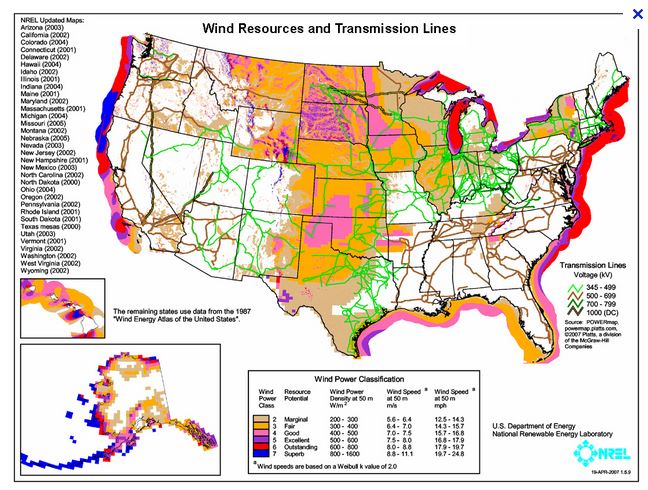 It is based on surface wind data, coastal marine area data, and upper-air data. In areas where there is little directly observed wind data, It uses topographic and meteorological indicators such as gorges, mountain summits, and sheltered valleys, and vegetation that has been deformed by wind; and landforms like sand dunes.
The other key factor for siting wind farms is access to transmission. NREL also provides maps of the electric power transmission grid overlayed on wind maps.
GIS is also being used in emerging economies to help site wind and solar renewable energy generation.

Be the first to comment