
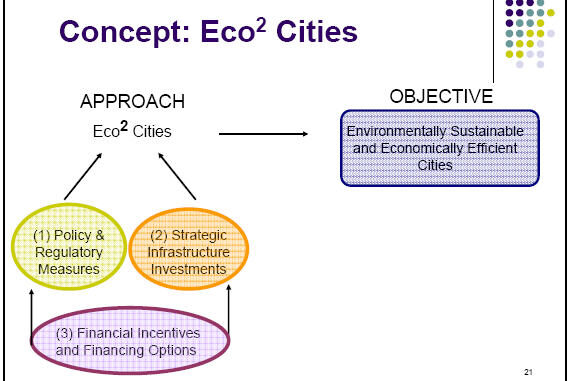
Last year the World Bank introduced the concept of Eco2 cities which is designed to combine both ecological and economic development. In the past economic development, especially rapid economic development, has been associated with rampant abuses of the environment. So the question that the World Bank is trying to address is can we have sustainable rapid development. Sometime in the middle of 2009 the number of urban dwellers will exceed rural dwellers and because of this and the importance of cities in economic development the World Bank is focussing on cities.
According to a recent blog post in ReNew Canada, the Eco2 program launch is scheduled for July 1st in Marseilles. An Eco2 Cities book will be coming out at the same time. Eco2 is aimed specifically at cities in developing countries.
The key principles of Eco2 cities are
- Synergy and balance between environmental and economic objectives
- Integrated approach
- Long-term and life cycle perspective
- Path-dependency (spatial pattern matters)
- Learning from best practice (Stockholm, Vancouver, Curitiba, Portland, Brisbane etc)
- Lessons from developing countries
- Linked to finanical incentives
The Eco2 cities approach involves policy and reform measures and strategic infrastructure investments.
Policy and Reform Measures
Policy and reform measures include
A. Urban Planning
- Spatial Development Plans, Land Use Plans and Zoning
- Construction Standards and Building Codes
- Public Transport Policies
B. Integrated Utility Management
- Power (Renewable Energy and Energy Efficiency)
- Water (Water Conservation and Reuse)
- Wastewater (Biogas and Biosolids Recovery and Reuse)
- Solid Waste (Recycle/Waste-to-Energy/Composting)
C. Private Sector Engagement
- Industrial and Investment Policy, Regulation and Taxation
- Integrated Industrial Eco-Zones
- Innovative Policies and Programs for the Service Sector
 Strategic Infrastructure Investments
Strategic infrastructure investments involve
- Land development and servicing and spatial development
- Multimodal Transport Network (synchronized with land use planning and regulations)
- Combined Heat & Power (with district heating)
- Energy Efficient Water and Wastewater Operations
- Water Savings
- Solid Waste Management (composting, recycling and energy use)
- Industrial Eco-Zones

Be the first to comment