
I blogged earlier about Ontario and Quebec protecting a significant proportion of the world’s boreal forests and an agreement between environmental organizations and forest companies also designed to protect forest resources across Canada.
According to the FAO, the world’s total forest area is about 4 billion hectares, which is 31% of total land area. The most forest-rich countries are the Russian Federation, Brazil, Canada, the United States and China, which together account for more than half of the total forest area. Forests store a vast amount of carbon estimates by the FAO to be about 289 gigatonnes (Gt) of carbon in their biomass alone.
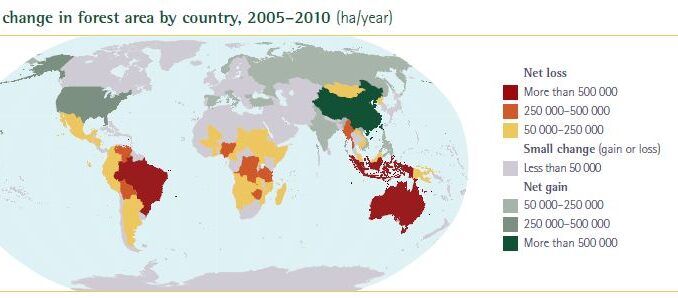
The rate of deforestation in the 1990s was about 16 million hectares per year. In the last decade (2000-2010) this rate has dropped to around 13 million hectares per year. Both Brazil and Indonesia, which had the highest net loss of forest in the 1990s, have significantly reduced their rate of loss. For the world as a whole, carbon stocks in forest biomass decreased by an estimated 0.5 Gt annually during the period 2005–2010, mainly because of a reduction in the global forest area.
Large scale planting of trees and natural expansion of forests in some countries and regions have reduced the net loss of forest area significantly. The net change in forest area in the period 2000–2010 is estimated at –5.2 million hectares per year, down from –8.3 million hectares per year in the period 1990–2000.
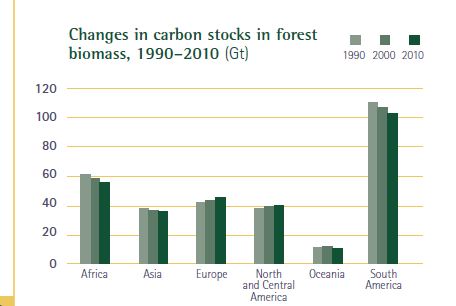 South America and Africa continue to have the largest net loss of forest. Oceania also reported a net loss of forest, partly due to forest fires and drought in Australia. The area of forest in North and Central America is about the same in 2010 as in 2000. The forest area in Europe continued to expand, although at a slower rate than in the 1990s. Asia, which had a net loss in the 1990s, reported a net gain of forest in the period 2000–2010, primarily due to the large-scale afforestation reported by China and despite continued high rates of net loss in many countries in South and Southeast Asia.

Be the first to comment