
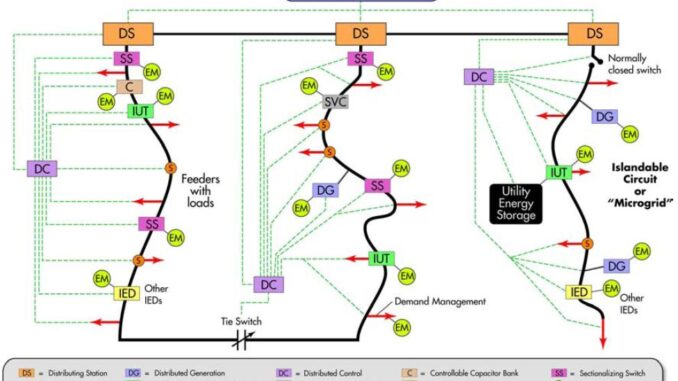
Smart grid means different things to different utilities in different geographies. In many parts of North America, the UK and Denmark, for example, the emphasis has been and continues to be on smart meters and the AMI and AMM infrastructure to support these devices. In Switzerland and Germany on the other hand distributed generation, not smart meters, is the priority.
According to EPRI a growing variety of automated devices are being added to distribution systems. Adding real-time monitoring of distribution system operations is the next step. The monitoring components which collect the data include dedicated sensors, embedded sensing capabilities within distribution equipment, and operating data from AMI. These devices need to be integrated with communication and control infrastructure, typically using fiber and wireless communications eqipment. DA also involves distributed controllers to manage the resources locally by feeder or groups of feeders, with overall supervisory control of the distribution system at a higher level. A key component is a local controller that can be used with a wide variety of feeders in which the types and numbers of controllable equipment will vary. The advanced control infrastructure includes integration of the distribution management system (DMS), energy management system (EMS), and outage management system (OMS).
NIST and EPRI have identified a number of potential benefits from distribution automation including
- Improve reliability and performance of distribution systems
- Reduce operating costs
- Enhance contingency responses
- Improve power quality
- Increase customer service options
- Prevent and mitigate outages
- Aid in outage recovery operations
- Support DER integration into distribution operations
- Make customer systems part of the system performance equation
According to a report from Pike Research there are signs that distribution automation (DA), motivated by plug-in electric vehicles and distributed generation, is moving from pilots to early commercial adoption. The report says that worldwide DA revenues have increased significantly in the past few years, rising from $1.2 billion in 2008 to $2.7 billion in 2010. The report forecasts that by 2014 DA revenues will reach $10.4 billion annually. For 2010 to 2015 it is projected that the aggregate worldwide investment in DA will reach $46 billion. According to Pike Research the major benefits of DA are improving reliability and efficiency of electricity distribution. But in the context of the challenges of changing consumer behaviour associated with smart meters, DA has the “potential to deliver strong return on investment without requiring intensive consumer engagement or behavior change.”

Be the first to comment