
On 30 July 2004 at a construction site in Ghislenghien, Belgium a one metre diameter natural gas pipeline ruptured resulting in 24 fatalities, including five fire-fighters, a police officer and five employees, plus 132 injured requiring hospitalization. It caused total devastation within 200 metres in an industrial/agricultural area destroying a cardboard mill, a gas station, and a large number of roofs and cars. A portion of the construction site was damaged and many agricultural fields burned.
In 2007, the first version of KLIP, the Flemish one-call system which is a broker for information about the location underground utilities, went into production in Flanders. In the Netherlands in 2008 the Sub soil Cables and Pipelines Information Exchange Act (WION) came into effect. The objective of the system is to prevent damages to the utility network and to ensure the safety of excavators during excavations. WION made KLIC, the Dutch one-call system, which had existed since 1967, mandatory for both network operators and excavators with severe penalties for excavators who circumvented the system. Violating WION can entail a maximum fine of € 450,000 for network operators and € 100,000 for excavators. WION obligates all network operators to participate in the system, using a standard information model for registering their infrastructure. The KLIC-online system, which provides on-line information exchange of underground utility information between network operators and exvators, was built and is maintained by the Dutch Kadaster. The Agency Telecom, part of the Ministry of Economic Affairs, is designated as the regulator and enforcer of the act.
I blogged previously (2013 and 2014) about the Dutch KLIC system. In 2010 the Netherlands switched to a digital information system (KLIC-Online). Currently there is a charge of € 32 for every information request.
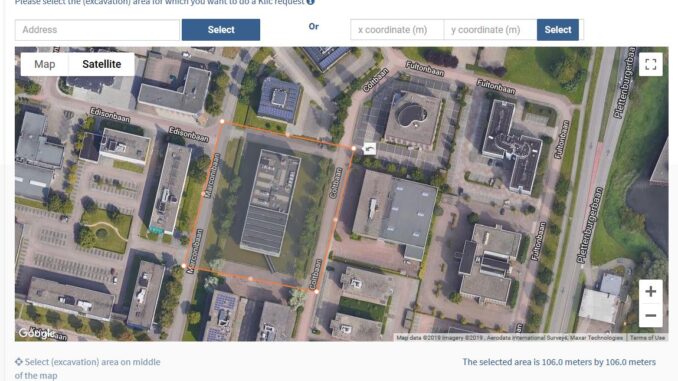
Anyone planning to excavate within the next 20 days is required to go to the KLIC App site and create a polygon enclosing the proposed excavation area (which cannot exceed 500×500 meters). They then click on the type of work: dredging, grub/plan trees, deep ploughing, foundation work, drive piles, gardeners work, place/remove poles/masts, demolition work, pond digging, dam-wall/timbering, drainage, site preparation, place fencing, place cables/pipes, sewerage work, dig or excavate tanks/wells/containers, dig forage hole, or reallocation; enter personal information; and pay. It is important to note that engineering design is not one of the options.
For 95% of information requests within one business day the excavator will receive an email with links to a location where maps of all underground infrastructure and the names of the utility and telecom operators with facilities in the excavation area can be accessed or downloaded. This data can be used both online and offline. The system allows distances to be measured and provides information about the quality of the location information about underground utilities. For the next 20 days the excavator is cleared to begin excavation unless some the facilities in the area are high consequence utility lines such as gas transmission and high voltage electric lines. In these special cases the excavator will be directed to contact the network operator for supervised excavation.
Network operators are required to report all incidents of damage to their infrastructure including location, cause and other information. Based on this and other information Kadaster publishes an annual report with statistics on underground utility damage. The following is an example of statistics about underground utility information requests and damage in the Netherlands for 2018.
|
Network operators/managers |
1,130 |
|
Annual notifications (request for info) |
759,000 |
|
Annual excavation damage |
41,169 |
|
Direct costs from damage |
€ 34,500,000 |
|
Average repair cost per excavation damage |
€ 838 |
I would assess the biggest benefit of the KLIC system is efficiency. KLIC seems light years ahead of North America and other jurisdictions where every request for information to a one-call centre results in seven or so vans converging on the spot where detection tools are used to locate underground utilities whose location is then marked by paint or flags.
However, to the best of my knowledge the goal of substantially reducing excavation damage has not yet been reached. With tens of thousands of incidents of utility damage every year, there is certainly room for improvement. That this is achievable can be seen by contrasting the number of incidents in the Netherlands with Japan where in 2016 the number of incidents of underground utility damage was 134.
Furthermore, information about the location of underground utilities needs to be available for other use cases than just excavation; first and foremost, the planning and engineering design phases of construction projects (as Colorado has just mandated), but also disaster planning, and emergency response.

Be the first to comment