
Unless you live under a rock, and that rock is buried very deeply underground, you will know that Canada is ramping up its naval and marine capabilities in a serious way.
We are investing in ships, people, and long term operational capacity across the country. That includes the Navy, the Coast Guard, and the broader marine ecosystem that supports safety, sovereignty, and operations on our coasts and waterways.
This could be a really great option for some people. I want to highlight it here as something worth considering.
In some cases, these pathways allow people with a passion for geomatics and geospatial work to get paid to learn those skills through structured federal career programs, rather than taking on student debt and hoping a role appears at the end.
This article was prompted by a post shared by Mariah McCooey, Director of Hydrography at the Canadian Hydrographic Service, Pacific Region. She reshared a post from the Canadian Coast Guard highlighting the Officer Training Program, and that endorsement caught my attention.
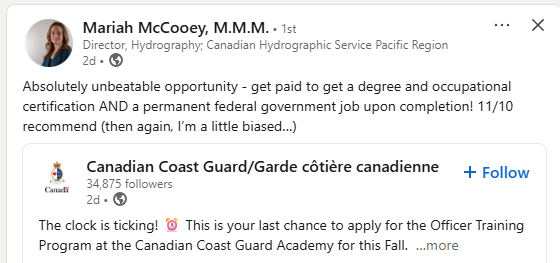
Coming from someone working at the intersection of hydrography, navigation, and marine operations, her perspective was a reminder that some of the most interesting geospatial career paths sit just outside the usual job listings.
Granted, this is not a conventional geomatics career path, but it is deeply connected to the real world use of charts, navigation systems, and spatial decision making in operational environments. This is spatial thinking at its roots, tied to the earliest questions of positioning and navigation. How do we get from point A to point B without hitting rocks or reefs.
That part speaks to the archaeologist in me.
Thinking beyond job titles
When people think about careers in geomatics, they often default to familiar roles. GIS. Office based analysis. Maybe field work that feeds data back into a system.
All of those are valid paths. But they are not the only ones.
There are also careers where navigation, charts, positioning, spatial judgement, and real time decision making come together in operational environments where the stakes are real and immediate.
These roles tend to be structured and disciplined, which works well for some people and not for others. That is part of the fit.
So ask yourself a few simple questions.
Do you like structured environments
Do you like applied problem solving
Do you like navigation and situational awareness
Do you like the idea of your decisions having immediate real world consequences
If some of those resonate, then this kind of career path is at least worth understanding, even if it is not what you originally had in mind.
Some practical facts
The Officer Training Program is delivered at the Canadian Coast Guard Academy in Sydney, Nova Scotia. It is a four year, fully funded federal program that trains officers for careers in marine navigation or marine engineering.
Here is the key thing I want people to understand.
You are not applying to a school. You are applying for a federal job, and the training comes with it. You are paid while you train.
As part of the program, you earn a university degree and a diploma, along with the professional certifications required for service. But it is delivered through a federal training and employment pathway, not a traditional university experience.
Navigation as applied geomatics
From a career coaching perspective, marine navigation is one of the clearest examples of applied spatial thinking you will find.
Officers rely on nautical charts, electronic navigation systems, positioning tools, and constant spatial awareness. They interpret spatial information in real time and use it to make decisions that affect safety, logistics, and operations on the water.
If you have ever thought that you enjoy maps and navigation but are not sure you want a desk focused career, this is one of those paths that is worth understanding.
Learning more from official sources
Rather than trying to summarize every aspect of the program here, anyone seriously interested should spend time with the official material published by the Canadian Coast Guard and the Canadian Coast Guard Academy.
The Officer Training Program is a structured, employment based federal pathway with clearly defined academic, professional, and service requirements. The details matter, and they are best understood directly from the source.
Official Resources:
Canadian Coast Guard Officer Training Program application page
https://www.ccg-gcc.gc.ca/college/officer-training-formation-officier/admission/apply-appliquer-eng.html
Officer Training Program overview and prospectus
https://www.ccg-gcc.gc.ca/publications/academy-academie/prospectus-eng.html
Canadian Coast Guard Academy main website
https://www.ccg-gcc.gc.ca/academy-academie/index-eng.html
Officer Training Program admissions and eligibility requirements
https://www.ccg-gcc.gc.ca/academy-academie/officer-training-formation-officier/admission/index-eng.html
Canadian Coast Guard careers and recruitment page
https://www.ccg-gcc.gc.ca/careers-carrieres/index-eng.html
Those sources provide the most accurate and up to date information on program structure, commitments, timelines, and expectations.
Applications for the Canadian Coast Guard Officer Training Program close on February 13, 2026.
If you miss the February 13, 2026 application deadline, the Canadian Coast Guard typically opens applications again in the fall for the next year’s intake, although specific dates for the 2027 cycle have not yet been published. They might move this up. Who knows?
Even if you never apply, reading through the official documentation is a useful exercise in understanding how geomatics, navigation, and applied spatial thinking show up in real world public service careers.
Sometimes the most interesting career paths are the ones you did not realize were connected to your skill set.


Be the first to comment