
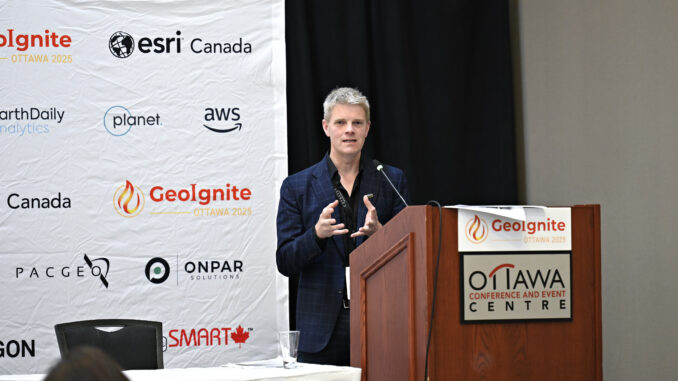
At this year’s GeoIgnite conference, Amazon Web Services (AWS) delivered one of the most forward-looking presentations in the geospatial track. In a session titled “Navigating the Future: Generative AI for Enhanced Geospatial Data Quality,” Phil Cooper, Global Geospatial Lead at AWS, shared how cloud, open data, and AI are converging to redefine how geospatial data is created, processed, and trusted.
Building on a Foundation of Good Data
The session opened with a simple but powerful reminder: everything starts with good data. In an era where satellites, sensors, and ground-based networks are producing vast quantities of Earth Observation data, the challenge is no longer access rather its quality, consistency, and usability.
“We simply don’t have enough people to manually go through this volume of imagery,” he said. “AI is not a luxury anymore; it’s a necessity.”
Cooper emphasized that the most impactful AI applications in geospatial science rely on accurate, repeatable, and timely datasets. Whether used for monitoring urban growth, responding to natural disasters, or assessing biodiversity, poor data quality can compromise entire workflows. This is where generative AI is now playing a transformative role. AI is now capable of learning patterns through self-supervised and few-shot learning techniques. Cooper described this as a major breakthrough that frees analysts from the bottleneck of manual data prep.
Earth on AWS: Enabling Global-Scale Access
At the heart of this transformation is Earth on AWS, a program designed to democratize access to petabyte-scale datasets like Landsat, Sentinel-2, and NEXRAD. These are hosted and made immediately accessible via AWS, eliminating traditional bottlenecks like local storage or slow downloads.
Rather than requiring users to download and store massive datasets locally, Earth on AWS enables cloud-native processing allowing users to analyze data directly in the cloud, reducing costs and dramatically accelerating workflows. From government agencies to academic researchers and non-profits, a wide range of users are leveraging this infrastructure to build data-driven solutions at global scale.

Generative AI: Enhancing Data Quality and Speed
With the rise of generative AI, AWS is helping redefine how geospatial data is processed and enhanced. Using platforms like Amazon Bedrock, organizations are training large language and vision models to automate traditionally manual geospatial tasks. For example, models can now:
- Fill gaps in satellite imagery caused by cloud cover
- Improve classification of land use and land cover
- Create synthetic datasets for training
- Generate predictive layers for disaster or infrastructure planning
These capabilities don’t replace domain experts—they augment their reach, enabling faster, more scalable decision-making without compromising precision.
To support these AI-driven workflows, AWS offers a suite of cloud-native services that form the backbone of many modern geospatial platforms:
- Amazon SageMaker enables the training and deployment of custom machine learning models on massive satellite datasets. Use cases include flood prediction, vegetation classification, and air quality forecasting.
- Amazon Bedrock provides access to foundational generative AI models, allowing users to build custom applications without managing complex infrastructure.
- AWS Ground Station lets organizations ingest satellite data directly into the cloud in near real-time, minimizing latency from acquisition to insight.
- Amazon Location Service offers scalable, integrated mapping, routing, and geofencing capabilities to build location-aware applications.
Together, these tools help organizations not only process geospatial data, but turn it into actionable intelligence faster than ever.
Real-World Use Cases
Cooper shared several compelling examples:
- Using AI to monitor vegetation changes and land degradation.
- Tracking urban sprawl and illegal construction by detecting new infrastructure.
- Classifying and mapping biodiversity patterns from space.
- Enhancing environmental protection efforts, such as identifying critical bird migration paths with radar data.
- Supporting disaster response with predictive mapping layers.
In one case, a conservation group used AI to scan satellite imagery for forest health, tracking biodiversity loss and climate impact with a level of precision and speed that would be impossible manually.
Facing the Technical Challenges and a Human-Centric Future
Cooper did not shy away from the challenges. He acknowledged issues around fragmented geospatial tools, metadata inconsistencies, and training data limitations. He also emphasized the importance of explainability and transparency in AI-generated outputs, especially when used for public sector decision-making.
He urged attendees to engage with this transformation: “It’s not about fearing AI, it’s about understanding how to use it responsibly. We all have to become fluent in this new language.”
Cooper closed the session with a powerful message: when cloud infrastructure, open geospatial data, and generative AI are combined, the result isn’t just better analytics. it’s a fundamentally new model for understanding and managing our planet. He reminded the audience that the ultimate goal isn’t just automation, it’s empowerment.
“We’re not just building better models,” he said. “We’re building a better understanding of the Earth.”
By removing barriers to data access, simplifying AI integration, and supporting rapid innovation, AWS is helping geospatial professionals, researchers, and developers unlock the full potential of Earth Observation.



Be the first to comment