
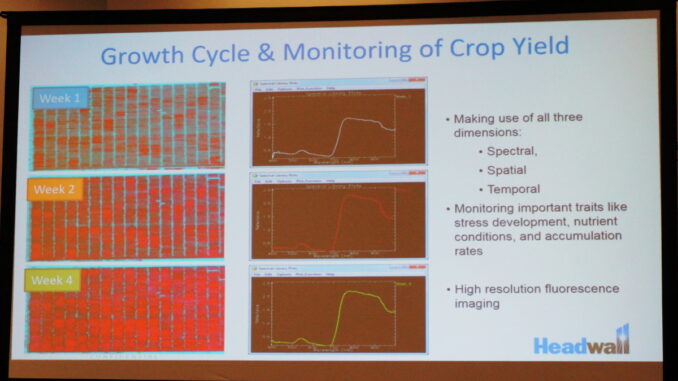
The typical multi-spectral camera used on satellites and airborne platforms captures three or four bands – typically the Landsat bands: green, red and near-infrared. But hyperspectral cameras can capture 270 bands and are light enough to be mounted on a UAV. At the annual Hexagon conference HxGN Live in Anaheim, Headwall Photonics gave an overview of the capabilities and advantages of hyper-spectral remote sensing. Headwall and Leica Geosystems have partnered to offer a complete UAV-based hyper-spectral package which includes the Aibotix X6, Headwall hyper-spectral camera, storage, IMU/GPS, and software.
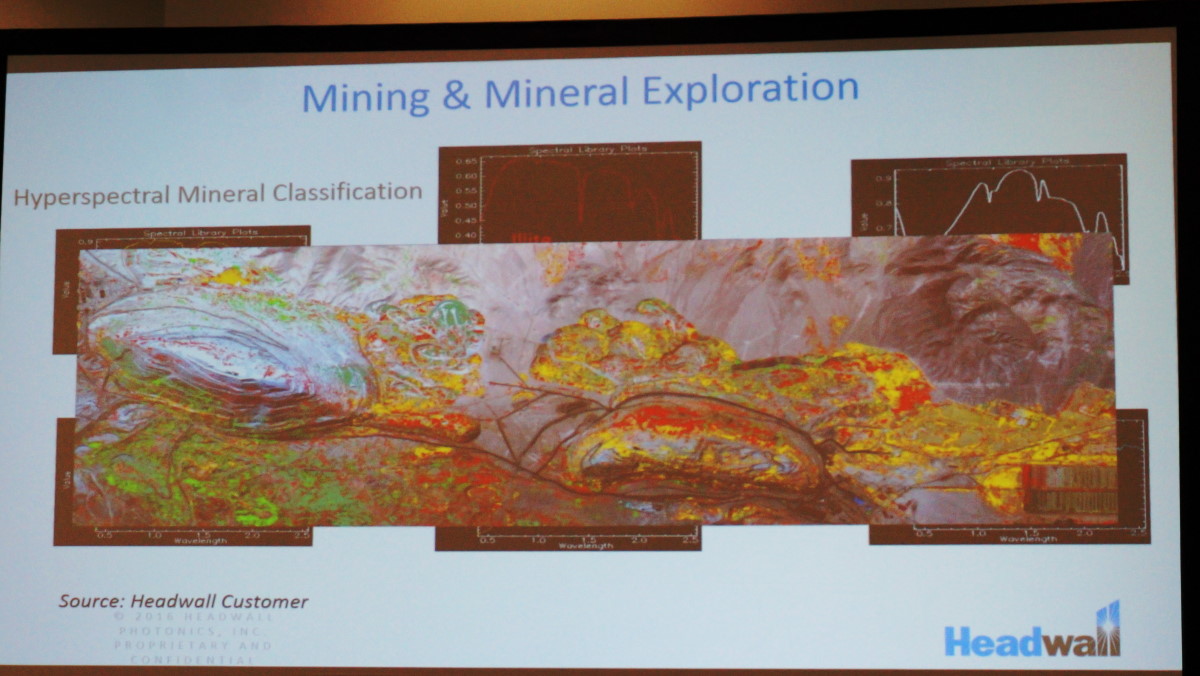 A hyper-spectral camera passes the light it captures through a diffraction prism that breaks the light into a spectrum that ranges from infrared through visible to ultraviolet. The Headwall camera records 270 bands ranging from the infrared through the visible spectrum. This broad spectrum allows the chemical composition of materials to be detected. Spectral fingerprints can be defined based on chemical composition which enables detection of different species of trees, stages of crop development, disease incidence in crops, specific chemical compounds in mining tailings, and many other materials. The Headwall camera can capture up to 300 frames per sec. That generates a lot of data. The key to extracting information from this volume of imagery is spatial analytics software which is part of the package.
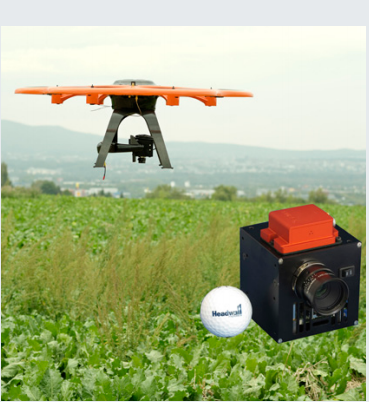 The Headwall Leica Geosystems package is an integrated multi-rotor UAV and visible and near infrared (VNIR) hyper-spectral imaging system with software control. It includes Headwall’s Nano-Hyperspec VNIR sensor with the Leica-Geosystems Aibot X6 multi-rotor UAV. The Nano-Hyperspec VNIR Sensor captures bands in the wave length range 400-1000 nanometers (nm) with a 12 bit pixel and a maximum frame rate of 300 Hz. It also includes 480GB of on-board storage and an attached GPS/IMU. 480 GB corresponds to about 130 minutes of imagery at 100 fps.
Typical applications of hyper-spectral imagery are
precision agriculture, mineral exploration, and civil engineering. Specific examples of the application of the technology include marijuana plant detection, crop health monitoring, citrus species mapping, invasive species monitoring, growth cycle and monitoring of crop yield, mine tailings monitoring, storage tank leakage detection, environmental monitoring, disaster monitoring, and mapping urban areas.
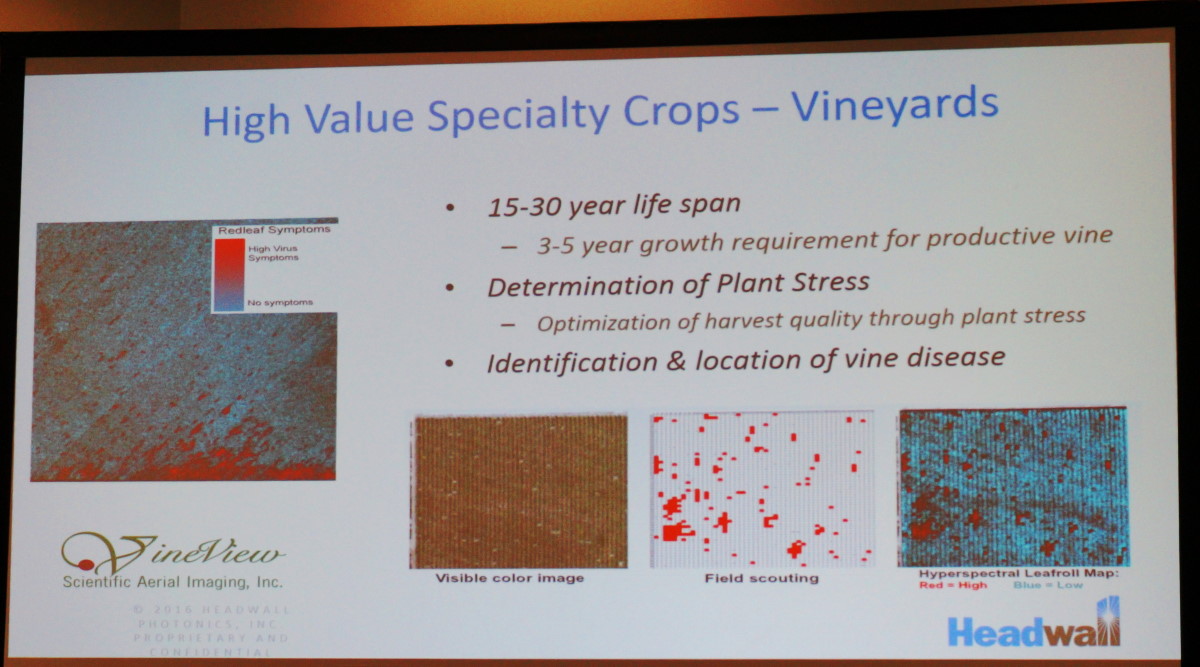 A fascinating example is monitoring crop health where a scan of a field shows areas where the plants are not doing well. This enables the selective application of fertilizer to only those areas where it is required. Similarly a hyper-spectral scan reveals areas of insect infestation, which enables the selective application of insecticide. Another application that would interest grape growers in the wine industry is using hyper-spectral imaging to identify and monitor leaf roll virus infestations.
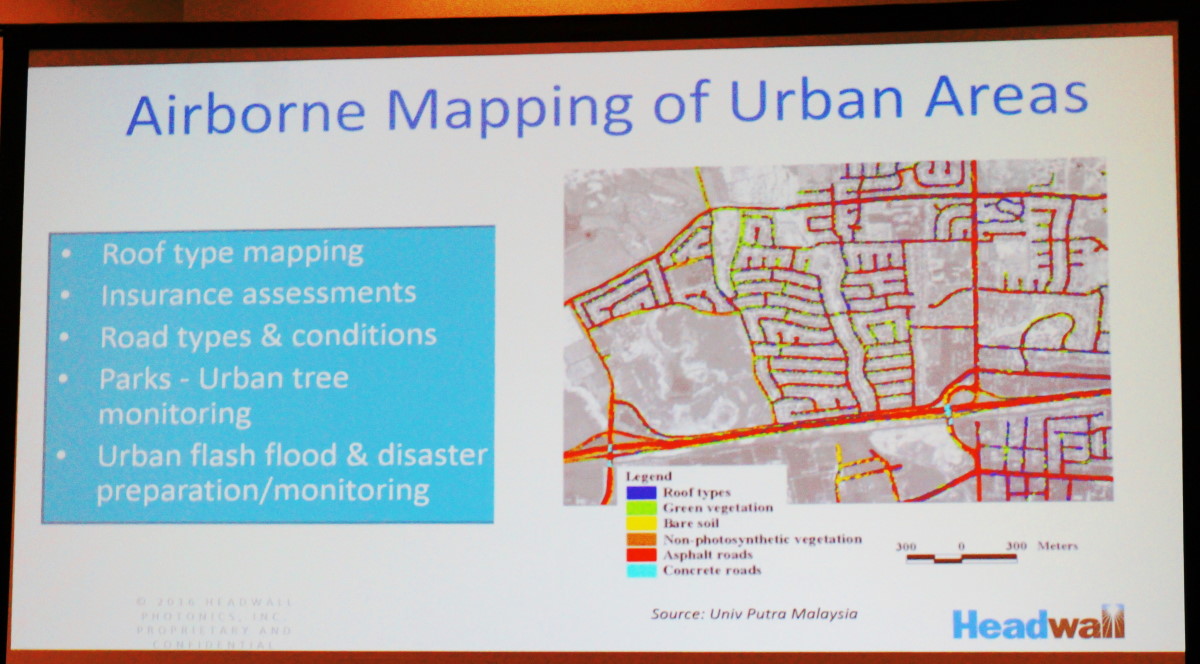 Hyper-spectral imaging can also be used in an urban environment roof type mapping, insurance assessments, identifying types of road and monitoring road conditions, monitoring tree conditions in urban forests, and for urbanflash flood and disaster preparation and monitoring.
The key differentiator of hysper-spectral imaging is much greater precision in recognizing specific chemical compounds whether in plants, rocks, mine tailings, or urban environments. However, the price is managing a much greater volume of data. Spatial analytics is key to extracting information from the huge volume of data collected in the field.

Be the first to comment