
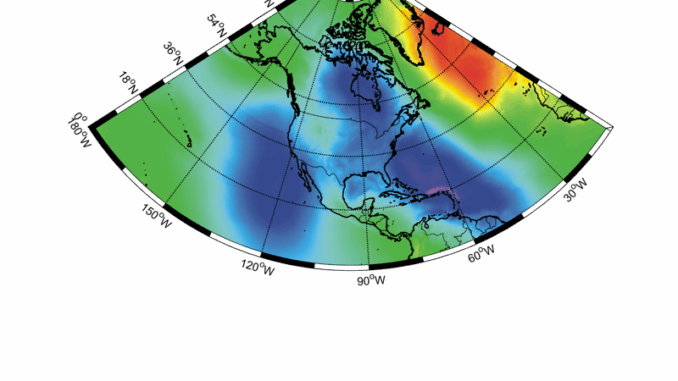
The North American geodetic community is on the brink of a major shift, one that promises improved positional accuracy and stronger cross-border alignment. But beneath the progress lies an unsettling reality: the very systems enabling these advancements are at risk. The modernization of national reference systems is not just a technical upgrade. It is unfolding against the backdrop of what experts increasingly call a geodesy crisis.
This issue took center stage during a key session at the 2025 SaGES conference, where speakers from the U.S. National Geodetic Survey (NGS), Natural Resources Canada (NRCan), and the National Society of Professional Surveyors (NSPS) addressed the future of reference systems. The session emphasized how technical modernization efforts, including NATRF2022, NAPGD2022, and CGVD2013, must contend with political uncertainty, staffing shortages, and declining institutional capacity.
Why the Shift Is Needed
For decades, NAVD 88 and NAD 83 have formed the backbone of height and positioning systems across North America. But these legacy systems contain embedded errors: vertical biases as high as one meter in some regions and horizontal inaccuracies due to non-geocentric datums. As GNSS-based workflows become standard, the gap between legacy datums and satellite-derived positions has grown increasingly difficult to ignore.
The new systems, NAPGD2022 for vertical reference and NATRF2022 for horizontal positioning, are designed to address these issues. Anchored to the International Terrestrial Reference Frame (ITRF2020), they will allow users to access consistent, plate-fixed coordinates with time-dependent models. In Canada, CGVD2013 has already laid the groundwork, based on a gravimetric geoid model that avoids traditional leveling benchmarks.
A Continental Effort
What makes this shift unique is its scale. Canada, the United States, and Mexico are coordinating to build a unified geoid model, a first for the continent. Canada’s contribution, led by the Canadian Geodetic Survey, includes high-resolution gravity data (airborne and terrestrial), digital elevation models, and validation across coastlines and river systems.
This collaboration will underpin orthometric height models for all three countries, ultimately making it possible to derive accurate heights using GNSS and a geoid model alone, without the need for leveling infrastructure.
Tools and Timelines
The U.S. is preparing several tools to ease the transition: the Geoid Offset Application (GOA2022), a web-based orthometric height calculator, and transformation utilities for converting legacy data into the new systems. Beta versions are already available. Public adoption is expected in 2025.
Meanwhile, Canada will retain CGVD2013 but ensure alignment with the continental geoid. Tools like Natural Resources Canada’s geodetic calculators and access to open datasets will continue to support practitioners.
The Crisis Beneath the Progress
Despite these milestones, the discussion turned somber as NSPS representative Tim Burch addressed a critical question: will there be enough trained professionals to carry this transition forward?
The answer is uncertain.
The U.S. National Geodetic Survey has lost more than a third of its workforce. Staffing has dropped to 135 people, well below the 210-220 needed. Senior geodesists are retiring without adequate succession plans. Simultaneously, academic programs in geodesy are shrinking, and few students are entering the field. The knowledge gap is widening.
As Burch warned, “If we don’t get ahead of this now, we won’t be able to maintain the system we’ve built.”
Policy signals are also concerning. The U.S. Department of Transportation has indicated it may allow states to bypass national geodetic references in highway construction, undermining national consistency. Without coordinated policy and investment, there is a real risk that the gains from modernization will be lost to fragmentation.
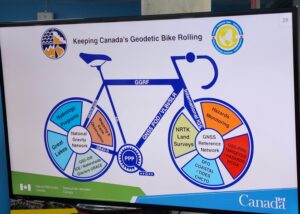
What It Means for the Geospatial Community
Surveyors, GIS professionals, and geomatics engineers depend on stable, accurate reference systems to ensure data compatibility and decision-making precision. The transition to modern datums will improve that accuracy, but only if there is a workforce equipped to implement, maintain, and teach these systems.
The tools may be modern, but without people to run them, the system fails.
The 2025 SaGES session served as both an update and a warning. There is significant progress in reference system modernization. But unless the geodesy crisis is addressed with training, recruitment, and policy commitment, the future of spatial infrastructure in North America will remain uncertain.
It’s not enough to modernize the system. We must also protect the people and knowledge that hold it together.


Be the first to comment