
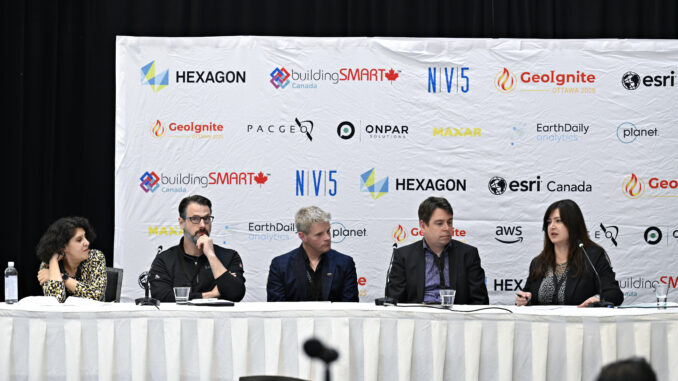
A heavyweight panel of experts explored how Earth Observation (EO) and Artificial Intelligence (AI) can be scaled effectively — not through standalone tools, but through strategic collaboration and shared infrastructure.
Held on May 14, 2025, at GeoIgnite 2025 in Ottawa, and moderated by Bilyana Anicic, President and Principal Consultant, Aurora Consulting, the session was part of the event’s broader focus on geospatial innovation and cross-sector transformation. The panel featured Nadine Alameh, Executive Director of the Taylor Geospatial Institute, who opened with a call to close the gap between research and real-world impact. From industry, Kevin Jones, Vice President of Product at CATALYST (PCI Geomatics), stressed the need to move from prototypes to production-ready pipelines that serve global-scale challenges. Nicholas Kellett, Founder and CEO of Deploy Software Solutions, brought in the software perspective, emphasizing interoperability and agile development cycles. Representing the cloud and AI infrastructure layer, Phil Cooper of Amazon Web Services spoke to the importance of scalable platforms that democratize data access and accelerate insight generation.
Driving Technological and Economic Advancement
The session opened with a discussion on the interplay between geospatial intelligence and artificial intelligence, underscoring the foundational role of collaboration in harnessing the full potential of these tools.
The first major theme addressed how EO and AI can drive technological and economic advancement. Alameh led this section by sharing her experience at the Taylor Geospatial Institute, where the team identified two core priorities: technology and impact. Food security emerged as the chosen impact theme, while artificial intelligence was deemed the crucial technology to explore.
To push the boundaries of what is possible with AI and geospatial data, the Institute launched a partnership with AWS, initiating a generative AI for geospatial challenge. AWS contributed one million dollars’ worth of credits to support the initiative. This North American challenge attracted 55 proposals, each based on collaborative teams combining expertise in cloud computing, geospatial analysis, and subject-matter areas like disaster response. Nadine described a compelling example of a team that developed a generative AI tool to produce disaster recovery plans in real time, highlighting the layers of interdisciplinary collaboration that made the solution viable.
She emphasized that breakthroughs in this space are rarely, if ever, achieved by a single entity. Partnerships enable smaller players to innovate by leveraging cloud infrastructure, foundational data, and shared resources from large organizations such as the Clay Foundation, IBM Research, ESA, and Google. Nadine noted that Google’s geospatial reasoning foundation models have begun to support a range of applications, including population forecasting and mobility analysis, which are now expanding into EO and satellite imagery.
Lowering Barriers to Innovation
Cooper built on Alameh’s points, explaining that AWS aims to remove barriers to entry by enabling companies of all sizes to scale and experiment. He reflected on his 30-year career in the geospatial sector and observed a shift from expensive, centralized satellite data systems to a more democratized, cloud-enabled ecosystem. Today, even lesser-known startups are producing high-impact applications by integrating EO with unstructured data, such as social media, and running analytics in scalable cloud environments.
Cooper discussed how AWS views itself not only as a provider of cloud infrastructure but as an enabler of innovation. The 55 participants in the AWS generative AI challenge came from diverse backgrounds, yet the common thread was their ability to leverage cloud tools and partnerships to overcome technical limitations. One standout case involved the fusion of geospatial and social media data to create real-time insights for emergency management and planning. He underscored that AWS is committed to supporting open data, interoperability, and community-driven progress in EO and AI.
Building Foundational Capabilities
Jones offered the perspective of an established Canadian geospatial company with over 40 years in the industry. PCI Geomatics, (now rebranded CATALYST), has long focused on enabling scientific and technical workflows in EO. Jones pointed out that despite the futuristic promise of EO and AI, much of the work requires meticulous and often “boring but difficult” preprocessing tasks such as geometric alignment, radiometric normalization, and data harmonization.
He explained how PCI Geomatics has modernized its scientific algorithms to be cloud-native, allowing government agencies and commercial satellite providers to process massive amounts of data efficiently. The company works closely with Canadian federal agencies to ensure tools are compatible with multi-source EO data, including optical and radar imagery. According to Kevin, partnerships with cloud platforms like AWS, Azure, and Google Cloud have allowed PCI Geomatics to remain relevant and scalable, without compromising scientific rigor.
Citizen Science, Disaster Response, and Collaborative Innovation
Kellett shared a practical example of collaboration through his company’s involvement in the CSA SMARTER program. Deploy Solutions developed a citizen science-based tool for monitoring floods along the Ottawa River. The app allows citizens to upload geolocated observations, which are then fused with EO data to improve situational awareness for emergency response teams.
To build this tool, Deploy Solutions had to partner with a South African disaster response expert and PCI Geomatics for algorithm development and satellite data processing. Nick emphasized that the tool’s success hinged on interdisciplinary cooperation and respect for the scientific process. He discussed the tension between collecting data from casual users and ensuring data quality, noting that expert partners played a critical role in setting thresholds and standards.
The tool relied on data fusion, drawing from Sentinel, Landsat, Planet, Airbus, and RCM sources, and employed AI for object classification. The project reached Technology Readiness Level (TRL) 5, demonstrating both technical feasibility and a strong proof of concept.
Strengthening International Collaboration
The conversation then shifted to global partnerships. Kellett highlighted a project titled “Field Boundaries of the World,” a public good initiative involving over 20 international experts who are collaboratively building a global layer of agricultural field boundaries. The project’s significance lies in its ability to monitor shifting agricultural patterns globally, an urgent task given the changes driven by climate change.
Jones added that PCI Geomatics actively participates in the Joint Committee on Earth Observation Data Quality (JECAM), a collaborative forum hosted by the USGS. JECAM focuses on harmonizing calibration and validation protocols to ensure data comparability across platforms. This work is essential for integrating EO into decision-making processes that require trusted, standardized outputs.
Adapting to Global Economic Pressures
The panelists were then asked to reflect on how shifting geopolitical and economic pressures are shaping their work. Cooper explained that while trade disruptions and tariffs pose challenges, the geospatial community remains collaborative and adaptive. He pointed to the rise of open data ecosystems and GitHub-based projects as signs that knowledge sharing continues, even amidst global uncertainty.
Kellett echoed this sentiment, noting that the geospatial community balances openness with the realities of national security and proprietary regulation. He expressed concern over the tension between open source and proprietary algorithms, emphasizing the need for transparency in AI models, particularly when products are used in public safety or defense contexts.
Both speakers emphasized that AI models must be explainable and validated. Inaccurate or hallucinated outputs could have serious consequences when decisions involve infrastructure or national security. They called for greater emphasis on provenance, reproducibility, and the documentation of data transformation processes.
Future Trends: Toward a Queryable Earth
In closing, the panel looked ahead to the future of EO and AI. Alameh introduced the concept of the “Queryable Earth,” a vision where users interact with data through natural language interfaces. She described systems that allow users to ask questions, such as when to reinforce a roof based on hurricane patterns, and receive targeted, data-driven responses. Companies like LuxCarta and Danti are developing tools that enable customizable 3D mapping and scenario planning using AI and multimodal data.
Jones highlighted time series analysis as an underutilized but powerful trend. With decades of historical imagery from Landsat and Copernicus, analysts can now detect subtle changes over time and feed this information into predictive models. However, harmonizing and indexing these vast datasets remains a challenge.
Cooper urged the community to better leverage existing datasets. He stated that technology is no longer the main constraint, adoption and application are. AI is making it easier to query, process, and interpret EO data. He encouraged attendees to embrace the potential of existing data archives and use AI to make insights more accessible.
Kellett proposed an operational model for change detection using tipping and queuing systems. Low-resolution, freely available imagery can be used to flag areas of concern, triggering the download of high-resolution commercial imagery for validation. He emphasized the importance of defining thresholds and involving subject-matter experts in setting AI parameters.
The Future of EO and AI
This panel was a rich exploration of the future of EO and AI, grounded in real-world examples and framed by the urgency of climate change, geopolitical complexity, and technological acceleration. The message from all four speakers was consistent: progress in geospatial intelligence depends on collaboration. Whether through open data, multi-stakeholder partnerships, or cross-disciplinary projects, the only path forward is together.
The panelists offered a compelling call to action for government agencies, private companies, researchers, and entrepreneurs alike. As the data deluge continues and AI capabilities expand, the imperative is not simply to innovate, but to do so responsibly, transparently, and inclusively.


Be the first to comment