
Read the French version of this article here
Following his 2024 Sam Masry Award, Denis Hains is once again recognized, this time with Université Laval’s highest academic honour, celebrating a life devoted to the blue of our blue planet.
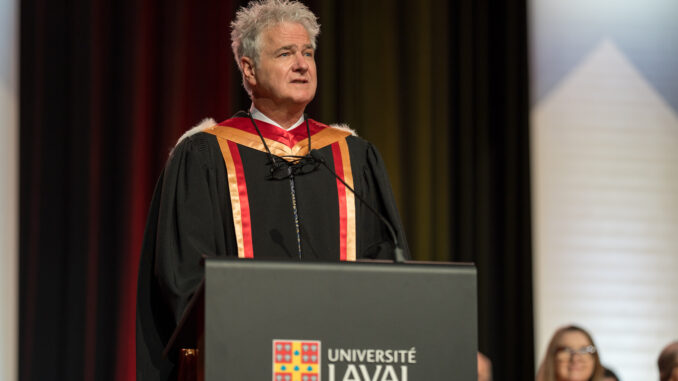
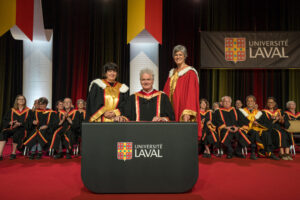
June 25th, 2025, Université Laval conferred an Honorary Doctorate (Doctorat Honoris Causa) in Geomatics Sciences upon Denis Hains, celebrating a lifetime of leadership and advocacy in hydrography, ocean mapping, and what he has been advocating for the hydrospatial domain (Official Université Laval Annoucement link: here). This distinction comes just a year after Hains received the “2024 Sam Masry Award” from the Canadian Hydrographic Association (CHA), a recognition documented in a two-part series article last year that explored his professional journey and lasting impact on the marine geospatial community.
The honour at Université Laval carries a deeper emotional note for Hains, who graduated from the same institution 42 years ago. In her tribute speech during the convocation ceremony, Professor Sylvie Daniel, Director of the Department of Geomatics Sciences, described his life’s work as something more than a career, « En somme, Denis Hains, ton parcours est à l’image de l’océan : vaste, profond et en perpétuel mouvement. »
(“In short, Denis Hains, your journey is like the vast, deep and constantly moving ocean.”)
In this exclusive conversation, Denis Hains reflects on what this honour means to him, how his philosophy has shaped his contributions, and the future he envisions for the hydrospatial sciences. Woven throughout are echoes from his powerful commencement address, which he titled, had he been asked, “Human Being 101.”
Congratulations on receiving an Honorary Doctorate “Honoris Causa” from Université Laval, a deeply meaningful recognition of your lifelong contributions. What does this honour represent to you, both personally and professionally, at this stage in your journey?
I am profoundly overwhelmed and deeply honoured by this unexpected distinction. Never in my wildest dreams did I imagine receiving an Honorary Doctorate. This exceptional recognition of my contributions to the Geomatics Sciences far exceeds anything I could have ever envisioned. To receive this honour from Université Laval, a globally respected francophone institution and my alma mater, 42 years after graduating fills me with immense pride and heartfelt gratitude.
I have never sought recognition, and certainly never expected anything of this magnitude. It is a deeply humbling validation that reignites my passion to keep advancing and inspiring hydrospatial and geospatial innovation worldwide. As I said during the ceremony, “life goes by fast, make the most of each moment.” Receiving this distinction reminds me I may be getting older, but I am far from done.
From serving as Hydrographer General of Canada to leading H2i Inc. and contributing to Seabed 2030 and other initiatives, your career has shaped ocean mapping nationally and internationally. What do you consider your most enduring contribution to the hydrospatial domain?
When I look back, I believe my most lasting contribution is helping to shift the way we think about ocean mapping, from seeing it as primarily bathymetric data collection to understanding it as a much broader and integrated approach. Hydrospatial sciences embrace the entire “blue” of our blue planet sciences, the water column, sub-seafloor, ocean surface, coasts, flood zones, and more.
Professor Daniel said something that truly touched me: “You broke away from established paths and charted original directions.” That’s exactly what I tried to do, redefine what hydrography could become. Today, hydrospatial thinking supports better-informed decisions, sustainable resource management, and global collaboration. That shift in perspective is what I’m most proud to have contributed to.
You’ve championed the hydrospatial field for years. Do you see this Honorary Doctorate as a sign of broader recognition for Hydrospatial sciences in academic and policy circles?
Absolutely. While it’s a great personal honour, I see this recognition as a powerful signal that hydrospatial sciences are gaining the traction they deserve, in academia, policy, industry and practice.
If my role as a sort of ambassador has helped open minds to this evolving science, I’m deeply grateful. It reflects a growing awareness that understanding our oceans, coasts, and inland waters is essential not just for scientists, but for our collective future. As I often mentioned it, “the Earth has two lungs, one green, the other blue.” Although it is more than twice as big as the green one, the blue one has long been underappreciated. That’s starting to change.
You’ve spent much of your career building bridges between government, academia, industry, non for profit organizations and stakeholder communities through initiatives like the Canadian Ocean Mapping Research and Education Network (COMREN). What leadership lessons would you share with the next generation of hydrospatial scientists?
Collaboration is everything. Real progress happens when we listen, when we engage across boundaries. No one sector, not government, academia, nor industry and non for profit organizations, can solve today’s challenges alone.
My advice to the next generation? Stay curious. Build your network, keep nurturing and expanding it. Value relationships as much as results. In my commencement address, I spoke about the importance of remaining true to your values and being active, not just reactive. “Have a strategy. Be patient. Be tenacious. And always remain kind.”
Leadership isn’t about having all the answers, it’s about bringing people together, building trust, respect and creating space for shared solutions. That’s how we create momentum and move forward with impact.
This recognition comes at a time of rapid transformation through Artificial Intelligence (AI), automation, and open data. What excites you most about the future of the hydrospatial field, especially Canada’s role in it?
This is an exciting time for ocean mapping and the Hydrospatial Domain! The convergence of AI, Aerial, Surface and Underwater Autonomous platforms, and open data is transforming what’s possible making it faster, smarter, and more inclusive. What excites me most is the shift from limited data sets to connected, near real-time, real-time, intelligent systems that can truly support global ocean measurements.
Canada has a powerful voice to bring to the table. With our vast marine territory, three oceans including the challenges of the Arctic, strong scientific community, and deep-rooted commitment to collaboration, we’re uniquely positioned to lead, not just in technology, but in shaping sustainable approaches to ocean mapping in the Hydrospatial domain.
I’m thrilled by the potential ahead, and particularly proud to see Canada stepping forward with both innovation and purpose. The next wave of progress is already here, and we have everything needed to ride it with impact.
What message would you like to pass on, not only to the hydrospatial community, but to anyone reading, about understanding and protecting the blue of our blue planet?
I want to contribute further not just to the Hydrospatial community, but to everyone who shares this planet and especially the blue of our blue planet.
My message is simple but vital: What lies beneath the surface matters, even if we mostly can’t see and touch it. The ocean is alive. It’s a dynamic system that sustains all of us.
I said in my speech that success in life isn’t defined by titles or paychecks, but by how you stay anchored to your family and values. That applies to the ocean too. We need to stay anchored to it, to measure it better, protect it more thoughtfully, and build a relationship based on understanding, not blind exploitation.
We all have a role to play in that stewardship. Everyone!
***TAKE THE TIME TO WATCH Denis Hains’ full tribute and commencement address can be viewed on YouTube at this link, starting at the 00:59:20 mark. Subtitles are available in English and other languages of your choice via the YouTube “Close Captioning” and “Settings” ideally on desktop as it does not work always well on smart phone.
Be the first to comment