

The Canadian government has released its Defence Industrial Strategy.
It is being presented as a procurement reset, an industrial jobs plan, and a commitment to rebuilding Canada’s military capacity. It is all of that. But as I read it, what I see is something deeper.
This is not only about ships, aircraft, and ammunition. It is about sovereignty in an era where infrastructure is digital, conflict is technological, and control is defined by who owns and governs the systems beneath everything else.
If that is the frame, then geospatial and geomatics are not peripheral. They are foundational.
More than a year ago, I wrote that Canada can no longer pretend digital sovereignty isn’t at risk. At the time, that argument was framed around cloud dependency, foreign jurisdiction over data, and the quiet erosion of national control over digital infrastructure.
This new defence strategy makes that concern unavoidable.
Every major commitment in the strategy depends on spatial systems.
You cannot increase maritime fleet serviceability without assured Arctic positioning, bathymetric mapping, and persistent satellite monitoring. You cannot expand aerospace capability without precise orbit determination and sovereign ground control. You cannot deploy drones at scale without resilient PNT, sensor fusion, and trusted spatial reference frameworks. You cannot secure critical minerals without modern subsurface mapping and national geodetic control.
And you cannot speak about sovereign defence intellectual property while core spatial data, digital twins, AI training sets, and operational analytics are hosted in foreign data centres governed by foreign law.
Sovereign data centres are no longer a commercial preference. They are strategic infrastructure.
Where defence spatial data resides matters.
Who has legal jurisdiction over it matters.
Whether Canadian courts or foreign legislation ultimately govern access to that data matters.
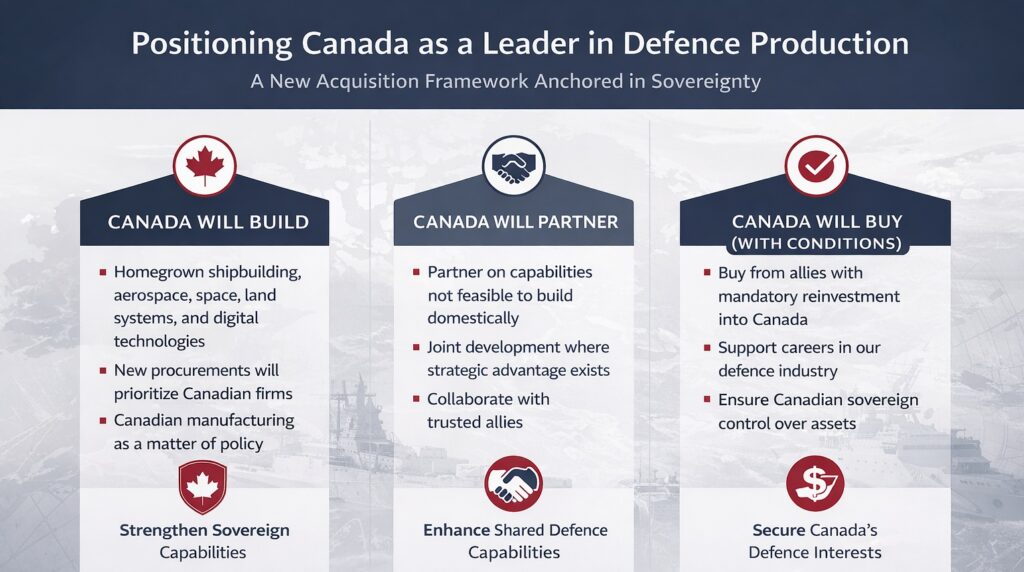
The strategy emphasizes building in Canada, partnering with trusted allies, and buying with conditions that protect national control. That logic must extend to digital and spatial infrastructure — including secure, sovereign data hosting environments for defence and geospatial systems.
At present, Canada lacks modern geodetic observatories. We remain dependent on external Earth orientation parameters. GNSS timing and orbit precision rely on foreign systems. Our cloud backbone is dominated by foreign hyperscalers. That is not abstract. It affects satellite accuracy, Arctic operations, InSAR reliability, autonomous systems, defence analytics, and data governance.
We are committing over half a trillion dollars to defence transformation. If spatial infrastructure and sovereign hosting are not embedded in that transformation, we risk rebuilding the visible layer of defence while leaving the invisible layer externally defined.
Artificial intelligence, drones, space, quantum, and cyber are highlighted as priority domains. All are spatially dependent. AI requires structured geospatial data. Drones require positioning integrity. Space assets require geodesy. Digital twins require secure domestic hosting and governance. None of this scales without coherent national geospatial architecture — and infrastructure physically located and legally anchored in Canada.
The creation of the Defence Investment Agency, BOREALIS, and the Drone Innovation Hub creates an opening. This is the moment to recognize that geospatial and digital sovereignty are enabling infrastructure. They are the reference framework for everything else.
Globally, this shift is already underway. Earth observation markets are consolidating around dual-use security systems. GNSS interference is no longer confined to conflict zones. Sovereign cloud environments are being built explicitly for defence and critical infrastructure. Digital sovereignty has moved from theory into execution.
For Canada’s geospatial sector, this is a structural inflection point.
Organizations working in positioning, mapping, Earth observation analytics, Arctic surveillance, digital twins, and navigation resilience are now operating at the centre of national strategy. The opportunity is significant. So is the responsibility.
Sovereignty does not mean isolation. It means control. It means knowing where your data resides. It means investing in geodesy. It means resilient PNT. It means sovereign data centres capable of hosting defence-grade spatial systems. It means coordinated national spatial governance.
We have been talking about this for some time. The warning signs were visible well before today.
This strategy confirms that the issue is no longer theoretical.
Buy Canadian must apply to geospatial infrastructure. That includes sovereign geodetic investment, national GNSS resilience planning, defence-grade Canadian cloud environments, and a coordinated federal geospatial strategy linking defence, industry, and the public interest.
Security and prosperity are intertwined. The strategy says so directly. Geospatial sits precisely at that intersection.
If Canada is serious about strategic autonomy, we must stop treating spatial systems and digital infrastructure as background technical plumbing. They are part of the core architecture of sovereignty.
This is not another funding cycle.
It is a defining moment for geospatial in Canada.


Be the first to comment