
Aligning NOC and CIP to strengthen visibility, education and labour planning
This article is published as submitted as part of the Canadian Geospatial and Geomatics Advisory Forum at GeoIgnite 2026. It reflects ongoing national discussions on workforce visibility, education alignment, and the future of Canada’s geospatial capacity.
We need you! At the very end of this article, we invite you to complete a short questionnaire that will help guide the discussions on May 11.
Across Canada, geospatial technologies have become essential infrastructure. Geographic Information Systems (GIS) now support climate adaptation, housing development, emergency response, public health, transportation planning, natural resource management, and the transition to a low carbon economy. Despite this rapid expansion, the federal frameworks used to describe geospatial education and employment no longer reflect the realities of the sector.
Canada’s National Occupational Classification (NOC) provides the standard for organizing labour roles. The Classification of Instructional Programs (CIP) is used to describe what is taught across post-secondary education. Together, NOC and CIP shape labour market intelligence, workforce development, funding decisions, education programming, immigration pathways and public understanding of career options. When geospatial education and occupations are inaccurately classified or poorly represented in either system, the sector becomes difficult to measure. When it becomes difficult to measure, it becomes difficult to support.
This challenge is not abstract. It has direct consequences for students, educators, employers, and policymakers across the country.

What the NOC misses about modern geospatial work
As Academic Chair at the Nova Scotia Community College Centre of Geographic Sciences (NSCC COGS), I see this disconnect year over year. Our geomatics graduates enter high demand careers with applied training in surveying, geomatics engineering technology, marine geomatics, GIS, cartography, remote sensing, spatial data analytics, and information technology. Yet many of the roles they are trained for are difficult to locate within the current NOC system or are grouped under titles that no longer describe current skills needed in the workforce. This affects graduates as they search for job codes, prospective learners seeking guidance and funding, and employers who struggle to classify positions that fall outside outdated occupational categories. It also affects labour market intelligence at a national level, where workforce demand is underestimated simply because the work is not clearly named.
The geospatial sector includes professionals who collect, analyze, visualize, and apply spatial information in increasingly complex digital environments. These include GIS analysts, geospatial developers, remote sensing specialists, cartographers, survey and mapping technicians, UAV operators, and geospatial data scientists. Yet the NOC still reflects a narrower, more traditional picture shaped by legacy drafting and mapping roles.
A 2015 environmental scan prepared for Natural Resources Canada estimated that the geomatics industry comprised approximately 2,450 firms and contributed more than $2.3 billion dollars to Canada’s gross domestic product in 2013. Since then, the sector has expanded significantly with the rise of cloud GIS, spatial analytics, GeoAI, digital twins, and drone-based data acquisition. Professional networking platforms show thousands of Canadian professionals with GIS or geospatial in their titles, with many more whose work relies on geospatial skills even when job titles do not. The NOC has not kept pace with this evolution.
The hidden impact of CIP misalignment
While the NOC governs how work is classified, the CIP system governs how education is counted. CIP codes standardize how fields of study are identified and reported across the post-secondary system. Statistics Canada maintains the Canadian edition of CIP aligned with current international standards. For example, the NSCC GIS Program is recorded with a CIP code of 45.0700.
Within the current CIP framework, many GIS programs are recorded under social sciences rather than under science, technology, engineering, and math fields. This matters because Immigration, Refugees and Citizenship Canada now links eligibility for the post graduate work permit for many non degree programs to an approved list of CIP codes in fields tied to long term labour shortages. IRCC uses this linkage to steer enrollment toward high need sectors, to limit study to work pathways in fields with weaker employment outcomes, and to support long term economic integration. Current eligible categories include health care and social services, STEM, skilled trades, transport, agriculture and agri food, and an education list that includes early childhood and special education. When a GIS program’s six digit CIP is not on the eligible list at the time of the study permit or PGWP application, graduates may be ineligible for a PGWP, which reduces Canada’s capacity to retain geospatial talent at the very moment colleges and universities are reporting program fragility and closures.
Improving CIP clarity does not require reinventing the system. It requires precise documentation of where geospatial education resides within existing structures, and coordinated engagement with Statistics Canada and education partners so that program classifications reflect contemporary practice and skills.
Real consequences for planning, students, and employers
When occupational and instructional classifications fail to align with real world practice, the impacts cascade. Labour market intelligence becomes unreliable because geospatial roles are not clearly identified, leading to persistent underestimates of workforce demand and weakened economic planning. Students receive limited or misleading guidance and may assume that GIS leads only to a narrow set of traditional technical roles rather than a diverse range of careers across public and private sectors. Critically, skills matching and career navigation tools such as Employment and Social Development Canada’s Occupational and Skills Information System depend directly on accurate and up to date NOC codes to surface job options, required skills, and career pathways. When geospatial work is poorly represented in the NOC, these tools cannot reliably connect learners, job seekers, and newcomers to real employment opportunities. Employers, in turn, face recruitment, workforce planning, and immigration challenges when positions do not align cleanly with NOC codes embedded in federal programs and systems.
National priorities depend on geospatial capacity
Canada’s strategic priorities increasingly depend on accurate spatial data and the professionals who manage it. The nationwide transition to Next-generation 9-1-1 relies on GIS for call routing, boundary management, and emergency coordination. Climate adaptation initiatives require advanced remote sensing and spatial analytics. Housing and infrastructure projects depend on digital twins, 3D modelling and land use intelligence. Defence and national security activities rely on geospatial intelligence and real time situational awareness. At the same time, advancing Truth and Reconciliation requires strong geospatial capacity to support Indigenous data sovereignty, land stewardship, rights recognition, and meaningful participation of Indigenous Nations in decision making. Taken together, these realities show that Canada’s geospatial capacity is core national infrastructure and belongs at the centre of planning and investment. Our workforce frameworks must reflect that reality.
Leading a coordinated national approach
To address these challenges, NSCC COGS and Esri Canada are convening a national working group that brings together post secondary institutions, professional associations, key industry sector employers, and government agencies. The goal is to prepare a comprehensive submission to ESDC that addresses NOC modernization and its alignment with geospatial education pathways.
As part of this effort, NSCC and Esri have launched the C-Geo Project, Coalition for Geospatial Work, to modernize occupational definitions and review CIP and OaSIS representation so that GIS programs are accurately and appropriately captured. The C-Geo Project team is planning engagement with Statistics Canada to prepare a formal submission that updates CIP and OaSIS placement for GIS programs, recognizing their STEM foundation and direct connection to Canada’s workforce needs.
The proposed approach distinguishes between technical roles focused on data acquisition, analysis, visualization and field operations, and professional roles focused on management, enterprise governance, and strategic leadership. Illustrative occupations for inclusion or revision include geospatial data scientist, remote sensing analyst, UAV survey technician, GIS developer, GIS manager, and cartographic technician within a broader framework that reflects the full diversity of geospatial work.
Building momentum through national dialogue
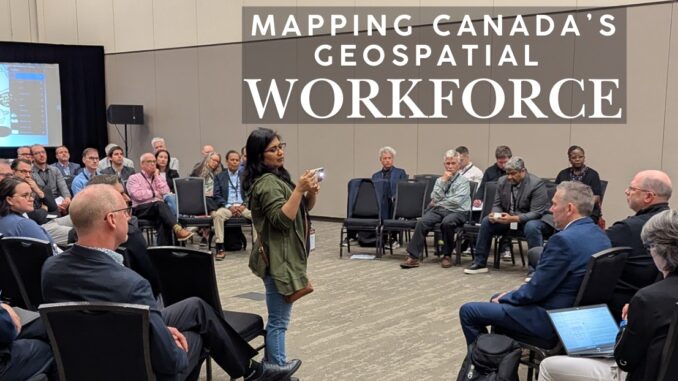
This work connects directly to national conversations already underway across Canada’s geospatial community. On May 11th, the Canadian Geomatics and Geospatial Forum will open GeoIgnite 2026 in Ottawa with a full day program focused on workforce visibility, standards, procurement realities, interoperability, and Canada’s long term geospatial needs.
The forum is supported by Esri Canada as part of its participation in GeoIgnite. A central element is the Canadian Geospatial and Geomatics Advisory Forum Workforce Visibility and the National Occupational Classification, a participatory session that will examine workforce development and the representation of geospatial professions within the NOC framework. The discussion will be co facilitated by Monica Lloyd and Frédéric Blouin Michaud and will be informed by a community wide survey conducted in advance.
Call to contribute your voice
What can you do now? Share your perspective on geospatial education, workforce needs, and classification gaps by completing the survey below. Register for and attend the Canadian Geospatial and Geomatics Advisory Forum on May 11 in Ottawa to participate in the discussion and help shape practical next steps. Later in May, survey highlights and session notes will be shared, and interested members will be invited to join the working group that will prepare the coordinated submission to Statistics Canada for CIP clarity and to ESDC for alignment with NOC. If you would like to contribute more directly, or if you are interested in being on the advisory board, email [email protected].
Together, these conversations underscore the urgency of coordinated national action. Modernizing how geospatial education and work are defined within CIP and NOC is essential to strengthening workforce visibility, supporting learners, enabling employers, and ensuring Canada has the geospatial capacity required for the challenges ahead.




Be the first to comment