

This interview is part of our GoGeomatics series on Canada’s infrastructure moment and its impact on the geospatial/Earth Observation industry.
Canadian startup Wyvern is carving out a leadership position in high-resolution hyperspectral imaging with a growing constellation of small satellites powered by deployable optics technology. CEO and Co-Founder Chris Robson talks about the company’s rapid progress, the competitive global landscape, and why building a space company in Canada can feel like “starting on hard mode.”
From the realities of selling into global markets to navigating Canada’s risk-averse procurement culture, Robson offers a frank assessment of the hurdles facing space startups at home. He explains how procurement rules, regulatory barriers, and limited early-stage investment can hold back innovation — even as Canadian talent, reputation, and export support open doors abroad. In this conversation, he also shares his vision for the future of Earth Observation, and why hyperspectral data must become as frictionless and ubiquitous as GPS to truly transform decision-making.
Let’s start with Wyvern’s constellation. What’s the current status, and where is it going?
At this stage, our constellation comprises three satellites that deliver five-meter hyperspectral imagery. We also have a fourth in orbit that will be ready in the fall, plus another on order and several more planned within the year.
It’s moving along nicely, and we’re on track to have a constellation of tens of satellites in the next few years. We’ll have six in space within the next year, and in three years, we plan to have between 10 and 20 satellites in orbit.
Your core technology is based on deployable optics, which enable high-resolution hyperspectral imaging from small satellites. What makes this approach unique, and how does it impact the insights you can deliver?
The key innovation is that deployable optics allow us to achieve a much larger aperture on a much smaller satellite than would otherwise be possible. That means we can launch a satellite costing $10–20 million that would historically have cost hundreds of millions.
In the private sector, there’s only so much hyperspectral data available. Who are your competitors right now?
When it comes to companies that have launched hyperspectral satellites, Planet with Tanager is the most well-known — but I wouldn’t consider them a direct rival because it’s a different type of hyperspectral imaging. They’re at 30 meters; we’re at five meters. They cover more bands and shortwave infrared, while we currently focus on high-resolution visible and near-infrared wavelengths.
Our more direct competitors are Pixxel, Kuva, and Orbital Sidekick. We were the first to have five-meter hyperspectral satellites in orbit. Pixxel recently launched a similar capability; Orbital Sidekick has had satellites in orbit longer than us — theirs are eight meters, not five, but they do shortwave infrared. Kuva operates at 25 meters GSD and only recently launched their first commercial hyperspectral satellite.
Where are your primary customers, and which sectors and regions are you focused on?
More than half of our business is in the commercial market, with the rest largely government. Sector-wise, it’s largely defense, agriculture, and forestry, with growing interest from energy, mining, financial markets, and insurance. Growth could go either way — I expect government (defense and civil) to become the majority, but I have more commercial users than I initially expected.
Geographically, our customers are truly global — on every continent, including the US, Canada, Europe, South America, India, Australia, and across Asia.
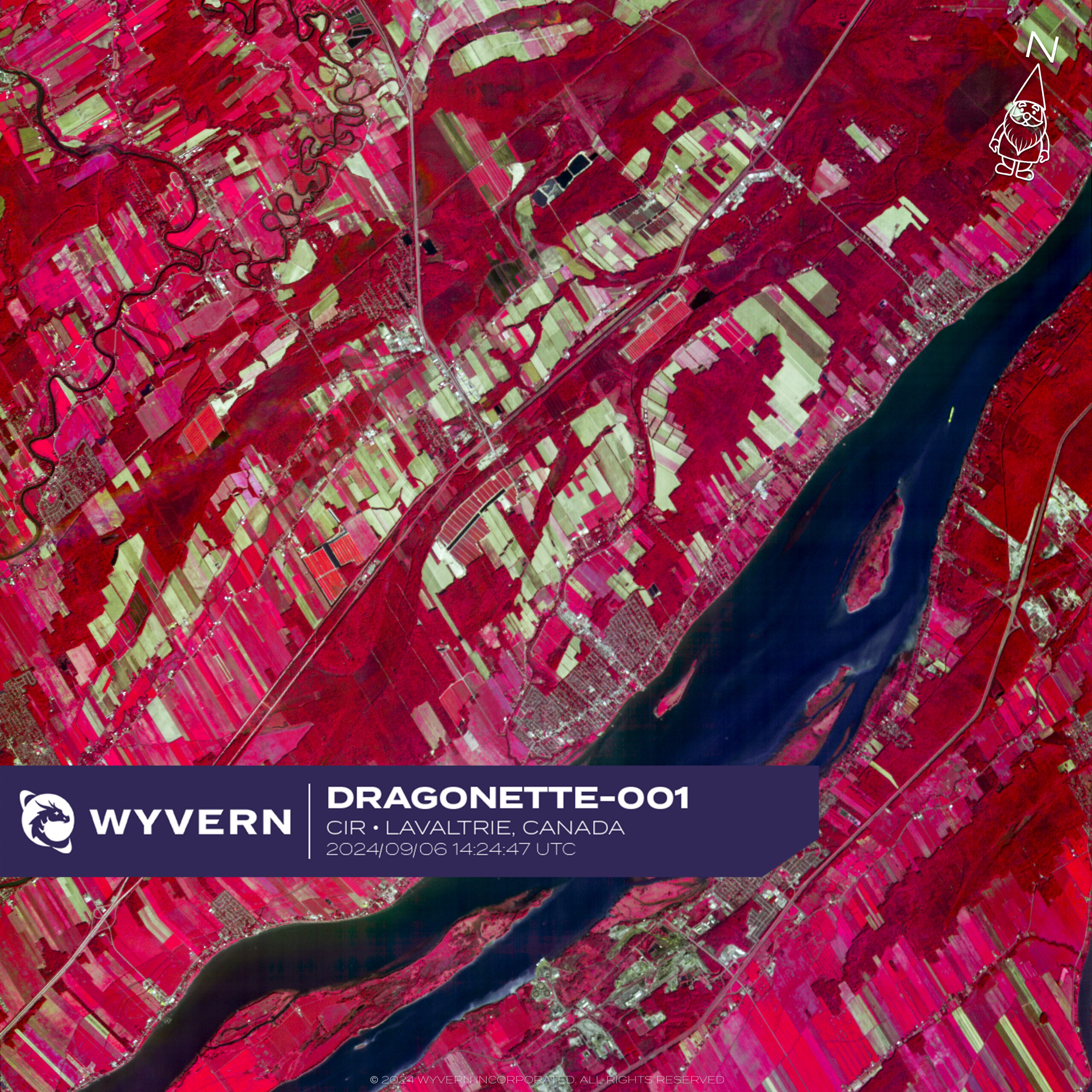
Hyperspectral data is rich and complex, making it challenging to work with. Are you investing in analytics tools or platforms to make it more accessible? And how are you approaching partnerships in this space?
Right now, our focus is on imagery rather than analytics or custom services. It’s not raw imagery, but yes, imagery is our primary product. To help users, we’ve built a knowledge base with examples and made our open data program available, allowing people to learn about the capabilities of hyperspectral data.
We also have over 20 analytics partners, value-added resellers, and direct channel partners who leverage our data to create useful analytics products. We regularly establish new partnerships across both commercial and defense sectors.
Do you see a role for Wyvern in the emerging space-to-cloud ecosystem, where hyperspectral data is fused with SAR, optical, and IoT streams?
Yes — that’s where the market is going. You have to be able to fuse data products. Even today, we layer products to get an answer. There’s no silver bullet dataset.
You mentioned the open data program — why did you decide to make some of your commercial hyperspectral imagery available under a Creative Commons license?
We didn’t open all of our data — just a subset. The reason was to educate the industry on hyperspectral data and different use cases. People don’t have access to hyperspectral data right now, and historically imagery has been behind expensive paywalls. We wanted to give people the opportunity to experiment and learn.
So far, we’ve had great uptake. A number of people have used our data to demonstrate different use cases, and some who tried our open data have become customers.
You’re one of the few commercial satellite companies headquartered in Canada. What are the biggest advantages and barriers to growing from here?
Canada offers some real strengths, starting with a deep pool of talent and a strong export development function in government that helps us build relationships globally. Our international reputation as a neutral, trusted partner also helps — people like working with Canadians.
That said, being a space startup in Canada is like starting a business on hard mode. In the US and Europe, startups can win contracts even before launching capabilities, through multiple contract vehicles and strategies. We don’t have that here, which hinders ecosystem growth and gives competitors an advantage.
Canada’s procurement culture is also a challenge. We pride ourselves on a fair process open to foreign companies, but foreign governments prioritize their own businesses. This often means Canadian startups lose out at home while being disadvantaged abroad.
The regulatory environment here is another hurdle — outdated policy and limited resources. And culturally, procurement here doesn’t do a great job of supporting innovation.
Procurement has come up as a challenge for Canadian space companies. Can you elaborate on the specific issues you’ve encountered?
One of the biggest challenges is the difficulty in engaging with the government during the early stages. If you want to discuss your product with a department, it can be perceived as biasing them against competitors, which can be frustrating if you’re simply trying to understand their problems or offer assistance in an emergency. It’s challenging to have that conversation without going through an RFP, even if the purchase would fall below the RFP thresholds.
The investment environment is another challenge. Canadian investors are not typically space investors, and they tend to take fewer big bets than their American counterparts. Part of it is cultural, part is access to capital. Government programs also don’t always put money where their mouth is. For example, Business Development Canada won’t loan to a startup without a personal guarantee.
Government-backed VC funds exist here but tend to back later-stage companies, while Canada needs more support for earlier stages.

The system supports incumbents, making it difficult for new players. Has it gotten worse over time?
We do support incumbents, and we often don’t look inside Canada for new capabilities, especially in defense.
Another issue is that all of Canada’s space ecosystem is in Quebec and Ontario, including the Canadian Space Agency. That proximity can feel like it leads to preferential access to grants.
Culturally, we’re risk-averse in grants. We require much more validation and evidence than the US before funding something, even if it’s already been proven elsewhere. If we want to back innovation, we need to make bets on things that aren’t yet fully proven, and back startups as well as incumbents.
It’s striking how often incumbents win CSA money, while startups struggle. Proposals here are met with skepticism because of perceived risk, even when they’re realistic and have been proven to TRL 5 or 6 elsewhere.
The road ahead for Wyvern — what does success look like in five years? Larger constellation? Analytics layer?
For us, success means worldwide coverage of hyperspectral data for purchase and providing the highest-quality data to the world. I’d like Wyvern to be recognized as the Canadian space company that has become the world’s leading hyperspectral data supplier, and as a global leader in harnessing the capabilities of hyperspectral imaging. There are a few more plans I’m not yet ready to discuss, but that’s the vision.
As hyperspectral becomes more accessible, what’s the next frontier — technically or commercially?
For Wyvern and hyperspectral, the next frontier is fusing hyperspectral data with other datasets, especially ground truth data, and turning that into something AI can use proactively rather than reactively.
Right now, Earth observation is reactive and siloed by data type. The business models we use aren’t sustainable. A lot changes once we reach the frontier of fusion and AI.
I think there’s a reckoning coming for Earth observation. Many businesses have focused on a traditionally small market — government and defense — without building good commercial models. Until customers can use hyperspectral as a key dataset without even thinking about it, like GPS, we won’t transform the industry.
And until it’s that frictionless — until the end user doesn’t care that it came from a satellite, doesn’t care about tasking, just gets the value — we won’t unlock the full potential. Currently, the public perception of EO companies that have gone public isn’t great; they don’t view it as a booming business. We need to change that.




Be the first to comment