
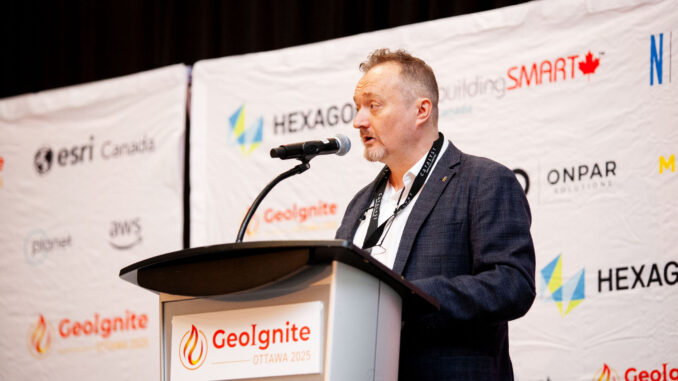
“We’ve done it before. And we can do it again.”
Jonathan Murphy, Founder and CEO of GoGeomatics Canada, concluded his keynote at GeoIgnite 2025 with this powerful reminder of Canada’s historical legacy. His address, “Beyond Borders: Charting Canada’s Geospatial Future in a Shifting World,” wasn’t just about the geospatial sector — it was a call for action, challenging Canada to reclaim its leadership role on the global stage and secure its sovereignty in an uncertain world.
History Lessons and Hard Truths
Murphy began his speech by framing the current moment in historical context, drawing parallels to moments when Canada has had to step up in the face of global uncertainty. He asked, “Why is Canada still waiting for permission to lead?”
He emphasized how Canada has been forced to confront trade tensions and growing geopolitical risks. These shifts, Murphy argued, are not just issues for businesses—they are directly tied to the geospatial sector, which supports national infrastructure, climate monitoring, and emergency response systems.
The message was clear: Canada must stop relying on foreign-controlled platforms for critical geospatial systems. We need to take control of our own infrastructure and data.
The Case for Canadian Sovereignty
A core message in Murphy’s speech was the need for Canada to take greater control over its own geospatial infrastructure and capabilities. He emphasized the importance of building sovereign data systems, not as a rejection of foreign technologies, but as a necessary step for Canada to strengthen its own national security and resilience.
“We must ask ourselves,” Murphy said, “The next time a crisis hits — whether it’s environmental or geopolitical — who controls the data? Whose systems do we depend on? And what happens if those systems become unavailable?”
Murphy argued that Canada has the expertise and the potential to lead in these areas. He called for a greater focus on building our own infrastructure, giving Canada the independence it needs to thrive in an increasingly uncertain world.
Canada’s Legacy and Leadership
Murphy highlighted Canada’s rich legacy in geospatial and technological innovation, urging the audience to draw inspiration from the country’s history of bold leadership. He reminded the crowd of Canada’s significant achievements in the global geospatial landscape:
- “We are the home of Roger Tomlinson, the father of GIS. It started right here in Ottawa.”
- “We created the world’s first digital atlas.”
- “We developed RADARSAT, establishing Canada as a leader in Earth Observation.”
- “We pioneered space robotics — the Canadarm is not just national pride, it’s a critical part of global space infrastructure.”
“This is our track record. This is who we are,” he said, emphasizing that Canada has always been a leader in geospatial and space technologies. The challenge, he argued, is not in our capability — but in our willingness to take risks and invest in the future.
Speaking Up and Showing Up
Murphy didn’t just focus on Canada’s history; he called for action today. He urged the geospatial community to stop sitting on the sidelines of international discussions about AI, geospatial intelligence (GEOINT), and Earth Observation strategies.
“Canada has world-class talent,” he stated, but added, “We won’t be invited to lead. We need to show up, speak up, and take our place at the table.”
He emphasized that leadership requires courage, and Canada must step forward and take a proactive role in shaping the future of global geospatial standards and technologies.
The Rideau Canal as a Metaphor for Bold Action
Murphy used the example of the Rideau Canal to highlight Canada’s history of bold, long-term investments in national security and infrastructure. He reminded the audience that the canal, built in the aftermath of the War of 1812, was a massive undertaking that required thousands of workers and resulted in the loss of many lives. However, it was built because the people of Canada understood the importance of securing the future.
“The Rideau Canal was built because when the security of this land was at stake, the people who would become Canada acted,” Murphy said. “They invested. They built for the long-term good of future generations.”
He drew a parallel to today’s challenges — data, infrastructure, and digital systems. “We are facing new challenges: data, infrastructure, and digital systems. And once again, the question stands: Will we build?” he asked.
Murphy stressed that leadership and bold action have always defined Canada during crucial moments in history. “This is one of those times,” he declared.
Looking Forward
Murphy ended his keynote with a call to action for the Canadian geospatial sector: “We have the talent. We have the technology. We have the history. What we need now is belief—in ourselves, in each other, and in the value of building a geospatial future that reflects who we are as a nation.”
He urged the audience to embrace risk, accept failure as part of the process, and take control of the global conversation about geospatial innovation. Canada, he emphasized, must stop waiting for an invitation to lead. The time to act is now.
Key takeaways:
- Canada’s overreliance on foreign data infrastructure is a growing vulnerability that must be addressed.
- Sovereign geospatial capacity is crucial for national security, climate action, and economic resilience.
- The Canadian geospatial sector must take on global leadership roles, particularly in the face of shifting international dynamics.
- Collaboration and innovation will be the cornerstones of Canada’s next phase of geospatial development, driven by resilience, equity, and bold action.
Jonathan Murphy didn’t just open GeoIgnite 2025 — he set the tone for the entire event. His keynote was a call for the Canadian geospatial community to think bigger, act bolder, and take its rightful place as a leader in a more resilient, self-determined future.


Be the first to comment