

This interview is part of our GoGeomatics series on Canada’s infrastructure moment and its impact on the geospatial/Earth Observation industry.
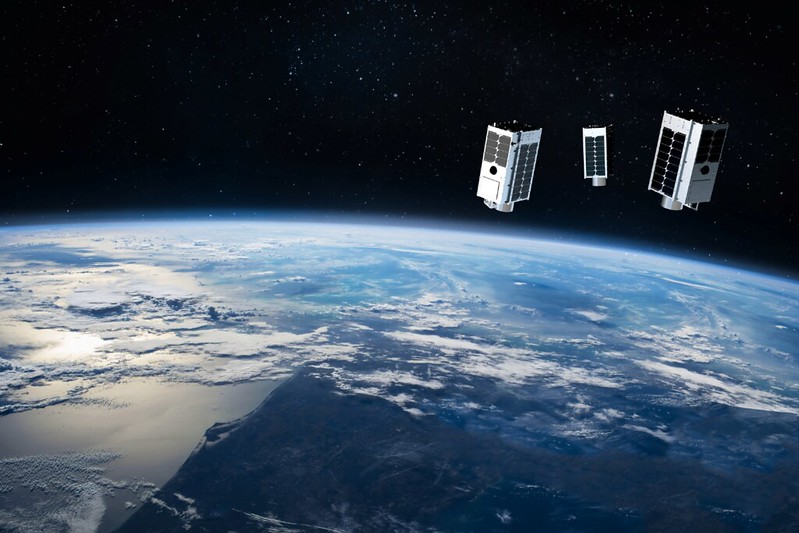
From its first satellite launch in 2016 to its recent acceptance into the International Charter on Space and Major Disasters, GHGSat has grown into a global leader in emissions monitoring. Montreal-based and internationally recognized for its focus on methane detection and greenhouse gas monitoring, the company has built a reputation for delivering high-resolution, facility-level emissions data once thought impossible from orbit. Today its satellites and airborne sensors are used by industries under pressure to cut methane, by regulators and governments enforcing climate policy, and by international partners responding to environmental risks.
For Canada, GHGSat’s trajectory raises bigger questions about how homegrown space firms scale, compete, and support national priorities ranging from climate resilience to infrastructure risk management. In this conversation, CEO Stéphane Germain reflects on the company’s rise, the structural barriers facing Canadian space companies, and the growing importance of emissions intelligence in a more contested and climate-constrained world.
Canada is embarking on its largest infrastructure investment in decades, with new commitments to civil preparedness, industrial capacity, and core infrastructure. Do you see this as a nation-building moment, and what role will geospatial intelligence play?
Canada is poised to take on a more prominent leadership role on the global stage. In terms of the space industry, Canada tends to punch above its weight – we accomplish a lot more with fewer resources. If executed well, this could certainly be a moment for Canada to build a global economic advantage in the geomatics and infrastructure sectors.
We are very interested in seeing how this federal commitment plays out in practice. While I don’t know the specifics of the projects that will take shape, what I can tell you is that geospatial intelligence is foundational to the sectors that Canada is interested in pursuing.
How does GHGSat’s mission align with Canada’s national priorities, such as climate resilience, infrastructure planning, and sustainable development?
GHGSat’s work is motivated by a desire to see emissions being reduced systematically and permanently. As Canada has consistently been at the forefront of policy and regulations aimed at managing and reducing emissions, we naturally align with these priorities.
Our data is multi-purpose – it can be used for a variety of situations outside of climate. For example, GHGSat’s data was recently accepted into the international Charter: Space and Major Disasters. While Canada was already a proud member, GHGSat’s role as the first Canadian data provider in the Charter strengthens Canada’s role. Through the Charter, government agencies worldwide will now be able to leverage GHGSat’s methane data to assess the health of critical infrastructure and identify potential risks to public safety if the infrastructure is damaged.
As natural disasters become more frequent and complex in a warming world, this presents a great opportunity to leverage Canadian innovation in understanding infrastructural risk. Emissions data can also be useful in driving accountability and promoting sustainable practices (for example, implementing a gas collection system at a landfill effectively).
Can you share examples where GHGSat’s data has uncovered overlooked risks or environmental gaps in Canada?
Data has revealed the aggregated magnitude of emissions from landfills across Canada, which in turn could provide opportunities for return on investment in more gas capture systems. The data have also revealed that an underground mine that has been dormant for some time still emits pollutants. With this data in hand, operators and government officials have a clear picture of what they need to address the challenge.
GHGSat has grown from a Canadian startup into a global Earth Observation company. What factors enabled that growth, and what challenges did you face along the way?
GHGSat has had fantastic support from Quebec and from Canada, which was instrumental in getting our first instrument into space. One of the key things that we did was to focus on a singular objective. We designed our satellites for a precise mission that addressed a global problem that had not been effectively solved. Our data addresses a challenge for multiple industries worldwide.
Another key is that our mission has a business case to back it up. Reducing methane is the right thing to do, to help the environment. But there are also operational and financial incentives for businesses to reduce their methane. In general, where there are unexpected emissions of methane, there is likely an issue that affects operational efficiency–so if operators fix the issue, they improve operational efficiency and reduce their carbon footprint. Our mission made both environmental and business sense.
On the challenges side: that singular focus comes with a risk as well, of course. Customers saw clear value, but very few of them believed that facility-level emissions could be measured from space. We had to prove it could be done, and that validation journey took several years. And of course, you can’t just rest on your laurels once the technology is proven. Competitors emerge. It is crucial to stay relevant and continually innovate to meet customer needs more effectively.
For many years, we have received funding and support from SDTC and CSA for instance, as well as key support from Emissions Reduction Alberta. The federal and provincial contributions we have received over the years were instrumental to our growth and developing/evolving our technology.
Building a world-class team is critical in such a specialized sector. How has GHGSat approached attracting and retaining talent?
At GHGSat, we are constantly seeking to continue to build our world-class team. At the beginning of our journey, we focused on creating a team that balanced scientific rigor with a customer-centric approach to solve real-world challenges. We continue and are evolving that focus today. The most critical piece is leading with our mission: empowering decision-makers to tackle greenhouse gases. That mission is central to everything we do—and we aim to attract talent that wants to contribute to that deeply meaningful challenge of reducing greenhouse gases worldwide.
You’ve mentioned GHGSat benefited from significant federal and provincial support during its growth. What challenges remain as you transition from R&D to commercial scale, particularly in terms of procurement?
In Canada specifically, the biggest challenge has been the failure of the government to recognize the importance of being an anchor customer for space missions like ours. This is something that many countries do very successfully, providing a stable level of revenue upon which to build a commercial foundation.
There is a growing view that Canada’s procurement culture is too risk-averse. What’s driving it? And what would a more innovation-friendly support system look like in practice?
Canada has consistently been cautious regarding its international trade obligations. In our current world, it is no longer appropriate.
Canada has been fantastic at supporting organizations at the research and development stage, but the next step is acting as an “anchor tenant” to enable those organizations to scale—if the technology works, of course! Having the government as an anchor customer means that companies don’t have to face a tough tradeoff: investing in commercial growth or continuing to innovate. Providing a secure floor makes both possible.
The United States, for example, has a strong track record of subsidizing homegrown companies with government funding to help them get off the ground (literally) and into launch. Even at the state level, we see 100M funding contracts going to satellite companies. That is a step change for those companies, and an advantage that Canadian companies just don’t have at this stage.
Canada continues to rely heavily on foreign Earth Observation systems for critical decisions. What’s at stake if this dependency continues, and how can Canada build a more resilient strategy and stronger global presence?
Canada has been a pioneer and a leader in certain areas of EO for many years, such as Synthetic-aperture radar (SAR). A robust and well-funded anchor tenancy program would help to foster an even healthier ecosystem by helping small space companies succeed.
Canada – and Canadians – have a long history of humility, of working in the background and being self-effacing. This is not a weakness—it means that we are focused on the mission. It is possible to stay true to that identity and still figure prominently on the global stage. GHGSat is proof of this.
Finally, looking ahead, what actions from the federal government in the next 12–24 months would make the biggest difference for Canada’s space sector?
Setting up an anchor tenancy policy and program to support small satellite companies that mirrors what other countries have been doing. This would be transformational for the industry and make the ecosystem that much more robust and successful. In addition, the government, of course, gains access to valuable data in the process, which can be used for research, driving decisions, etc.



Be the first to comment