
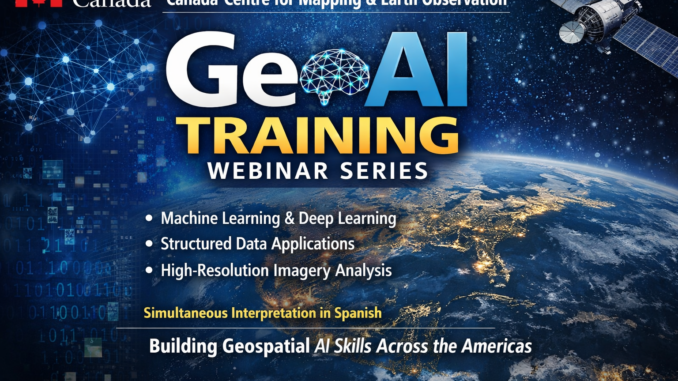
The Canada Centre for Mapping and Earth Observation (CCMEO) has announced a new public training initiative focused on geospatial artificial intelligence (GeoAI), offering a three-part webinar series this spring aimed at government practitioners, industry professionals, and students across the Americas.
The webinars form part of Canada’s contribution to the UN-GGIM: Americas Community of Practice 2025–2026 workplan and will include simultaneous Spanish interpretation, reflecting a regional capacity-building effort rather than a domestic program alone.
The series is designed to bridge foundational knowledge and applied techniques, helping participants understand how machine learning and artificial intelligence are being operationalized within geospatial workflows.
Why this matters
Public sector organizations across North and South America are rapidly moving toward operational use of Earth observation data, predictive modelling, and automated analysis. However, a major constraint is workforce capacity. Many agencies possess data but lack trained personnel able to use modern analytical approaches.
GeoAI sits at the intersection of:
• remote sensing
• GIS analysis
• data science
• geospatial intelligence workflows
The CCMEO program specifically targets that gap by focusing on practical implementation rather than research theory alone.
The Webinar Program
Module 1 — Foundations of Machine Learning and Deep Learning
March 5, 2026 | 11:00 am – 3:00 pm ET
This introductory session will explain how machine learning and deep learning operate within a geospatial context. Participants will learn core concepts such as training data, model behaviour, classification, and prediction as applied to spatial datasets.
Registration: https://lnkd.in/eSpMHN5z
Module 2 — Applying AI to Structured Geospatial Data
March 19, 2026 | 12:00 – 3:00 pm ET
The second session moves into application, focusing on numerical and tabular datasets rather than imagery. The training will demonstrate how AI methods can be used with census, environmental monitoring, and infrastructure datasets commonly held by government agencies.
Registration: https://lnkd.in/guJEEaEi
Module 3 — GeoAI for High-Resolution Optical Imagery
April 22, 2026 | 11:00 am – 3:00 pm ET
The final module examines automated interpretation of satellite and aerial imagery, including object detection and advanced analysis techniques. These approaches are increasingly central to environmental monitoring, emergency response, and geospatial intelligence operations.
Registration: https://lnkd.in/grEU3inq
A Regional Capacity-Building Initiative
Unlike many technical webinars, this series is structured as an international training effort. Through UN-GGIM: Americas, Canada is helping develop shared technical capability across the Western Hemisphere, particularly for government mapping agencies and public-good applications.
The program reflects a broader shift occurring in the geospatial sector. Artificial intelligence is no longer experimental; it is becoming part of operational mapping, environmental monitoring, disaster management, and national-scale data programs.
For many organizations, the challenge is no longer access to data, but the ability to interpret it quickly and consistently.
This training series aims to help practitioners move from traditional GIS analysis toward automated and predictive workflows.
All sessions are open to the public.

Be the first to comment