
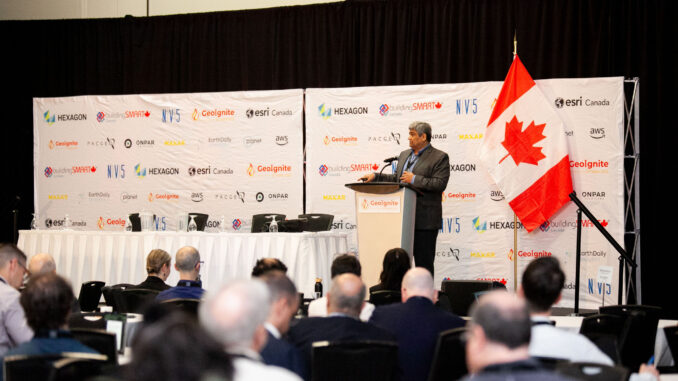
Canada is at a turning point. As global power dynamics shift and technological capabilities accelerate, the systems we rely on to manage, share, and act on data are showing their age. At GeoIgnite 2025, one keynote asked a simple but urgent question — Can Canada remain resilient, secure, and competitive if it keeps depending on outdated data infrastructure?
The answer, according to senior policy advisor and former CCMEO head Prashant Shukle, is no.
In his keynote, “Canadian Data at the Crossroads: The Need for Other Pipelines,” Shukle didn’t mince words. Canada’s current geospatial and data systems are no longer sufficient for the scale and complexity of challenges we face — from national security and AI to climate resilience and digital sovereignty.
A Wake-Up Call for Canada
“Geopolitics is shifting. Technology is fragmenting. The rules of engagement around data are being rewritten,” Shukle said. “And yet, Canada is still relying on old frameworks to respond to very new problems.”
He framed the current moment as a crossroads: Canada must either build the sovereign capacity to manage and govern its own geospatial and AI infrastructure, or continue to rely on foreign systems, without control or recourse.
What Are ‘Other Pipelines’?
The phrase “other pipelines” wasn’t about fiber optics or satellites. Shukle was referring to critical digital infrastructure –tools, platforms, and systems that enable Canada to:
- Store and process sensitive data securely (sovereign cloud)
- Develop AI solutions trained on Canadian data, governed by Canadian values
- Create open, standards-based ecosystems for interoperability
- Build national resilience while protecting public trust
He called for a more deliberate, strategic approach to infrastructure development, one grounded in transparency, capability, and national interest.
Turning Risk Into Opportunity
Shukle’s message wasn’t just about warning — it was also about possibility.
He laid out how a bold investment in Canada’s data future could position the country as a global leader in trusted, open, and climate-resilient systems. Use cases ranged from:
- Disaster readiness powered by real-time EO
- Infrastructure health monitoring through AI
- Energy transition support via integrated geospatial platforms
- Defense and sovereignty enabled by Canadian-owned intelligence networks
In every case, the challenge wasn’t a lack of tech — but a lack of coherent strategy and aligned investment.
Design With Purpose
Shukle closed with a simple but powerful call to action:
“If we’re serious about innovation, sovereignty, and serving Canadians, we need to stop retrofitting yesterday’s systems. We need to design the next generation — with purpose.”
He reminded the audience that trusted data infrastructure is no longer optional — it’s central to how Canada will function, lead, and protect its interests in the years ahead.
Key Takeaways:
- Canada needs new, sovereign digital pipelines to remain secure and competitive.
- Investments must go beyond tech—they must focus on strategy, governance, and public trust.
- Now is the time to build systems that reflect Canada’s values and enable real-world impact.
- In a conference full of ambitious ideas, Prashant Shukle’s keynote offered something rare: a roadmap grounded in urgency, clarity, and conviction.



Be the first to comment