
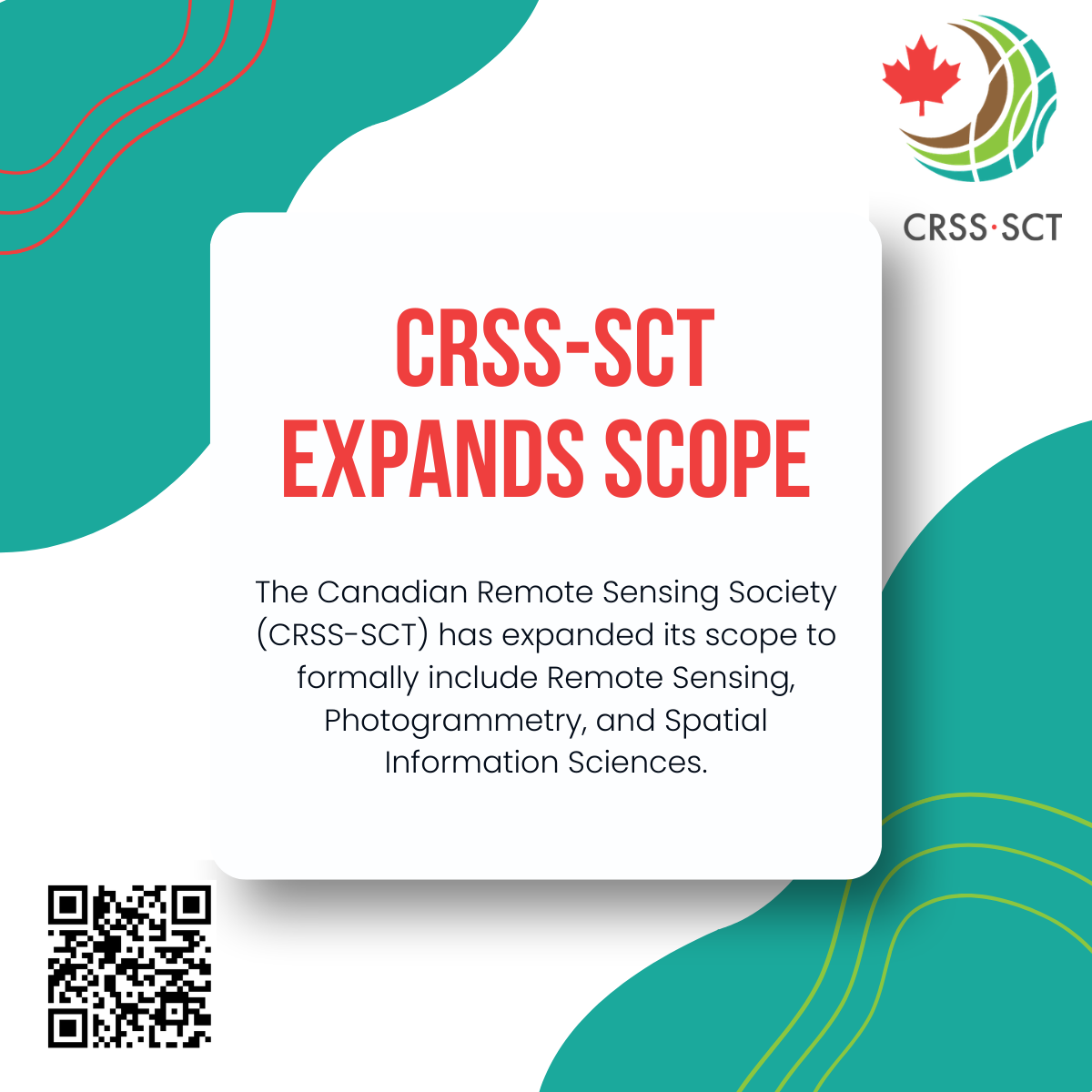
The Canadian Remote Sensing Society (CRSS-SCT) has formally expanded its scope to include Remote Sensing, Photogrammetry, and Spatial Information Sciences, marking a notable shift in how one of Canada’s longstanding geospatial organizations defines its role.
The update comes at a moment when the Canadian geospatial sector is increasingly defined by integration across disciplines rather than separation between them.
A Society Rooted in Canada’s Remote Sensing Legacy
CRSS-SCT has its roots in the early development of remote sensing in Canada, closely tied to federal science leadership and institutions such as the Canada Centre for Remote Sensing.
For decades, the Society has served as Canada’s national learned body for remote sensing, connecting federal science, academia, and applied industry. It is best known for organizing the Canadian Symposium on Remote Sensing and publishing the Canadian Journal of Remote Sensing.
This history placed CRSS-SCT firmly within the Earth observation tradition, focused on satellite imagery, environmental monitoring, and resource management. While photogrammetry and broader spatial sciences evolved alongside it, they were often represented through separate communities and institutional structures.
A Shift Toward an Integrated Discipline
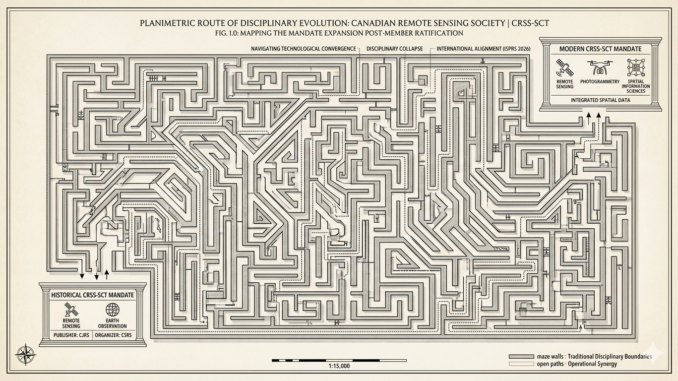
The Society’s expanded scope reflects a reality that has been building for years: the boundaries between remote sensing, photogrammetry, and spatial information science have largely collapsed in practice.
Modern geospatial workflows now routinely combine satellite and aerial Earth observation, drone-based photogrammetry and 3D capture, LiDAR and point cloud processing, GIS and spatial data science, and artificial intelligence-driven analysis.
By explicitly incorporating these domains, CRSS-SCT is aligning its mandate with how geospatial work is now carried out across government, industry, and academia.
Timing and International Alignment
The timing of this shift is not incidental.
Canada is hosting the ISPRS Congress 2026 in Toronto this July, one of the most significant global gatherings in the field. The International Society for Photogrammetry and Remote Sensing (ISPRS) is structured around the combined disciplines of photogrammetry, remote sensing, and spatial information science.
Expanding the Society’s scope ahead of the Congress positions CRSS-SCT as a more accurate national counterpart to the international community it is hosting. It signals that Canada’s representative body reflects the full breadth of the discipline, rather than a narrower historical definition.
A Strategic Broadening, Not a Reinvention
This change should not be interpreted as a reinvention of the Society, but rather as a strategic broadening.
It reflects the convergence of sensing, mapping, and spatial analytics, the need for alignment with global frameworks, and the importance of maintaining relevance within a rapidly evolving geospatial landscape shaped by AI, digital infrastructure, and cross-domain collaboration.
In this sense, CRSS-SCT is not leading a transformation so much as recognizing one that has already taken place.
What It Means for the Canadian Geospatial Community
For the broader community, the significance lies in what this signals about direction.
The expansion points toward continued integration across disciplines, stronger alignment with international geospatial structures, and a broader platform for engagement across sensing, mapping, and spatial data science.
As Canada prepares to host a global audience this summer, the move positions CRSS-SCT as a more inclusive and representative platform for that conversation.
It is a measured change, but a timely one, reflecting where the sector is already heading.
Announcement
More information: https://crss-sct.ca




Be the first to comment