
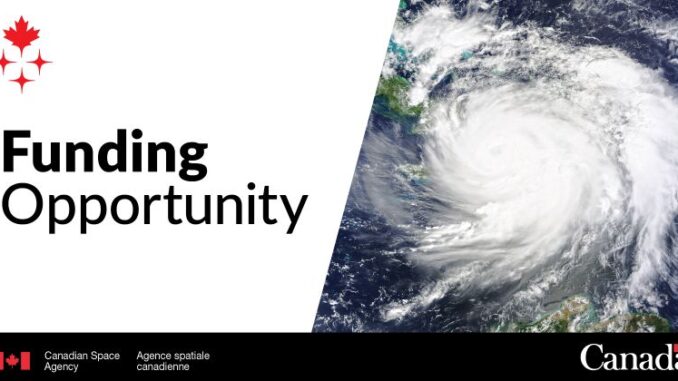
- Advance primary HAWC/AOS science objectives;
- Advance applications enabled by HAWC/AOS for a healthy and climate-resilient Canada.
This AO is consistent with the terms and conditions of the CSA Class Grant and Contribution Program to Support Research, Awareness and Learning in Space Science and Technology – Research Component.
Applicants are asked to read the following AO thoroughly before submitting their applications. This AO was prepared to help applicants complete the application process, and outlines key elements, including mandatory criteria for eligibility, details on eligible projects and the selection process. In the event of any discrepancies between this AO and the individual funding agreements governing a project, the latter document(s) will take precedence.
2 AO Objectives
The objective of this AO is to support science and applications development activities related to the HAWC/AOS initiative.
More specifically, through this AO, the CSA seeks to:
- Advance HAWC/AOS science and applications through research and development;
- Increase Canadian participation in the HAWC/AOS initiative;
- Increase Earth system model developments and/or the use of data acquired and processed with CSA support.
Projects selected from this CSA competition must have as their objective to increase scientific knowledge that will contribute to the objectives of the HAWC/AOS initiative and enable the development of applications.
3 Eligibility criteria
In this section3
3.1 Eligible Recipients
To be eligible, the applicant must be a recognized Canadian university or post-secondary institution. The Canadian Information Centre for International Credentials (CICIC) maintains a directory of recognized schools in Canada.
The researcher leading these projects must:
- Hold a PhD obtained from a recognized institution.
- Hold a permanent, term, or contract position at the applicant institution for the duration of the funding agreement. The position may be paid or unpaid. This includes Adjunct Faculty that may be employed by industry. The signature of the Duly Authorized Representative on the Application Form is sufficient evidence that the Applicant believes that the Lead Researcher will hold a position at the applicant institution for the duration of the funding agreement.
Note: A Lead Researcher may lead only one (1) grant at a time per ROHSSA Stream.
These are the sole conditions that must be satisfied at the time of application.
3.2 Eligible Projects
To be eligible for CSA funding, projects must consist of one or more of the following:
- Research activities of interest to Canada related to space science and technology disciplines and their applications;
- End project phases such as analyses of space data and the transformation of that data into useful information.
Projects must also meet funding limits specific to the targeted Stream (see section 7.1).
All development phases necessary for a project are eligible. Any logical breakdown or combination of these phases can constitute a funded project under this AO. However, breaking down a project into numerous phases submitted as distinct proposals to obtain more than the maximum grant or contribution under this AO is not allowed. Furthermore, the completion of a funded phase does not automatically guarantee future funding of the remaining phases.
To be eligible, the activities outlined in the project must also align with one of the following Streams:
- Stream 1: Advancing primary HAWC/AOS science objectives by conducting ground-based and/or airborne data collection.
- Stream 2: Advancing primary HAWC/AOS science objectives by conducting model development and/or data analysis.
- Stream 3: Advancing applications enabled by HAWC/AOS for a healthy and climate-resilient Canada.
Detailed definitions of eligible activities under each Stream can be found in Appendix B.
3.3 Links to CSA Priorities
To be eligible, projects supported under this AO must contribute to at least one of the primary HAWC/AOS science objectives (Stream 1 and Stream 2) or enabled applications (Stream 3).
Detailed descriptions of these priorities can be found in Appendix C.
3.4 Links to the Class G&C Program Objectives
To be eligible, projects supported under this AO must contribute to the achievement of at least one of the following objectives:
- To support the development of science and technology relevant to the priorities of the CSA;
- To foster the continuing development of a critical mass of researchers and highly qualified people in Canada in areas relevant to the priorities of the CSA;
- To support information gathering, studies and research related to space.
3.5 Research and Development (R&D) Definition
Eligible projects supported under this AO must comply with the following definition for basic R&D:
“Any pre-commercial science and technology activities that are carried out to resolve unknowns regarding the feasibility of (i) space concepts or (ii) applications in the space sector.”
The following due diligence process will be applied to determine whether projects are compliant with this definition:
- Are the scientific unknowns to be answered clearly stated?
- Is there a description of how the expected results will be obtained (methodology)?
- Are the working hypotheses used to solve the scientific unknowns clearly stated?
- Is it clearly demonstrated that the proposed solution consists of more than routine analysis, engineering or current operations?
Basic R&D activities supported under this AO shall be undertaken in Canada unless it is essential to the success of the project.
Further Details here


Be the first to comment