
The Canadian Space Agency’s latest spending plan maintains steady funding across its core responsibilities, from satellite operations and space science to robotics and international programs. Within that broader mandate, the plan highlights ongoing investment in satellite data continuity, wildfire and climate monitoring, and support for Canadian-led innovation.
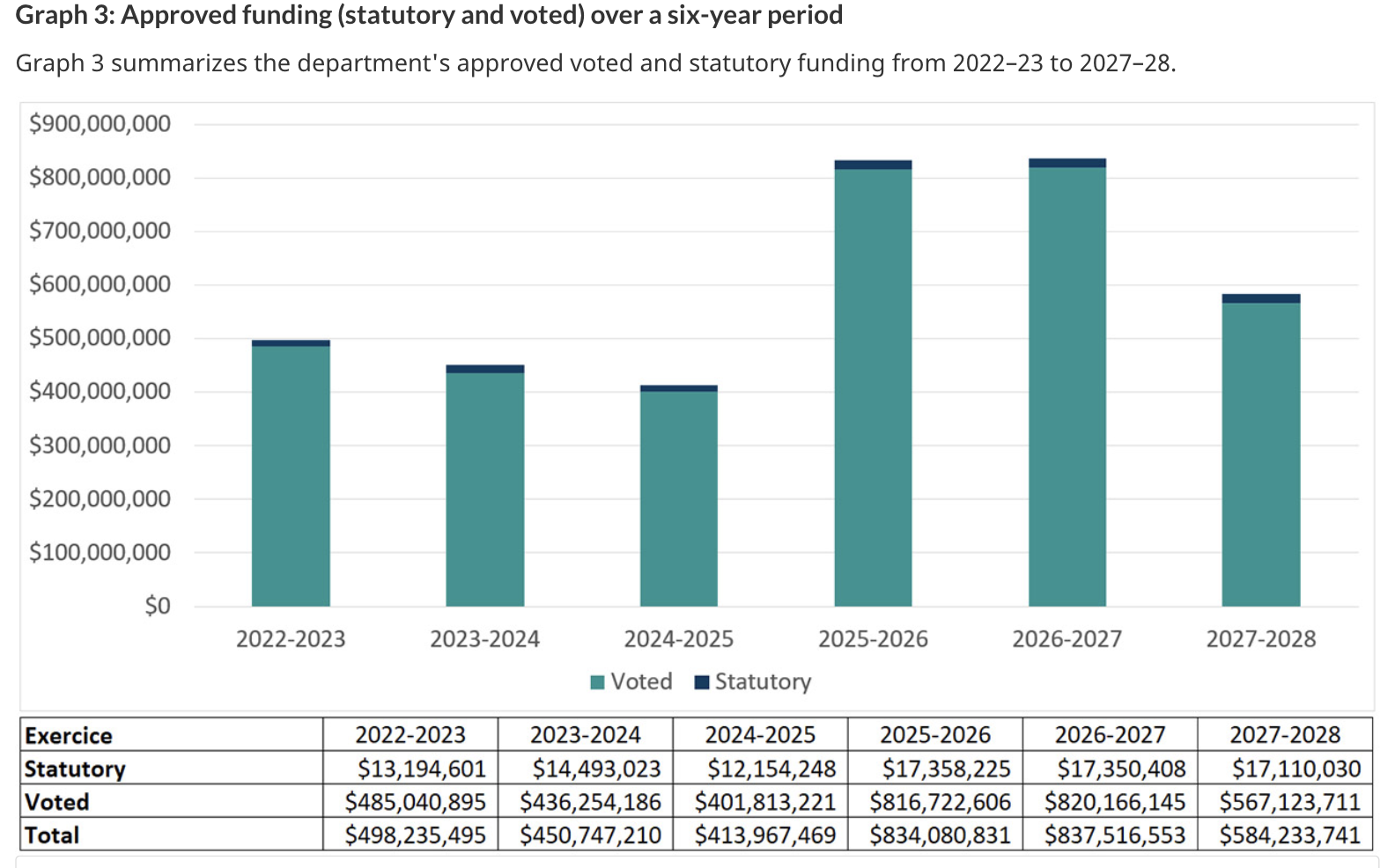
The CSA plans to spend just over C$834 million in 2025-26, with the bulk — around C$778 million — dedicated to its core mandate, Canada in Space. While actual spending dipped in the last couple of years due to delays in some major projects, this year’s plan signals steady support for key priorities like Earth Observation, commercial innovation, and satellite systems tied to national sovereignty.
Key initiatives such as RADARSAT+, WildFireSat, and HAWC continue to advance, with emphasis on maintaining access to satellite data and supporting wildfire and atmospheric monitoring. Funding tools like the Space Technology Development Program (STDP) and Smart Earth are positioned to strengthen Canada’s space supply chain and help small and medium-sized firms develop new capabilities.
For the Earth Observation and geospatial community, the plan reflects a continued commitment to data continuity, applied science, and long-term technical capacity.
ALSO READ
Canada’s Commercial Space Sector Faces Major Hurdles, New Report Warns
Why Canada Must Step Up in Arctic Monitoring
Satellite Data Continuity and Access
The CSA highlights its role in managing synthetic aperture radar (SAR) data from missions such as RADARSAT-2 and the RADARSAT Constellation Mission (RCM). The plan notes over 300,000 annual user requests for SAR data, which is made available through the Earth Observation Data Management System (EODMS).
In a reference to national data access, the plan states that these efforts help support Canada’s “satellite data sovereignty.” While this language aligns with CSA’s long-standing role in EO data delivery, it resonates at a time when questions around domestic infrastructure, resilience, and autonomy are being raised more broadly.
Climate and Emergency Response
Canada is warming twice as fast as the global average. The Arctic is moving even quicker. This isn’t new, but it’s starting to show up in ways that are harder to ignore — fire seasons that don’t end, permafrost that doesn’t stay frozen, glaciers that don’t come back. The CSA’s 2025-26 plan puts climate resilience at the centre of its scientific work, with missions focused on real-time monitoring and long-term forecasting.
Top of the list is WildFireSat, a joint mission with Natural Resources Canada and Environment and Climate Change Canada. Scheduled to launch later this decade, it will deliver near-real-time thermal imaging of wildfires across the country. The data is expected to support emergency operations, air quality assessments, and emissions tracking — closing a gap in Canada’s ability to monitor wildfire activity at scale.
HAWC (short for High-altitude Aerosols, Water Vapour and Clouds) is being developed with NASA. It will collect data on upper-atmosphere conditions that influence long-range climate trends. That includes aerosol behaviour, water vapour movement, and cloud dynamics — factors that shape precipitation, drought cycles, and temperature shifts.
Both missions underscore how Earth observation is evolving within the CSA’s mandate. The focus is shifting toward operational use — supporting agencies that need timely, accurate data to respond to environmental risks.
Strengthening Domestic Capacity
The Departmental Plan ties Canada’s autonomy to something equally vital: the strength of its commercial space sector. Two programs are central to that effort: the Space Technology Development Program (STDP) and SmartEarth. They fund early-stage research and help Canadian companies test and build technologies like satellite components and Earth observation tools. The plan identifies small and medium-sized enterprises (SMEs) as key partners, with targeted support intended to grow industrial capacity and foster Canadian participation in global supply chains.
There’s a clear reason behind this push. With the global supply chain getting harder to navigate, the CSA is explicitly aiming to reduce reliance on foreign hardware and software by investing in Canadian suppliers, startups, and SMEs. This aligns with concerns echoed across Canada’s geospatial and tech communities: if we can’t build it here, we can’t control it when it matters.
The CSA also frames this as an economic move. Supporting homegrown innovation, especially through partnerships and procurement, is one way to make sure Canada stays competitive — and keeps control of what it builds.
A Focused Year Ahead
The CSA confirms its continued participation in the Committee on Earth Observation Satellites (CEOS), following its term as CEOS chair in 2024–25. The plan highlights work with international and domestic partners, including NASA, Natural Resources Canada, and ECCC, to advance shared EO goals related to climate and biodiversity monitoring.
While the plan does not outline new partnerships, it signals CSA’s intention to stay engaged in multilateral coordination and data-sharing frameworks.
The CSA’s 2025–26 plan keeps attention on key missions already in progress. Earth Observation, wildfire and atmospheric monitoring, and Canadian-led R&D remain priority areas. The agency continues to provide EO data across departments, while supporting capacity development through industry-facing programs.
For Canada’s geospatial sector, the message is clear: delivery, continuity, and technical depth remain central to the year ahead.




Be the first to comment