
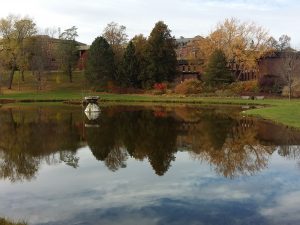
Mount Allison University campus
This weekend, I drove up to Mount Allison University situated in Sackville, New Brunswick, to participate in the Atlantic chapter of the Canadian Association of Geographers’ (CAG) workshop on Geography education. The event provided an update on actions regarding the St John’s Declaration (August 2013).
The workshop was held in the campus chapel basement. It was scheduled 10:15 -11:30 AM on Saturday, November 5th. There were twelve participants: university professors, high school teachers, the CAG executive, a student and myself. While the gathering was small, the content was rich. There was an opportunity to hear updates from the CAG executive, Canadian Geographic Education, GeoAlliance and the Royal Canadian Geographic Society. There were two handouts: one page declaration ‘Advancing Geographic Education for Canadians’ and 2016 International Charter on Geographical Education produced by the IGU Commission on Geographical Education.
The issue under discussion was the decline in the number of students studying Geography in high schools. This, at a time when there is an increased realization of the value of Geographic science and the application of Geomatics technology.
The average GoGeomatics reader is likely a reasonably well-paid young Geomatics professional who wants to see the next generation apply their geographic knowledge and associated technology to current problems. To them the shortage of Geography courses in high school should matter. So does the ‘erosion of Geography’. In a country as large and diverse as Canada, this ‘crisis’ in Geography education is a common concern.
In each provincial and territorial jurisdiction we need a network that brings together students, Geography teachers in schools, technology instructors in community colleges, Geography faculty in universities and curriculum developers in the provincial/territorial Department of Education. We cannot afford silos among them.
What do students, parents and guidance councilors need? They need profiles of high school graduates who have built successful careers based on their Geography education and associated technology. (see below, John Trites work for GANS).
Earlier this Fall, the Royal Canadian Geographic Society (RCGS) announced a new Centre for Geography and Exploration. The Geo-Alliance has been created with a focuson sectors, education and data access.
I believe that Canada needs a voice for people, land, sea and sky and that voice is the voice of Geography (see Carl Sauer’s book Man and Nature). We should use the tools of Geographic science and Geomatics technology to address this ‘erosion of Geography’.
We should arrange for more place-based education (including field work). In Annapolis Valley (Nova Scotia), this could include: canoe trips in the Tobeatic Wilderness Area; bike rides along the Harvest Moon trail from Grand Pre to Annapolis Royal; car excursions along the Highway #101 to observe the changes in agricultural land use; boat trips on the Bay of Fundy foe whale watching.
Geography graduates need to communicate their observations, use GIS to produce an online digital atlas depicting agricultural land use change or South Mountain Acadian forest loss . They can produce maps showing flooding at the Muskrat Falls dam in Labrador. They can learn to use UAVs, and GPS for geo-caching or develop mobile apps that help find local food products in the Annapolis Valley. Similar examples can be replicated in every province and territory.
We are losing Geography departments. In 1986, we created the College of Geographic Sciences (COGS) in Lawrencetown. At that time, Geography was taught at University de Moncton, Mount Allison, Saint Marys and Memorial University of Newfoundland in Atlantic Canada,. Today, COGS is only a part of the Annapolis Valley campus – one of thirteen campuses that make up the Nova Scotia Community College (NSCC).
I wish to thank Stuart Semple and Michael Fox of Mount Allison University for organizing the workshop. As well as Dan Shrubsole and Neil Hanlon for providing the CAG Exceutive perspective. I am grateful to John Trites, the other school teachers, educators and student for their examples from the ‘trenches’. As Pam Mood , Mayor of Yarmouth, would say ‘we need all hands on the deck’ if we will stop the decline of Geography.
I suggest focussing on Geography education at the RCGS. The Explorers can look after themselves. The GeoAlliance should commit funding to support the voice of Geography. Collectively, we should be able to demonstrate significant action at the joint CAG/IGU meetings in Quebec, 2018. That means a Geography education network in every province and territory should be developed. The GoGeomatics community should support their Geography teachers (if appropriate), Geography Awareness week and GIS Day on November 16th.
References
Geography Poster Series at http://gans.ca/Geospatial-Careers (John Trites for GANS)
International Charter on Geographical Education at www.igu-cge.org
For an electronic copy of the St John’s Declaration, go to the GoGeomatics post by Chris, posted December 2nd, 2013. Fixing Geography Education in Canada: the First Step.



Be the first to comment