
As Europe confronts shifting global alliances, growing defence pressures, and questions about long-term U.S. reliability, its space ambitions are expanding in kind. The European Space Agency (ESA) is now planing its first major dual-use satellite program — a move that reflects broader efforts to strengthen the continent’s military resilience and technological autonomy.
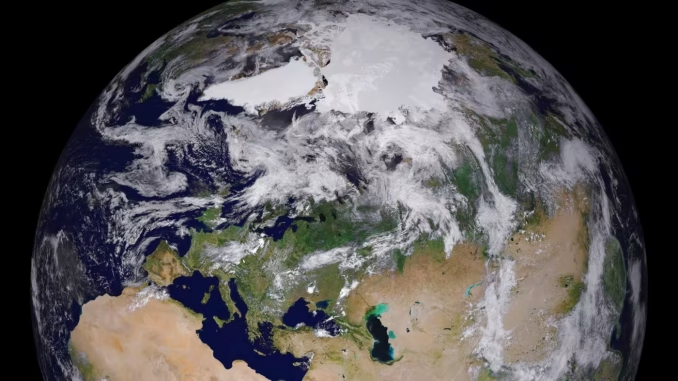
According to the Financial Times, ESA is seeking €1 billion to fund a constellation designed to provide military-grade intelligence and high-frequency Earth Observation. Director-General Josef Aschbacher told FT the proposed system would include 15 to 30 satellites, equipped with optical and radar sensors, onboard AI, and edge computing. The satellites would revisit key areas every 30 minutes, a sharp improvement over current imaging capabilities.
“This will be something quite significant,” Aschbacher said, emphasizing the system’s potential for both civil and defence applications. It would be the first large ESA program explicitly designed for dual use.
The initial €1 billion figure would cover satellite development, launch, and ground infrastructure, but experts estimate total costs could climb much higher. According to Maxime Puteaux of Novaspace, a full-scale multi-orbit geointelligence constellation “could easily amount to €4bn to €6bn over a 10 to 15-year horizon.”
A Step Forward: European Resilience from Space Program
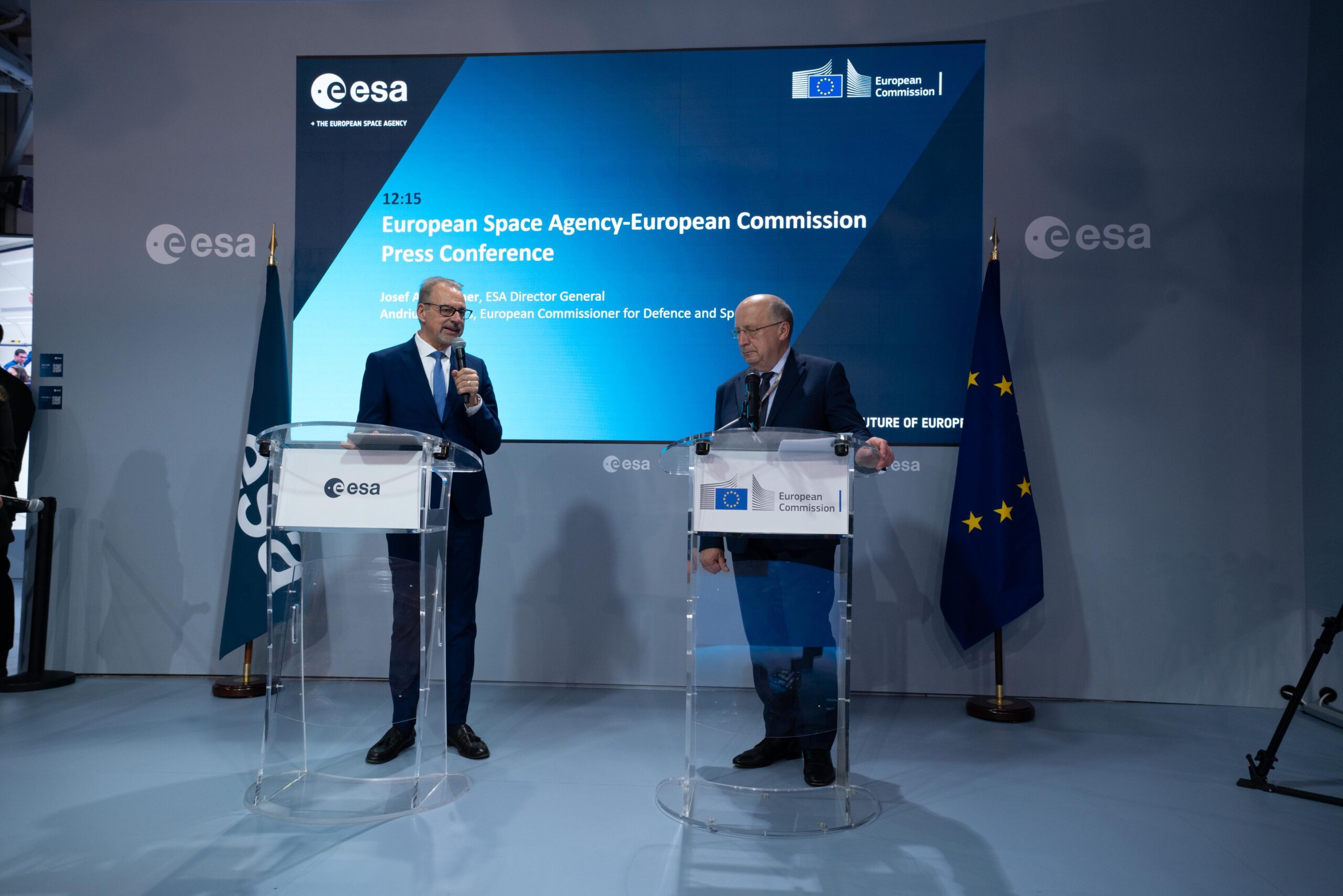
The proposal builds on momentum already underway within ESA. At a June 12 press briefing, following a meeting of the ESA Council, Aschbacher announced that the Council had approved an “enabling resolution” for the European Resilience from Space (ERS) program — a satellite imaging initiative focused on crisis monitoring, infrastructure security, and environmental surveillance.
As reported by SpaceNews, ERS includes the Earth Observation Government Service (EOGS), which would deploy radar and optical satellites to support public-sector users. The system’s architecture is designed to provide rapid, reliable imaging for disaster response, climate impact monitoring, and potentially, strategic intelligence.
ESA plans to formally seek funding commitments from its member states at its ministerial conference in November.
The FT reports that ESA will request a 36% increase in its overall budget, raising it to €23 billion over the next three years — the largest proposed boost in its 50-year history. This request reflects growing European interest in space-based autonomy, as global instability and shifting transatlantic dynamics raise concerns about reliance on foreign systems.
Andrius Kubilius, EU defence and space commissioner, reinforced that urgency at a summit in Brussels, calling it “crucial” to develop systems capable of delivering very high-resolution geointelligence every 30 minutes. The current capability, he said, is limited to about once per day.
Managing Risk Amid U.S. Uncertainty
ESA’s proposed expansion comes at a time when Europe’s longstanding reliance on the United States — for both space collaboration and broader security — faces growing strain. Transatlantic ties remain unsettled by ongoing trade tensions, a shifting NATO ties, and repeated criticism from US Administration about Europe’s underinvestment in defence.
The White House has proposed a 24% cut to NASA’s budget, with particularly steep reductions to science missions. If enacted, the cuts would reduce U.S. science funding to its lowest level in more than four decades. Several joint ESA-NASA missions, including LISA, EnVision, and NewAthena, may face delays or require reconfiguration. ESA has begun consulting with its suppliers and science teams to prepare contingency plans.
The risk is not just financial. With growing geopolitical instability — particularly in Eastern Europe — there is concern in Europe that the U.S. may not remain a fully reliable partner in space or security. The war in Ukraine and the prospect of renewed Russian aggression have only sharpened that focus. Space, once seen primarily as a scientific and commercial domain, is now being treated as a strategic asset that Europe must be able to control and sustain independently.
ESA’s European Resilience from Space (ERS) program and the proposed dual-use satellite constellation reflect a clear pivot toward autonomy. The agency’s leadership has framed these systems not just as technical infrastructure, but as enablers of resilience, security, and operational readiness.
ESA is expected to present the plan formally at the agency’s ministerial conference in November, where it is also expected to seek a 36% increase in funding — to nearly €23 billion over three years. If approved, it would be the largest funding boost in ESA’s history.
With increasing pressure on European governments to build military capability — and space systems now central to that conversation — the coming months will test how far that commitment goes.




Be the first to comment