
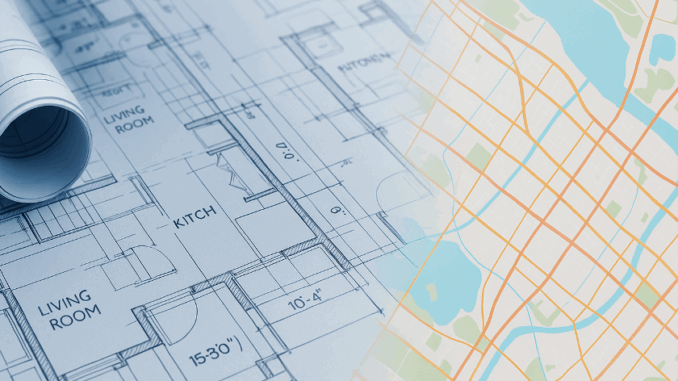
When I first chose architecture, I imagined a future filled with site plans, 3D models, and the creative challenge of shaping spaces where people live and work. To me, it was more than drawings or calculations. A home isn’t just walls and a roof, it’s a safe space where stories unfold.
Over time, I realized that architecture is more than sketches and renderings. Even the most beautiful design fails if it sits in a floodplain, lacks road access, or is built in an unsafe area. That bigger-picture thinking where placing design in its geographic and environmental context was my first step toward GIS.
The Seeds of Curiosity
My fascination with maps started in school. I remember tracing rivers, mountains, and cities on political outline maps, amazed that symbols and scales could represent the real world. That early curiosity stayed with me.
When it came time to choose my undergraduate program, I found something unique: the chance to study both architecture and GIS. That combination revealed how buildings and environments are closely linked. A structure might rise from a site, but it depends on utilities, land use, and transportation networks around it. This realization began my journey from blueprints to basemaps.
Blueprints and Basemaps: Two Sides of Design
In architecture, blueprints are the language of creation. They describe the dimensions, structure, and materials of a building. In GIS, basemaps serve a similar role. They provide the spatial foundation that gives meaning to infrastructure, cities, and landscapes.
I remember holding a site plan in one hand and a city map in the other. One showed me what I was building, the other showed me where and why it mattered. Together, they gave me the complete picture.
Discovering BIM and GIS Together
One pivotal moment was a green building design project where we used BIM (Building Information Modeling) to explore energy efficiency and sustainability. BIM offered insights into the building lifecycle, from materials to maintenance. What fascinated me most, though, was how powerful it became when combined with GIS.
BIM revealed how a building could perform, while GIS showed where that performance mattered most whether in a dense city block, an environmentally sensitive zone, or a new neighborhood. That project convinced me that architecture and GIS were not competitors but partners.
A Shift in Thinking
During my master’s program, I transitioned fully into GIS. It was exciting but also intimidating. Suddenly, I was considering entire systems rather than just single buildings like zoning, utilities, transportation corridors, and environmental impacts.
At first, it seemed like a leap. But soon I realized that many of my architectural skills carried over naturally:
- Double-checking details from site plans helped me digitize pipelines with accuracy.
- My habit of organizing layouts translated into managing precise, attribute-rich geodatabases.
- The presentation skills I gained in architecture helped me design maps that were both accurate and easy to understand.
This shift showed me that career changes aren’t about starting over. They are about building on what you already know. Architecture gave me spatial awareness; GIS expanded that awareness to a bigger stage.
Why This Transition Matters
Shared Goals of Architecture and GIS
Looking back, my move from architecture to GIS wasn’t a switch it was an expansion. Architecture gave me creativity and empathy for human spaces. GIS gave me the tools to apply those qualities across entire communities and landscapes.
Both disciplines share the same purpose: improving lives through thoughtful design and planning. The difference lies in the scale.
Scaling Up the Questions
In architecture, I asked: How should this building look and feel? In GIS, the questions grew larger:
- How can we design not just homes, but neighborhoods safe from floods?
- How do we plan transport routes that reduce traffic and emissions?
- How do we balance development with the protection of natural systems?
Looking Ahead
Today, when I create a basemap, I see more than lines and polygons. I see the foundations of schools, hospitals, and homes that will shape communities in the future. I also imagine the people who will one day live their stories in those spaces.
My journey has taught me that career transitions are not about leaving skills behind, they’re about finding new ways to use them. For anyone curious about stepping into geospatial from another discipline, my advice is to embrace the common ground. Your past experiences bring a unique lens, and GIS gives you the tools to scale it.
For me, what started as a love of site plans has grown into a passion for maps and spatial analysis. And with each project, I feel like I’m adding another basemap to my journey, one that expands what we can design, build, and sustain.



Be the first to comment