
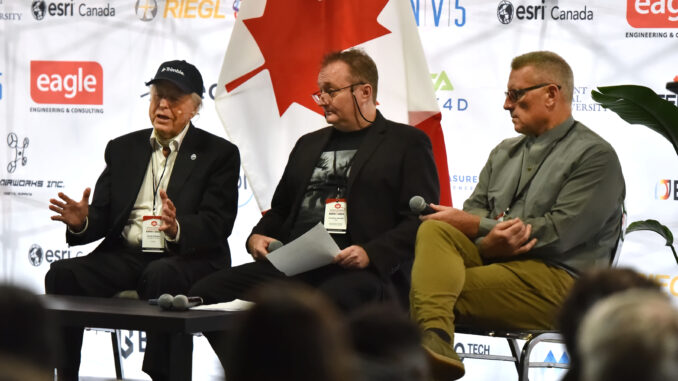
At the National Geomatics Expo in Calgary early November, a rare cross-generational fireside chat brought together three influential voices from the past, present, and future of the profession. Charlie Trimble, founder of Trimble and a pioneer who helped commercialize GPS, joined Bryn Fosburgh, Trimble’s long-serving Vice President and industry leader, for an open conversation moderated by Jonathan Murphy, founder of GoGeomatics Canada.
Framed around the theme “Geomatics Through Time,” the discussion reflected on how the field has evolved from the early days of satellite positioning to today’s rapidly changing geospatial landscape, and on the emerging roles of AI, new technologies, and the next generation of professionals. Together, the speakers shared personal stories, industry insights, and candid reflections on innovation, mentorship, workforce challenges, and the future direction of surveying and geomatics.
This fireside chat set the stage for Charlie Trimble’s keynote, Stories That Shaped the Geospatial World, followed by a Calgary White Hat Ceremony honouring his lifetime of contributions.
To open the conversation, Jonathan Murphy began with a simple but revealing question that set the tone for the rest of the discussion: “What is Geomatics?”
Charlie’s response was a spontaneous smile as he admitted he never liked the term. Geomatics, he said, sounded like a made-up label that tried too hard to group everything together. “We’re surveyors, photogrammetrists, computer scientists, civil engineers. So, why not just say what we are?”
Charlie recalled how, back at Purdue, the faculty wanted to change the program name. Charlie was “militant” against it. He felt the new label would blur the identity of the profession. But after asking someone for the formal definition of geomatics, he acknowledged another angle: it really does describe the use of positional information, and sometimes time, to improve how we work.
Early GPS History
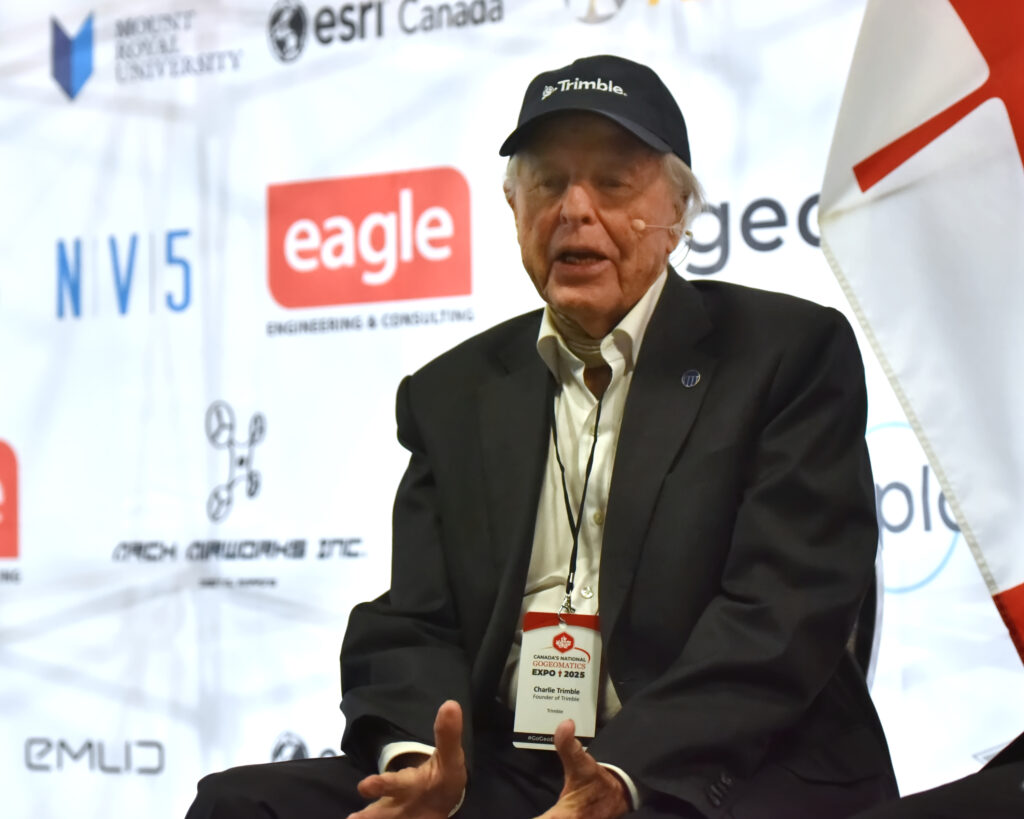
To deepen the conversation, Jonathan asked Charlie to take the audience back to the beginnings of GPS and how it became what we know today. Charlie explained that GPS was never designed with civilian use in mind, its origins were purely military. The catalyst was Sputnik, which proved that satellite orbits and timing could be used to determine position on Earth.
In the early days, Trimble was working with just seven satellites that provided only three hours of positioning per day, and the timing shifted slightly each day. Because the original navigation markets weren’t available to them, the company began exploring new applications. As they experimented, they realized the true value of GPS wasn’t the hardware. It was the information. Geotagging, timestamping, and precision location turned out to be far more transformative than anyone expected, and this realization set the foundation for treating GPS as a utility.
Sputnik Inspiration
Asked what Sputnik meant to him personally, Charlie described how deeply it shaped his generation. As a child on an avocado ranch, watching Sputnik pass overhead was a moment that pulled him, and an entire era, toward science, space, and technology. The Doppler analysis of Sputnik’s beeps made it obvious that orbit could be calculated, and therefore reversed to calculate one’s own location.
That insight eventually led to the Navy’s TRANSIT system, and later to the Congressional decision forcing the U.S. military branches to consolidate their ideas into a single, unified navigation system. That system became GPS. A 24-hour, all-weather global positioning network that would eventually transform not only defense, but every corner of the geomatics profession.
Mentorship
As the discussion moved toward leadership and career development, Jonathan asked Charlie about his own path into location technology. Charlie held back, saving that story for his keynote, but shared an important hint: “When opportunity knocks, don’t complain about the noise.”
The conversation then naturally shifted to mentorship, with Brynn reflecting on how it shaped his 40-year career. Bryn emphasized that real mentorship isn’t always formal or structured. “Often it’s about presence, curiosity, and care.” He recalled Charlie’s habit of walking the office late in the evening, stopping by each engineer’s desk to genuinely ask what they were working on. That small, consistent gesture, Bryn said, made everyone feel seen and connected: “It’s important that people feel they belong. That’s part of being a leader.”
He also encouraged the audience not to become “too digital,” reminding them that real human connection, like the kind found at conferences, is still essential.
Where Next? AI & Megatrends
Looking ahead, Jonathan asked both leaders to share their view of the future, especially around AI. Charlie framed AI as the next great megatrend in a long line of technological waves Trimble had ridden: integrated circuits, personal computers, the internet, smartphones, and now data and deep learning. The key, he said, is recognizing that anything that will matter in ten years already exists today, just not at scale. Visionaries are simply the people who can see where trends intersect.
Bryn added a cautionary note from his own experience: the biggest threat is complacency. He told a story from 1994, when surveyors questioned why Trimble was even at a surveying conference. Six years later, Trimble had acquired two of the dominant companies in that space. His message to young professionals was simple: “don’t get comfortable. Someone in a garage with beer, cigarettes, or dope might be inventing the thing that will disrupt you.”

Questions from Audience
GPS in a Golf Ball?
One audience member asked whether Charlie ever succeeded in putting GPS into a golf ball. Charlie laughed and explained the idea actually originated with engineer Arthur Wu, who really wanted a GPS watch. Trimble worked with Swatch on the concept but struggled with battery life a problem Steve Jobs later solved with the Apple Watch by embracing the idea of a one-day battery. Though the golf ball never materialized, the project earned Trimble a valuable ARM processor license.
Biggest Mistake?
Charlie shared that his biggest mistake was misunderstanding who the “customer” was when selling to the military. The real customer wasn’t the soldier using the device, it was the purchasing agent. That misalignment led to Trimble being used as a pricing pawn against Rockwell Collins. The lesson: few companies can succeed in both military and civilian markets because the sales channels are fundamentally different.
Why Isn’t the Geospatial Sector Bigger?
When asked why the sector hasn’t produced more companies on the scale of Trimble or Esri, Charlie pointed to two structural issues:
-
It’s not a consumer market, so growth is slower.
-
Government clients dominate, and they are not early adopters.
He noted that Trimble’s growth came one small survey shop at a time, with equipment priced to be paid off within a year. Surveying, construction, and mining simply aren’t massive industries, but the market continues to expand as new megatrends intersect with location intelligence.
Future of High-Precision in Smartphones
On whether consumer devices will reach higher accuracy, Charlie explained that early GPS development was constrained by weak processors and the expectation that software should be free unless bundled with hardware. Today, phones are more powerful than early Trimble receivers, and software-defined GPS is increasingly possible. Brynn added that the biggest limitations now are antenna design and multipath, issues that autonomy may eventually overcome.
Open Source vs. Openness
A question about open source prompted Brynn to clarify that Trimble’s strategy is openness through APIs, not open sourcing its core technologies. He emphasized the importance of Trimble’s dealer ecosystem and the need for interoperability rather than giving away foundational IP. Customers, he said, want systems that integrate, not necessarily systems that are open source.
Closing
The final questions wrapped up and it became clear that this fireside chat was far more than a panel discussion. It was a living bridge between generations of geomatics professionals. Through stories of early satellites, late-night engineering conversations, unexpected bugs, global megatrends, and the spirit of innovation in garages and workshops, Charlie Trimble and Bryn Fosburgh reminded the audience why this industry continues to evolve and endure.




Be the first to comment