
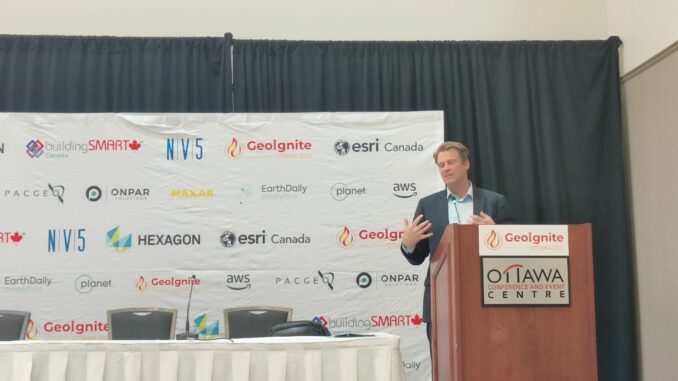
Space is no longer just about exploration — it’s about security, resilience, and economic sovereignty. In a powerful keynote at GeoIgnite 2025, Brian Gallant, CEO of Space Canada and former Premier of New Brunswick, made a compelling case for why Canada must treat space infrastructure as critical to its future.
Gallant spoke with clarity and conviction, blending political insight with technological foresight. He emphasized that in an era defined by global instability, climate volatility, and shifting alliances, Canada’s ability to access, analyze, and act on space-based intelligence is vital — not just for national defense, but for everything from climate adaptation to economic strategy.
Gallant opened with reflections on the recent cabinet formation in Canada, noting the implications of key ministerial appointments for the space sector. He highlighted the importance of government partnerships, particularly with ministers responsible for industry, defence, and digital innovation. Gallant emphasized that while being sworn into office is a moment of celebration, governing in today’s world is challenging, an important reminder as Canada charts its course in space policy and investment.
Growth in the Global Space Sector
Gallant pointed to the rapid growth projected for the global space economy. He underscored that this growth is not only fast-moving but driven by deeply transformative types of jobs and industries. According to the Canadian Space Agency, space-related industries invest eighteen times more in R&D compared to other manufacturing sectors. Two-thirds of the jobs in Canada’s space sector are STEM-based and highly specialized, but Gallant made a critical point: the remaining one-third are non-STEM roles, which still play essential parts in building and sustaining the ecosystem. In other words, there is room for everyone in space.
Climate, Natural Disasters, and Sustainability
Gallant passionately illustrated how space is integral to addressing some of humanity’s biggest challenges, especially climate change. He reminded the audience that fifty percent of the variables we must monitor to understand and mitigate climate change can only, or most effectively, be measured from space.
He emphasized that satellites help us protect forests, coastlines, and oceans. More practically, space technologies allow for real-time monitoring of natural disasters such as floods, wildfires, and ice storms. Gallant described this as not just an opportunity but a necessity, stating that space will be at the heart of disaster response and climate resilience in the coming decades.
Space as an Enabler of Traditional Industries
Many think of space as futuristic or limited to tech giants and emerging industries like AI or autonomous vehicles. But Gallant insisted that space is equally important to traditional sectors such as agriculture and forestry. For instance, satellites support sustainable agriculture by monitoring crop health and enhancing yield predictions. “Space,” he said, “will be a greater enabler of traditional industries,” not just a tool for new tech ventures.
Digital Access and Connectivity
Gallant turned to one of the most practical outcomes of space: global connectivity. He highlighted the role of space-based infrastructure in closing the digital divide. From rural towns to remote Indigenous communities across Canada and the globe, space will enable equitable access to the internet, education, health services, and economic opportunity.
Space and National Security
Space is now also a key part of defence and sovereignty. Gallant made the case that through satellites and space assets, Canada can better protect its borders, particularly in the Arctic and coastal regions. He recognized the shifting geopolitical landscape and how space plays an increasingly strategic role in national and global security.
Innovation Beyond Intention: The Case of GPS
One of Gallant’s most compelling moments came when he described the unintended innovations birthed through space R&D. GPS, he reminded the audience, was not originally developed for civilian use. Yet today, it underpins nearly every aspect of our lives, from navigation to logistics to emergency services. This, he argued, exemplifies why governments should support space R&D. “It’s not just what you set out to innovate, it’s what you stumble upon.”
Canada’s Legacy and the Road Ahead
Gallant celebrated Canada’s proud history in space, from the Canadarm to deep collaboration with NASA. But he was quick to caution that past success does not guarantee future leadership. He stressed the need for Canada to build on its legacy by investing, innovating, and collaborating internationally.
He provided updates on several initiatives involving Space Canada’s members:
- Launch framework discussions to establish domestic space launch capabilities
- Involvement in commercial space stations as the ISS is decommissioned
- Participation in Lunar Gateway projects and interest in space mining
- Earth observation programs, especially for environmental monitoring
- Health innovation in space, led by CSA astronaut David Saint-Jacques
- Energy solutions for long-duration missions, such as hydrogen and SMRs
Canada in the Global Space Race
Gallant highlighted the stark contrast in space investment between Canada and countries like the U.S., China, and Japan. Using data from the OECD and Canadian government sources, he showed that Canada’s spending is only a fraction of what the U.S. invests annually. He warned that geopolitical instability, especially with the U.S. scaling back its lunar ambitions and China and Russia doubling down, makes this an especially critical moment for Canadian space policy.
He advocated for Canada to double down on its collaboration with NASA, fulfill NATO commitments, and step up its role in NORAD and the Five Eyes alliance. Gallant called on the Canadian government to follow through with its promise to create a National Space Council and to support international agreements like the Artemis Accords.
The Role of Government and Commercialization
Gallant articulated the essential role governments play in space innovation, not just as regulators or policymakers but as investors and customers. He cited SpaceX as a case study, noting that ninety percent of its first billion dollars in funding came from NASA.
For Canada, Gallant proposed five core recommendations:
- A whole-of-government approach to growing the space ecosystem
- A review of space systems procurement
- Faster delivery of existing programs
- A dedicated Canadian commercial space strategy
- A modernized regulatory framework for space activities
Brian Gallant’s session offered a comprehensive roadmap that laid out why Canada’s next steps in space will determine its ability to stay globally competitive, support climate resilience, and strengthen digital and physical infrastructure. His call to action was both practical and ambitious, inviting collaboration, investment, and courage. Canada has the legacy, the talent, and the opportunity. What is needed now is the will to act.




Be the first to comment