
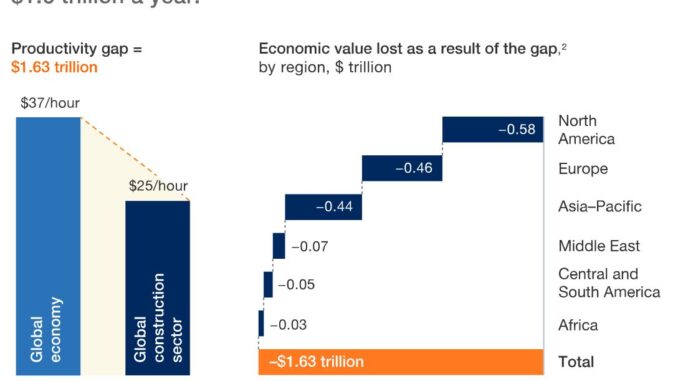
The $10 trillion global construction industry is facing a crisis. For many of the world’s advanced economies productivity in the construction sector has been stagnant for years. According to a McKinsey study whereas the average industrial worker adds $37 of value for every hour worked, a construction worker only adds $25. It is estimated that this productivity gap costs the global economy $1.6 trillion every year.
Since the mid 2000s, an increasing proportion of investment in infrastructure has come from private sources; pension funds, insurance companies and sovereign wealth funds which together manage over $60 trillion. According to the World Bank the level of private investment in infrastructure reached about $100 billion by 2015. Private investment expect a financial return and that is driving a growing investment in construction technology to improve productivity.
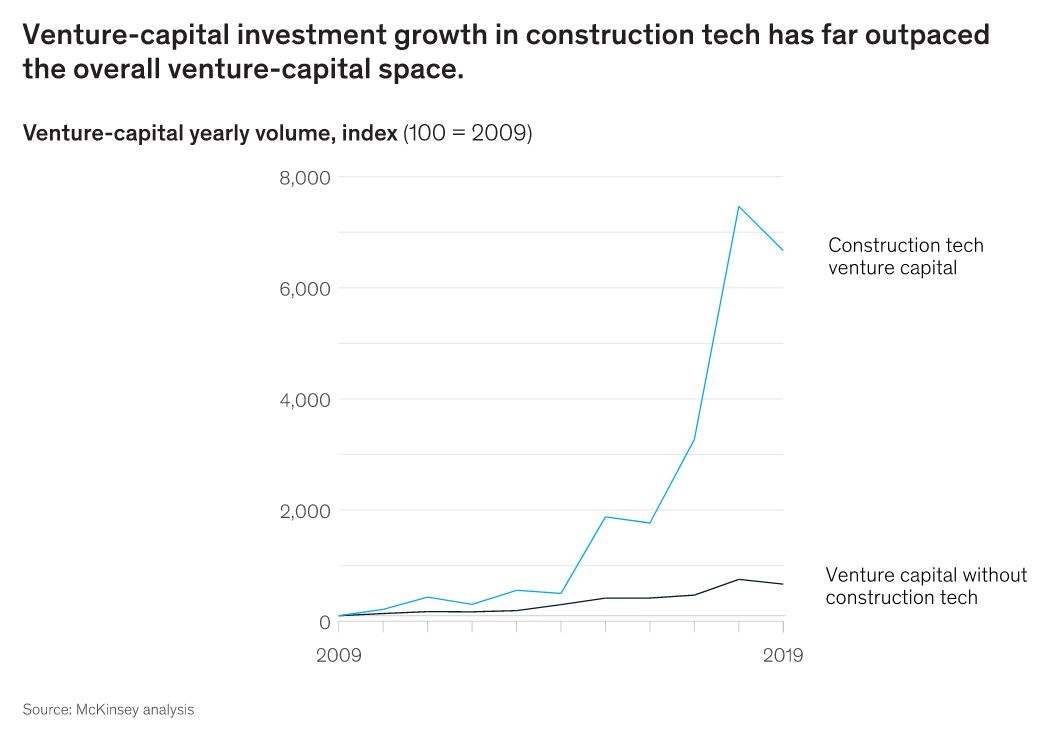 Historically, investment in research and development by the construction industry has been very low compared to other industries. Several years ago a McKinsey Global Institute study compared the degree of digitalization of nearly 30 industries and concluded that construction ranked at the bottom with hunting. This is changing. According to McKinsey venture-capital (VC) activity has risen to several billion dollars at the end of 2019 from low levels a decade ago. Specifically VC investment in construction technology far outpaced the overall VC industry in 2019.
Growing investment in technology for mapping underground utilities
One area that has seen an explosion in the development of new technologies is locating and mapping of underground infrastructure to avoid damage during construction. It is estimated that not being able to locate information about the location of underground infrastructure cost the US economy tens of billions of dollars every year and is a major risk factor for delays for highway and other linear construction projects.
There are four broad areas of accelerating investment in technology relating to the underground; reality capture, remote detection, mobile + cloud for capturing and sharing location data, and digital twins. Reality capture includes LiDAR and handheld photogrammetry enabling real-time capture of the location of newly installed infrastructure and infrastructure exposed during excavation. Some jurisdictions are using the new reality capture tools to replace traditional paper as-builts with digital point clouds. New detection technology includes inertial or gyro mapping of underground pipe networks, magnetometry using a drone, mapping underground assets using satellite and aerial imagery, quantum effect gravimetry, acoustic locating, advances in ground penetrating radar (GPR) including the ability to capture scans at roadway speeds and software simplifying the interpretation of GPR scans. it is estimated that the U.S. spends on the order of $10 billion on locating underground infrastructure prior to and during excavation. Most of this data in not captured and not shared. To address this problem a number of startups have developed mobile + cloud solutions for capturing underground location data during locate operations, subsurface utility engineering (SUE) surveys, and excavations and sharing this among construction stakeholders. A major area of new technology development is motivated by jurisdictions such as the City of Rotterdam, Estonia and the U.K. that are already developing or plan to develop a digital twin that includes underground and above-ground infrastructure. This will require large investment in technology to enable real-time monitoring, mapping and data collection, modeling and simulation of entire cities, regions and nations.

Be the first to comment