
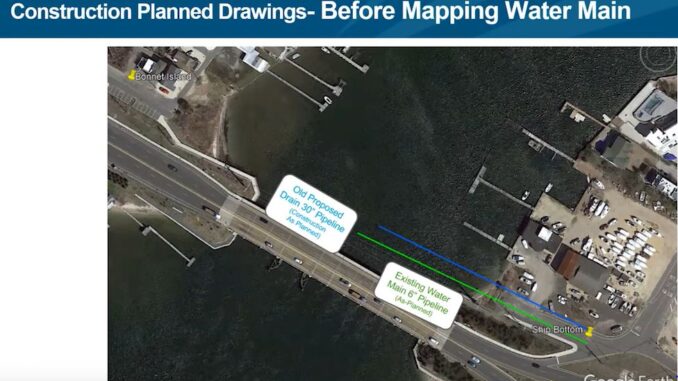
In New Jersey there was a $320 million project to replace a bridge connecting Stafford Township to Long Beach Island. There are many utilities involved including telecom, Comcast, water and sewer, and electric and conduits. They have carried out a SUE survey prior to construction to try to determine where the utilities are and have also come up with mitigation plans to reduce risk.
However there was a complication. They need to build a new drain line because there has been increased flooding during the rainy season and also because of high tides. It is planned to build the drain line into the water parallel and fairly close to an existing water main. But the water main that provides water to the island runs under water and all they had for locating the water line was an “as-planned” map from the water company engineering department, which is not reliable data. Cross-boring into the water main would leave the whole island without water. Traditional locating equipment, such EMI and GPR, cannot be used under water so an alternative locating technology was required.
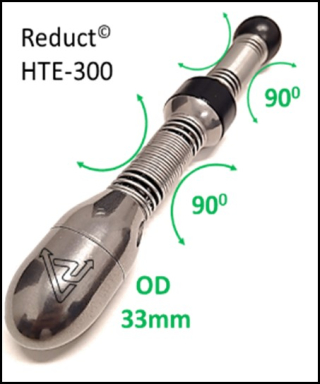 PRISUM Technologies provides a technology called inertial navigation technology, gyro mapping or inertial measuring unit (IMU) that relies on a battery powered autonomous probe with on-board gyroscopes, accelerometers, and odometers. The mapping tool records changes in direction and speed at a hundred samples per second (every foot) to create an accurate, high frequency 3D profile of the pipe segment being traversed. Inertial mapping avoids the major limitations of surface-based EM and GPR techniques; it is not sensitive to soil conditions and extraneous electromagnetic noise, is water resistant, works with all types of pipe materials and is safe because it does not require boots on the pavement. It can map sewer and water mains, electric power or telecom conduits, gas and oil of any material, plastic or metal. Pipe diameter can range from an inch and a quarter to 30 inches. The key to the technology is that the IMU is completely autonomous. There is no tethered cable and it does not communicate a signal to above ground equipment. All the data is stored within itself. Basically it is comprised of a battery, memory and various inertial devices such as accelerometers and odometers in a compact device that can be pulled or pushed through a pipe or conduit. Once the IMU tool has been run through the pipe or duct, it is removed from the pipe and connected to a laptop to download and process the data. The output is a report and a CSV file or a standard GIS format such as a shape file. Because of its autonomous nature, it can map utilities which are going under rivers or other obstructions, even a hundred feet or deeper. The IMU tool has the capability to map up to 5,000 feet recording X,Y and depth every one foot. To georeference the collected data, accurate GPS coordinates are recorded at the insertion point and and at the end point. With that information the entire path the autonomous unit travelled can be determined.
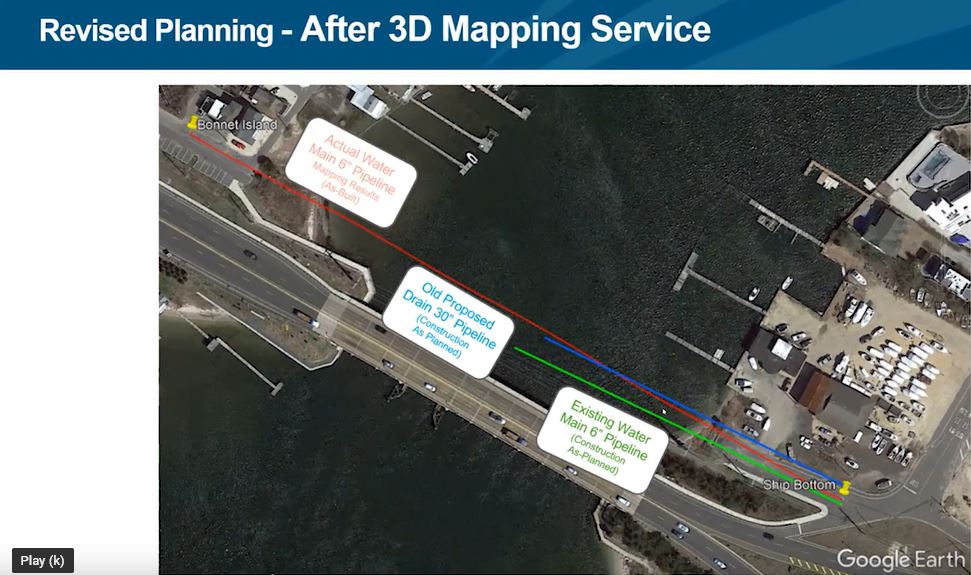 In New Jersey the IMU was inserted in one end of the water pipe and pushed through to the other end and then pulled back. This was repeated providing four runs. The data from the four runs showed a high degree of repeatability providing confidence in the accuracy of the data. According to the New Jersey DOT, the locating standard tolerance is plus or minus 2.74 feet horizontal and 1.09 feet in depth. The 3D mapping data collected by the IMU was much more accurate, 0.26 ft in XY, and 0.3 ft in Z.
This project entailed a one day activity where we were able to both run the IMU tool through the water main collecting data and also process and show the results to the New Jersey DOT on the same day. The overall operation time for the IMU run was two hours.
It was found that the water main actually had been installed at an angle. If the team had not had the accurate location from the gyro mapping run, shown by the the red line, they would have risked cross-boring into the water main with major consequences for the project and the island’s water supply. With the accurate location of the water main in hand, the team went back to the drawing board and redesigned the new drain line ensuring a safe separation from the water main.
This post is based on Santosh Saride’s talk at the Subsurface Utility Mapping Strategy Forum (SUMSF).

Be the first to comment