
The existing documentation about the location of underground utilities is poor in many countries and the costs associated with utility strikes, hitting a utility such as a fiber-optic cable, electric power cable, or a gas or water main during construction is high. Therefore, finding a way to improve our knowledge about the location of underground subsurface infrastructure is essential, but to be practical it has to be a way that does not add significantly to the cost of construction. At Geo Business 2018, Richard Bath, a surveyor at Costain, described an efficient way of capturing enough information with an ordinary smart phone to accurately survey, map and make available via the web the location of utilities encountered during a construction project.
About 4 million excavations are carried out on the UK road network each year to install or repair buried utility pipes and cables. Not knowing the location of buried assets causes practical problems that increase costs and delay projects, but more importantly, it increases the risk of injury for utility owners, contractors and road users. The problems associated with inaccurate location of buried pipes and cables are serious and are rapidly worsening due to the increasing density of underground infrastructure in major urban areas. The average direct cost of hitting an underground utility during construction ranges from £400 to £2800 depending on the type of utility. Research has found that the total cost of a utility strike in the UK is on average 29 times the direct cost.
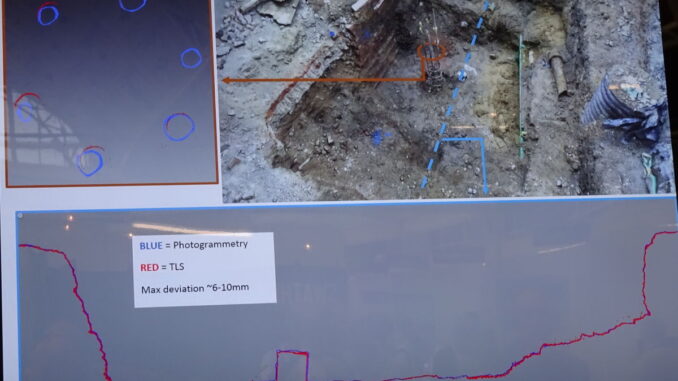
Performing a survey of utilities exposed during a construction project using a laser scanner and total station can be cost prohibitive and as a consequence is rarely done. A research project involving Costain and Bentley has found that photogrammetry using a consumer grade smartphone results in a 3D model of comparable accuracy to a laser scan survey and is much more cost efficient. They have also found a way to make 3D models created from the pictures captured with a smartphone available over the web.
Richard described a simple workflow to capture enough information with a smart phone to accurately determine the location of underground utilities.
- Step 1 Mark ground control points (GCPs) around the area. They have to be visible in the pictures taken with the smartphone.
- Step 2 Take pictures from varying angles and heights around the exposed utilities with a smartphone.
- Step 3 Survey the GCPs with a total station, at least three are needed to accurately determine the location of the 3D model created from the pictures.
- Step 4 Upload the photos taken with the smartphone and process them and GCPs together to create a georeferenced 3D model of the exposed utilities.
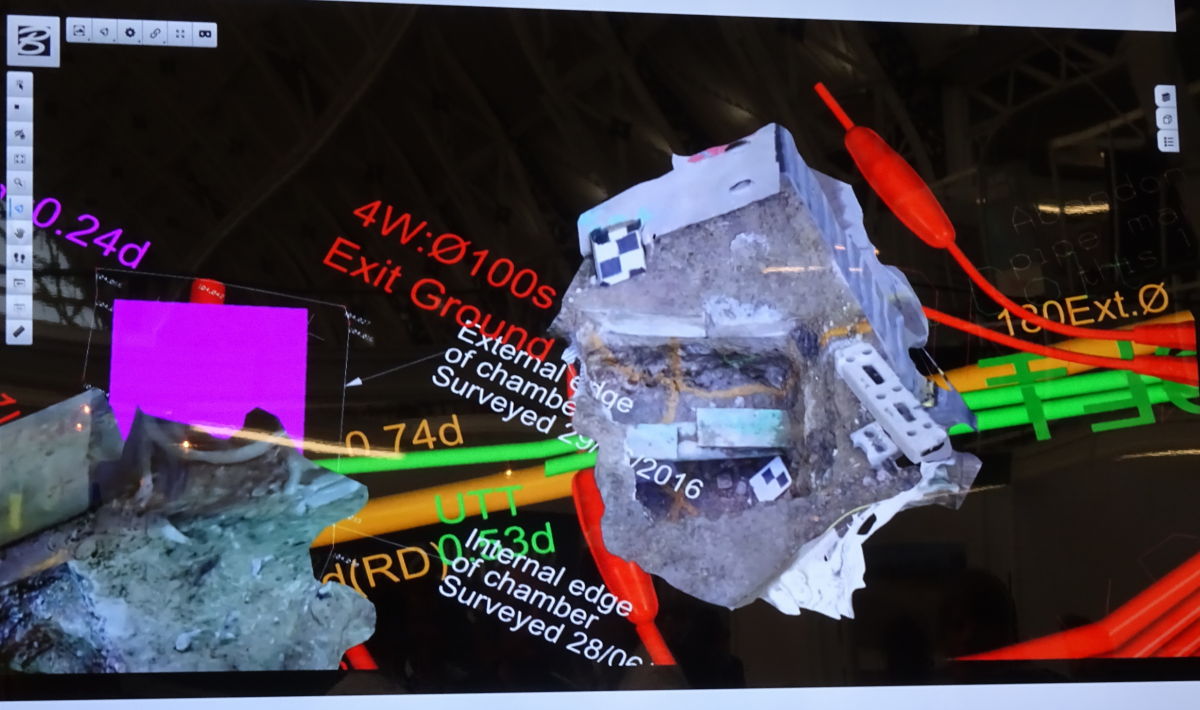 This process has been found to result in a 3D model of comparable accuracy to a full laser scan survey and unlike a laser scan survey it is something that anybody can do. Typically it involves taking 40-60 pictures with an ordinary smartphone. After uploading the pictures, processing them with Bentley’s ContextCapture software to create the georeferenced 3D model, the resulting 3D model can be made available to others on the construction project using an online web link that allows the 3D model to be displayed along with existing 2D utility as-builts.
Be the first to comment