
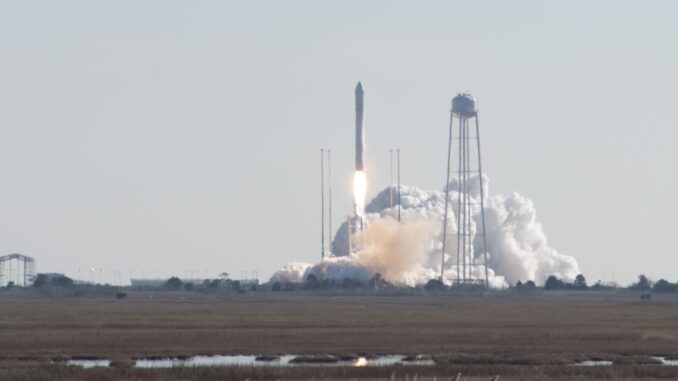
Antares launches Planet Labs 28 satellite Earth observation constellation

In April 2013 Planet Labs launched two demonstration satellites, “Dove 1” and “Dove 2”.  November 21 two more satellites Dove 3 and Dove 4 were placed into orbit by a Dnepr rocket. Dove 4 conforms to the 3U CubeSat specification, with a launch mass of 5.2 kg. Basic physical dimensions are 100 mm × 100 mm × 340 mm, with two 260 mm × 300 mm deployable solar arrays.  Power storage is provided by Lithium-Ion cells. The batteries will be recharged by solar cells mounted on the body of the satellite and on the two deployable solar panels.

Yesterday January 9 Orbital Sciences Corp. launched its Cygnus cargo spacecraft aboard its Antares rocket at 1:07 p.m. EST Thursday from NASA’s Wallops Flight Facility in Virginia.  Its primary mission is to resupply the International Space Station.  Solar array deployment has been reported as complete for the Cygnus spacecraft.  It is scheduled to rendezvous with the International Space Station on Sunday, Jan. 12.

In addition to the suppplies for the Space Station the Cygnus carries CubeSats for 23 experiments designed by students for a variety of technology demonstrations.

And it also carries a constellation of CubeSat based satellites that will form Planet Labs’ 28 satellite Earth observation constellation.  These mini-Earth observing satellites will orbit the Earth at an altitide of 400 km.  The satellites can provide much more frequent snapshots (revisits) of the same location on Earth than current Earth observation satellites.  This means basically 4D (2D/3D+time) allowing users to track changes—from traffic jams to deforestation—in close to real time. The satellites will send their images to at least three ground stations—two in the U.S. and one in the U.K. The data will be processed and uploaded for use by customers almost immediately.

Geoff Zeiss

Geoff Zeiss

Geoff Zeiss has more than 20 years experience in the geospatial software industry and 15 years experience developing enterprise geospatial solutions for the utilities, communications, and public works industries. His particular interests include the convergence of BIM, CAD, geospatial, and 3D. In recognition of his efforts to evangelize geospatial in vertical industries such as utilities and construction, Geoff received the Geospatial Ambassador Award at Geospatial World Forum 2014. Currently Geoff is Principal at Between the Poles, a thought leadership consulting firm. From 2001 to 2012 Geoff was Director of Utility Industry Program at Autodesk Inc, where he was responsible for thought leadership for the utility industry program. From 1999 to 2001 he was Director of Enterprise Software Development at Autodesk. He received one of ten annual global technology awards in 2004 from Oracle Corporation for technical innovation and leadership in the use of Oracle. Prior to Autodesk Geoff was Director of Product Development at VISION* Solutions. VISION* Solutions is credited with pioneering relational spatial data management, CAD/GIS integration, and long transactions (data versioning) in the utility, communications, and public works industries. Geoff is a frequent speaker at geospatial and utility events around the world including Geospatial World Forum, Where 2.0, MundoGeo Connect (Brazil), Middle East Spatial Geospatial Forum, India Geospatial Forum, Location Intelligence, Asia Geospatial Forum, and GITA events in US, Japan and Australia. Geoff received Speaker Excellence Awards at GITA 2007-2009.

View article by Geoff Zeiss

Be the first to comment

Leave a Reply

Your email address will not be published.


*