
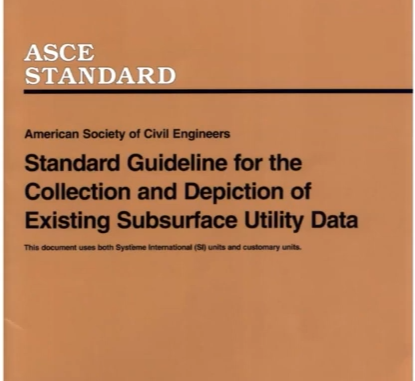
The grandfather of most quality standards around the globe for the location of underground infrastructure is the American Society of Civil Engineers (ASCE) 38 standard, which was published two decades ago. The original 2002 version of the standard was relatively short, only 20 pages long. Because the practice of subsurface utility engineering (SUE) was new and evolving at that time, the ASCE 38 committee intended to leave the standard very basic to enable it to accommodate new innovations and to allow best practices to emerge. But it also left it open to interpretations that the committee didn’t intend. The changes to the ASCE 38 standard that are coming in the update in 2021 are subtle but powerful and primarily intended to clarify the original intent and incorporate the experience of 20 years of practice and innovations to better elucidate those original concepts.
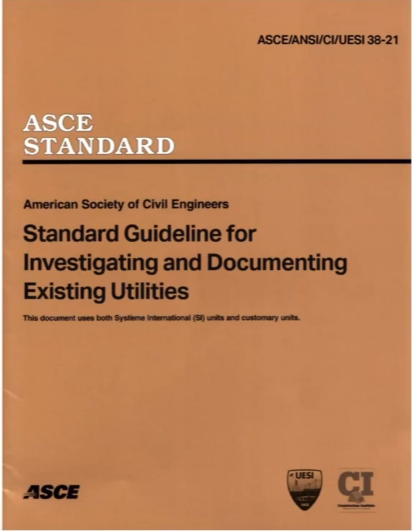 The update to the ASCE 38 standard has been in preparation for a long time, but the ASCE 38 committee wanted to ensure that the update incorporated the very fast changing technology and best practices from around the globe. Important technological advances and advances in best practices were emerging rapidly and frequently and it was a challenge to incorporate these, but now the ASCE 38 committee is confident that they have accommodated the most important of these. In March of this year, the ASCE 38 update achieved a significant milestone by passing unanimously its committee ballot. It was also approved by the three necessary ASCE entities; the standards and publications council, the utility engineering and surveying institute (UESI) board of governors and the parent organization, ASCE codes and standards division, which maintains its standards in accordance with ANSI standards. The draft standard is now with the publications department of ASCE and it’s being prepared for a 45 day public comment period. After addressing those public comments, ASCE will prepare the final version of the standard in accordance with the Library of Congress guidelines. The update will then be published as ASCE 38-21 with a new title Standard Guideline for Investigating and Documenting Existing Utilities.
In contrast to the first version, the latest version of the standard is both prescriptive and a performance standard. It is prescriptive in that it specifies the minimum actions that must be undertaken to achieve (or attempt to achieve) a particular quality level. As a performance standard it describes the professional judgment that needs to be exercised to determine the appropriate timing, sequencing, location and scope of a utility investigative effort to achieve the goal of reducing utility issues during project delivery. A typical project begins with whatever data is available. In the future that could be a digital twin of the underground. Currently it will include at least past project records in the area of geo-technical information and a topo survey. The engineer develops a scope of work based upon their professional judgment, the client’s needs, and the available data. Based on the scope of work, the engineer begins to compile data from various sources. According to the ASCE 38 standard there are four types of inputs; existing records, visibly apparent data at the site, inferred data from geophysical (remote sensing) exploration, and data about exposed utilities. For each utility segment, the professional engineer synthesizes the available inputs and based on the standard assigns a quality level. The quality level isn’t about how closely it reflects reality, it’s about the certainty with which the location has been determined. An important new concept in the update is guidelines for making professional judgment based upon non-utility information that may infer the presence and location of a non-recorded non-detectable utility such as a plastic waterline without records or trace wire feeding a house.
Related standards
The ASCE 38 standard is intended for subsurface utility engineering surveys (SUE) of existing infrastructure. Other standards, referred to as utility as-built standards, have been developed or are in progress for newly installed infrastructure.
Canada published its utility as-built standard CSA S250 for newly installed utility infrastructure in 2011. It has just been reauthorized and issued as CSA S250:20.
In 2012 at the request of the National Academy of Sciences, ASCE began assembling a committee of broad stakeholders to create the US version of a utility as-built standard. The US standard entitled Standard Guideline for Recording and Exchanging Utility Infrastructure Data is on the same timeline as the update to ASCE 38 and should be published at about the same time. For legal reasons it can’t be referred to as a “utility as-built” standard because that terminology conflicts with usage in statutes in several states. As a result it will referred to it as the “utility as-constructed” standard and it will have its own numerical designation distinct from ASCE 38.
Using these two standards in the US, every underground and above ground utility segment that’s depicted could have either a utility quality level based on ASCE 38 for existing infrastructure or a utility accuracy level from the “utility as-constructed” standard for newly installed utility infrastructure. For example, in Colorado both draft standards are mandated.
In Canada it’s a little different. Every utility segment could have either a utility quality level based on ASCE 38 for existing infrastructure or a utility accuracy level from the CSA S-250 standard for newly installed infrastructure.
This post is based on Jim Anspach’s talk at the Canadian Underground Forum. Jim Anspach is the Chair of ASCE 38. For details on what has changed and what has remained the same in ASCE 38, you can listen to Jim Anspach’s talk on the GeoIgnite Youtube channel.

Be the first to comment