
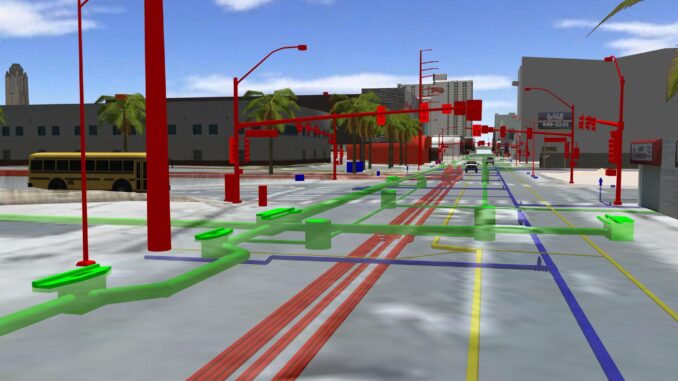
I blogged recently about a remarkable effort by the City of Las Vegas to create an accurate 3D model of the underground infrastructure of the city. An important question is what are the quantified benefits of improving the reliability of the geolocation and condition information about underground utilities ? As part of an effort in Australia to improve the reliability of information about underground utilities, the standards committee investigated the available evidence for quantified benefits.
Australia Subsurface Utility Engineering Information Standard
In May 2010, Standards Australia Committee IT-036, Subsurface Utility Engineering Information began developing a new Australian Standard, AS 5488—201X, Classification of Subsurface Utility Information (SUI).
The motivation for this standards effort was the lack of reliable information during design and construction activities that can result in costly conflicts, delays, utility service disruptions, redesigns, personal injuries to workers, and even lost lives. The fundamental problem is that the location of subsurface utilities often appears on design plans, but they are based on notoriously unreliable as-builts.
To address this issue Standards Australia (SA) began developing an Australian Standard for the practice of Subsurface Utility Engineering (SUE). SUE is an engineering process that combines civil engineering, geophysics, survey and CADD/GIS and provides much more accurate information on the location and condition of subsurface utilities than has been traditionally available.
As part of this effort SA committee researched the quantifiable benefits attributable to SUE. They found three studies that attempted to quantify the return on investment in improving the quality of subsurface utility data, including location and condition of assets.
USDOT – ROI of $4.62 per $1.00 invested
According to a USDOT sponsored survey conducted by Purdue University in 1999 (Cost Savings on Highway Projects Utilizing Subsurface Utility Engineering), two broad categories of savings emerged from using SUE — quantifiable and qualitative savings. The Purdue study quantified a total of US$4.62 in avoided costs for every US$1.00 spent on SUE. Although qualitative savings (for example, avoided impacts on nearby homes and businesses) were not directly measurable, the researchers believed those savings were significant, and arguably many times more valuable than the quantifiable savings.
Ontario Sewer and Watermain Contractors Association – ROI of $3.41 per $1.00 invested
In 2004 in Canada, the Ontario Sewer and Watermain Contractors Association commissioned the University of Toronto to investigate the practice of using SUE on large infrastructure projects in Ontario. This study, entitled Subsurface Utility Engineering in Ontario: Challenges and Opportunities, determined that the average rate of return for each dollar spent on SUE services on those projects that could be quantified was $3.41.
Pennsylvania DOT – ROI of $21.00 per $1.00 invested
In 2007, the Pennsylvania Department of Transportation commissioned Pennsylvania State University to study the savings on Pennsylvania highway projects that used SUE in accordance with the mapping provisions of the American standard. In their unpublished report, Subsurface Utility Engineering Manual, Pennsylvania State University found a return on investment of US$21.00 saved for every US$1.00 spent for SUE when elevating the quality level of subsurface utility information using SUE. This significantly higher return on investment when compared to Purdue and Toronto studies is thought to be a result of maturation of process and possibly a consideration of the qualitative savings noted above.
Not referenced in the Australian study, in
2010 a 12-month study conducted by researchers at the University of
Toronto took an in-depth look at 9 large municipal and highway
reconstruction projects that developed an enhanced depiction of
buried utilities. Based on this analysis, a cost model was proposed
that takes into account both tangible and intangible benefits. All
projects showed a positive return-on-investment (ROI) that ranged
from $2.05 to $6.59 for every dollar spent on improving underground
utility location data.
Image courtesy of VTN Consulting.
Be the first to comment