
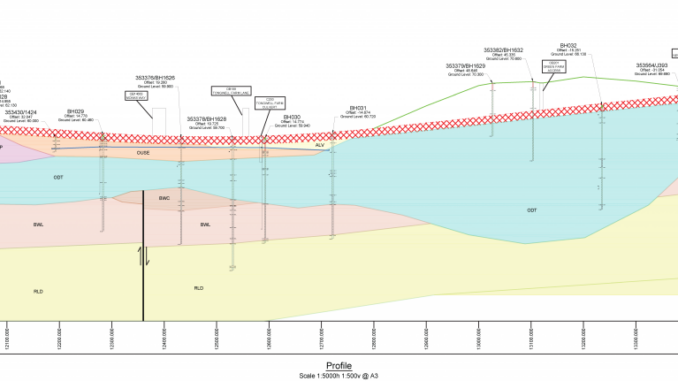
Unforeseen ground conditions are a major cause of delays in construction projects. This year, at Bentley Systems’ Year in Infrastructure Conference, Roger Chandler, Director of Geotechnical Information Management, announced OpenGround, a collection of applications for collecting, sharing, visualizing, analyzing, and accessing geotechnical information about the ground. OpenGround is a cloud-based SaaS application with a web API, which in its short life has already amassed a database of over 500 thousand boreholes.
Every construction project devotes considerable effort to discovering subsurface geotechnical conditions, but this data is often used by the engineering consultant for a sinle project and rarely shared. In the Netherlands an attempt is being made to address the problem by the Key Registry for the Subsurface (BRO) which came into force in January, 2018. The BRO registry ultimately will record 26 geotechnical data types.
In the UK the Dig to Share project, supported by Atkins, the British Geological Survey (BGS) and Morgan Sindall, is also attempting to address this problem. Its aim is to develop a fully digital workflow, which is accessible to the whole industry, to upload and access data from a web-based system.
I had the opportunity to chat with Roger to understand better the business drivers for OpenGround and the growing market for software for capturing, sharing and analyzing geotechnical information about the ground.
Roger explained that the market consists primarily of engineering consulting and construction contractors, although there are also utilities, primarily water companies, who routinely conduct borehole surveys prior to installing new infrastructure. The information captured from boreholes includes location, information about each layer or stratum including a description, standard soil type classification, and the geological formation to which it belongs together with in-situ and laboratory test data. Currently, this data is captured typically by pen and paper, but mobile apps are more efficient in capturing this information and is being rapidly adopted. Mobile apps are already being used by 20% of all users and the speed of adoption is increasing.
There are two important drivers that are behind the rapid expansion of this market. The first is sharing geotechnical information among consulting engineers and contractors on construction projects. Typically survey and borehole information is used by engineering consultants when designing a new facility, but this information is rarely shared with construction contractors. OpenGround is designed to enable everyone involved in a construction project to have secure access to this important information.
Secondly, over time storing the information captured from boreholes from various projects and keeping it alive and available for future projects is a benefit for regional bodies creating digital cities and may be a source of competitive advantage for a construction or engineering company doing repeat work in the same geographic areas. This may explain why some companies may be less than enthusiastic about sharing their private geotechnical information on open sites.
The borehole information that is captured by a company and stored using OpenGround remains private. But since it is stored in the cloud it can be made available to everyone within the company and can also be shared with other participants on a construction project. This enables consulting engineering companies to share geotechnical information with other players on a project. In the context of Bentley projects geotechnics is critical for many construction projects, but especially for civil engineering projects. OpenGround is designed to integrate with other products such as PLAXIS, OpenRoads, OpenRail, STAAD.foundation, and others.
OpenGround represents an important step forward in IT tools enabling the sharing of information about the ground. This is a commercial service, and the rapid growth in this market is evidence that companies are recognizing significant value in capturing and sharing geotechnical information both within a company and with other players on a construction project.
Be the first to comment