
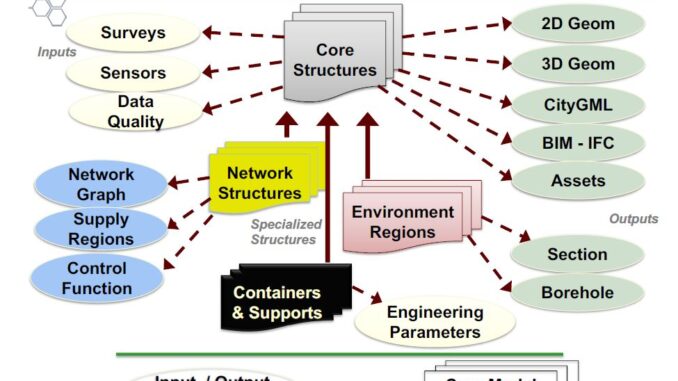
In July the Open Geospatial Consortium (OGC) held an underground Infrastructure ETL (export-transform-load) – Plugfest at the Fund for New York City (FCNY). The central theme was development of a Model for Underground Data Definition and Integration (MUDDI) on which to base interoperability between different data sources and applications about the location of underground utilities and other subsurface structures.
The MUDDI ETL-Plugfest Workshop was held at the Fund for the City of New York (FCNY) on July 24-25. During the workshop there were many ver interesting presentations from the international community interested in detecting underground infrastructure and finding way to make it easier to share the information.
Josh Lieberman of the OGC described the primary motivations for developing standards to make sharing underground infrastructure (UGI) easier. There are numerous examples of disasters that have occurred because we don’t know where UGI is. Lack of accurate knowledge about the subsurface is responsible for inefficiencies in construction that are a significant drag on the economy. Currently UGI data quality is poor, to a great part because we cannot the share the information that is captured during every construction project, environmental assessment or disaster planning and management exercise.
Josh piointed out that one of the biggest challenges is that there are a variety of proprietary and open data models for UGI and underground geology, each with its own special industry focus, are in use making interoperability a challenge. A partial list for UGI includes
- CityGML Utility Network ADE (Application Domain Extension)
- INSPIRE Utility Networks
- IMKL (Information model for cable and pipes)
- Land and Infrastructure Conceptual Model (LandInfra)
- Underground Pipeline Information Management System
- Power utilities transmission and distribution – CIM, Multispeak + several proprietary models from different vendors
- Gas Technology Institute (GTI) – Gas Distribution Model (GDM)
- Water and wastewater – several proprietary models
Similarly for subsurface soil, water and geology there are a number of standards in use with different applications.
- BGS National Geological Model
- BRGM SCUDD
- GeoSciML
- EarthResourceML
- INSPIRE
- GeoTOP
- GroundwaterML
- SoilIEML
Each of these models are designed for different purposes including engineering, facilities management, electric power grid performance modeling, water management, hazard assessment, and environmental assessment. Applications have been developed around each of these models serving the different communities for which they were developed. Josh then described how MUDDI attempts to provide a general 3D model for interoperability between these different specialized models and the types of questions such a general model would be able to answer.
Be the first to comment